It was reported in the Jerusalem Post that during the recent Rennert/Bar-Ilan University’s conference on “New Studies on Jerusalem”, Zachi Zweig pointed out that during reconstruction work at the El-Aqsa mosque in the 1930’s, the remains of a Byzantine mosaic floor and a mikveh (Jewish ritual bath) were discovered. The mikveh was located below the Byzantine floor.
This is an important discovery and will change our views on the history of the Temple Mount. The mosaic floor may or may not have belonged to a church. More information is necessary before deductions can be made about the nature of the building, but the mosaic pattern possibly indicates a public building.
The mikveh would be the third we know of on the Temple Mount, as two other ones have been identified previously by Ronnie Reich. He based his proposal on the shape of the shape of Cisterns 6 and 36 (1 and 2 on Warren’s map of the Temple Mount below). The exact location of the newly published mikveh (3) inside the El-Aqsa mosque is not yet known. However, this nevertheless proves the Jewish origin of the Temple Mount.
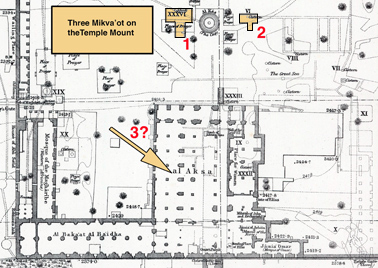
Source: Joe Lauer
That is crazy. Does it have any meaning?
It means that there was a Jewish presence in Jerusalem during the Byzantine or Roman period. Some of the houses to the south and west of the Temple Mount had Jewish symbols on them, such as the menorah and a mezuzah.
That’s very surprising, looking forward to read more.s
It leads to a question for me: when Jesus was in the temple and asked to talk about the woman caught in adultery, John says He bent down and wrote in the dust, the floor or the dirt. Was there flooring in the temple, or was it simply a dirt floor? Thanks for your interesting report on the “baptismal” tanks from long ago times.
John
Be blessed
I was wondering the same thing. Was there flooring in the Temple ? Was it a dirt floor?
Jesus was not in the Temple building itself, as that was reserved for priests only. Most of his teaching took place in the Court of the Women, also called the Treasury in the New Testament. All the courts were paved with stone, but strong winds could have blown a lot of dust on the pavement, as often happens. I suppose there was enough dust to write in.
Although we are not told what Jesus wrote, there is an interesting reference to writing on the ground in Jer. 17:13 “O LORD, the hope of Israel, all who forsake you shall be put to shame; those who turn away from you shall be written in the earth, for they have forsaken the LORD, the fountain of living water.”