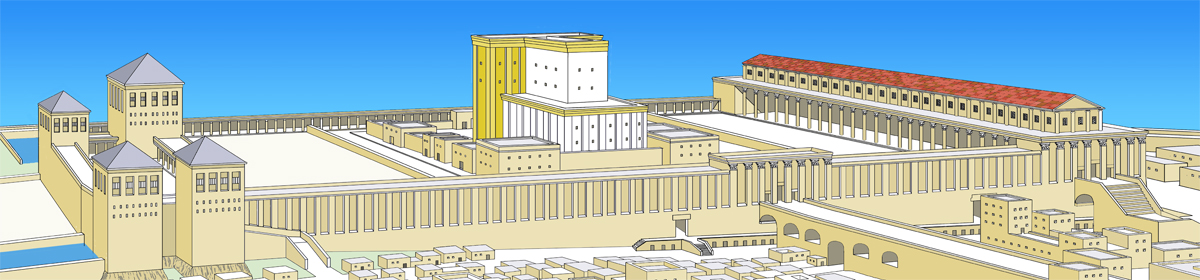
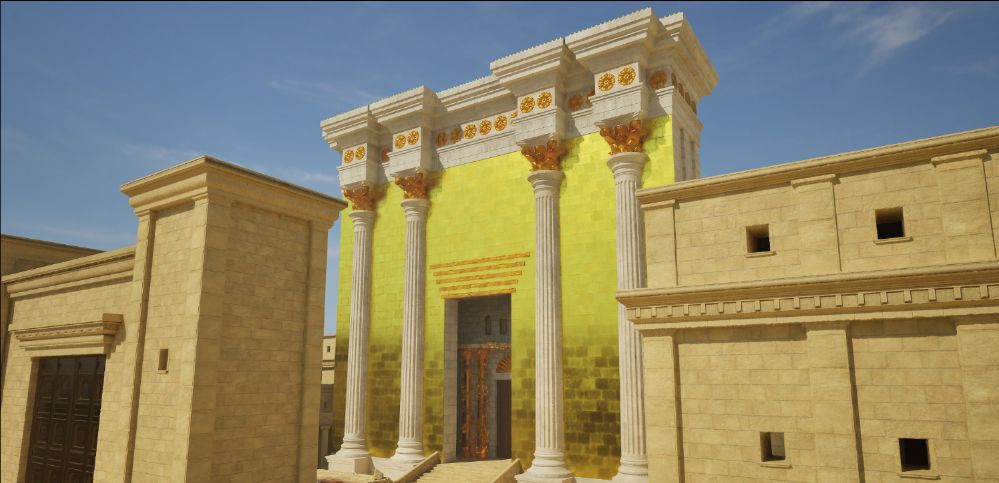
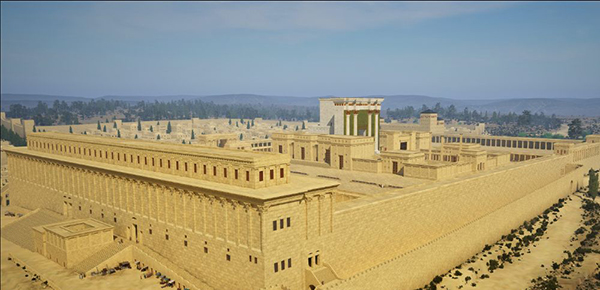
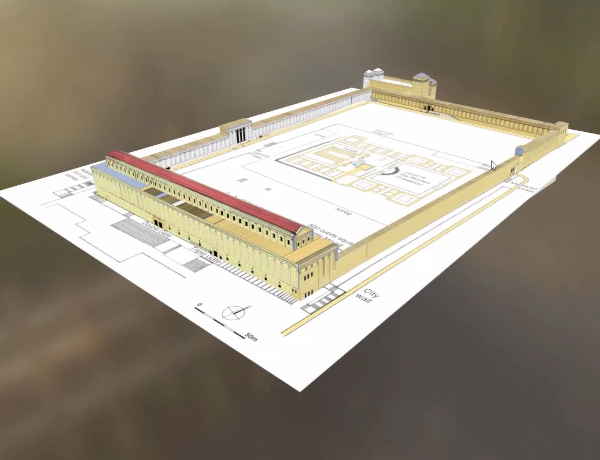
Jeremy Park of bible-scenes.com asked me a while ago if I could help him with his project of developing a 3D video of Herod’s Temple Mount. Last week he wrote the following:
“Shalom to you all. I am so excited to say that after almost two years working on this project it is finally finished; Herod’s Temple Mount. Journey back through time and see what Herod’s Crowning glory the Temple Mount could have looked like two thousand years ago. Places that we can see the remains of today, places like Robinsons Arch and Barclays Gate, Solomon’s Stables and the Western Wall, to name but a few.”
The compilation video can be seen here on YouTube.
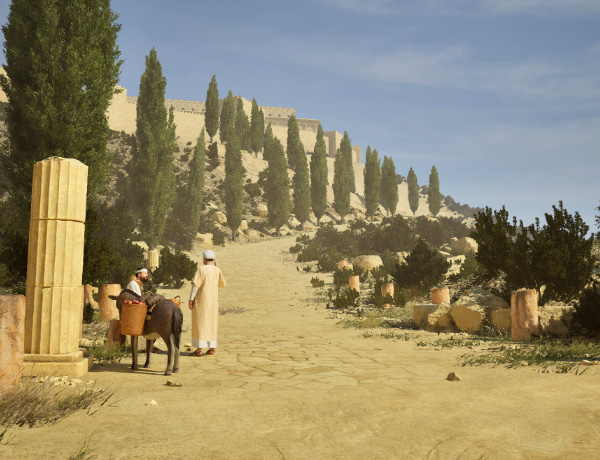
“When I made each scene I tried to include people. There were two reasons for this, firstly they gave a sense of proportion and scale as sometimes it is only when you see a person in the shot that you realise just how big some of the structures really are. Secondly, I tried to create a story of each scene where something is happening or has happened. For example, the picture of the two weary travellers on the road in the Kidron valley are obviously talking about the politics of the day:
Here are some additional images:
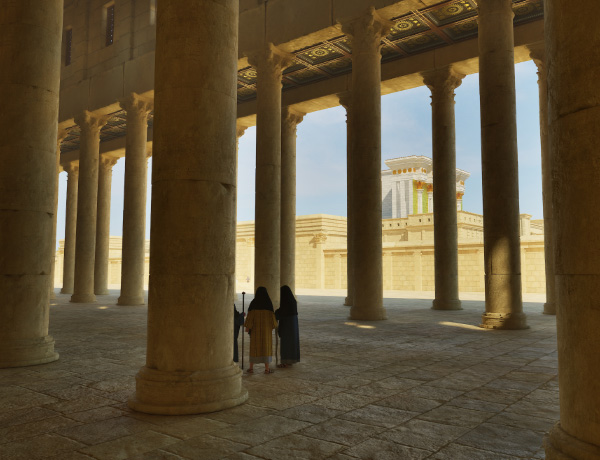
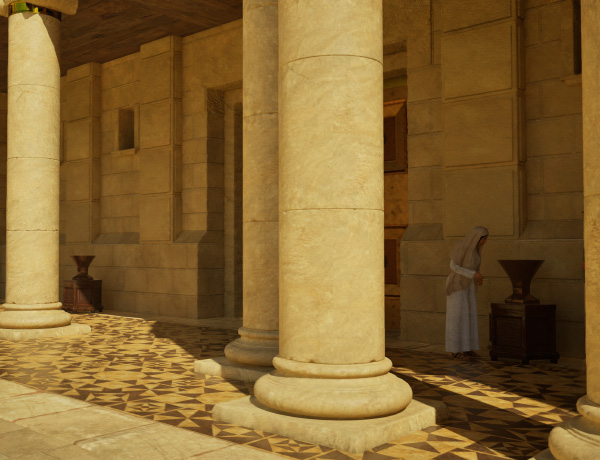
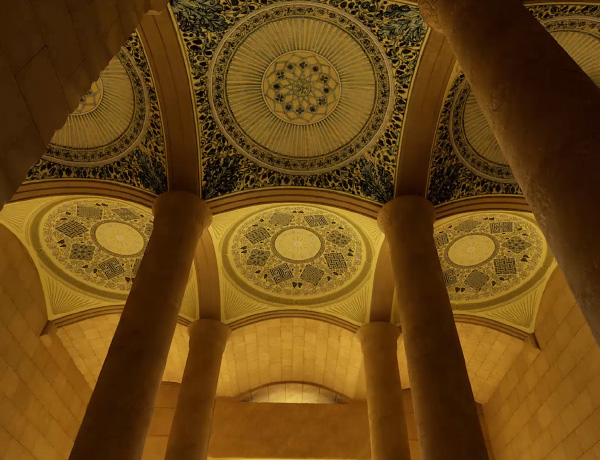
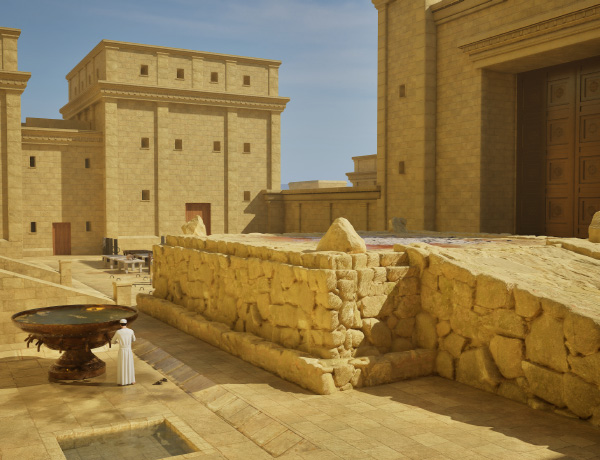
View of the Temple Mount from the southeastThe Temple, seen from inside the Royal StoaThe paving underneath the porticoes of the Court of the WomenThe domes inside the Double Gate passagewayThe altar was made of unhewn stones. According to Mishnah Middot 4:1, “The stones of the ramp and the stones of the Altar were alike taken from the Valley of Beth Kerem, where they were quarried from below virgin soil and brought from thence as whole stones upon which no tool of iron had been lifted up. For iron renders the stones invalid for the Altar even by a touch, and by blemish it renders them invalid in every respect.”
“As most of you are aware by now, I have followed Leen Ritmeyer’s model for this project and if anyone is interested in learning more about the Temple Mount, his book “The Quest” is a gold mine of information.”
“I was fortunate to discover the Ritmeyer Archaeological design Website where I was able to purchase comprehensive plans, elevations, images and information about all aspects of this incredible site that would have been the setting for many Gospel narratives. Without the Ritmeyer resource I don’t think I would have been able to have done justice to the historic and archaeological authenticity of the site.”
This shows how Jeremy used my plan of the Temple Mount to start his design
I am probably a little biased when I say that this is the best 3D rendition of the Temple Mount I have seen so far.
Do watch the video and let Jeremy Park know what you think. He would love to hear from you. His HD videos are free to watch and download, but only subscribers can download high-resolution 4K copies:
The High Definition (HD) videos on this site are free to download and are accessed from the HD download buttons that accompany each scene.
4K videos are available to all subscribers.
When anyone subscribes, an e-mail will be sent out with the necessary password enclosed.
Jeremy’s Bible Scenes is not a separate charity but a branch of his company Park 3D Ltd. Until Bible Scenes can provide him with a sufficient income to work full time on it he has, by neccessity, a day job. He would love to have your support!
What comes next?
“Over the next few days I will be uploading each camera move that you see in this video in HD and 4K to the Bible Scenes Website. As subscribers you will have access to these videos 4 weeks before they are released to the general public (and of course access to them in 4K). I will let you know as soon as the website is updated with the new videos. After this I will be concentrating on producing individual descriptive videos of most (if not all) of the elements that make up the Temple Mount. For example, there are 18 chambers that surround the Temple itself, all of which serve a different purpose and while I may not be including all of them, I think there is a wealth of information to share regarding them. Then there are the various entrances and gates, the Royal Stoa, the Antonia Fortress and all the other parts that make up this project, all have their own story. I am excited to start producing them and will let you know as soon as they are completed.”
In the 1980’s, I used to visit Mount Gerizim as part of my work making reconstruction drawings for the Staff Officer of the Civil Administration of Judea and Samaria. These drawings showed what the different buildings from the area, dating from the Hellenistic, Roman and Byzantine periods, would have looked like.
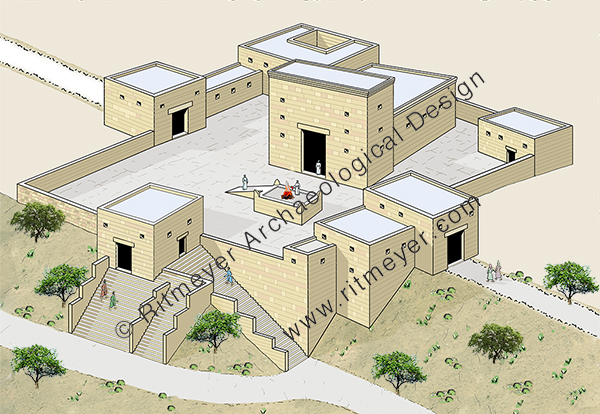
Archaeological remains of a Samaritan sacred precinct were discovered in these excavations around the turn of the 21st century. These date from the time of Nehemiah (mid-fifth century BCE). The Bible doesn’t mention any temple as standing on Mount Gerizim, so we wondered how such a building fitted in with the biblical history. It was the reading of Josephus that provided the missing historical information, as we will see later on.
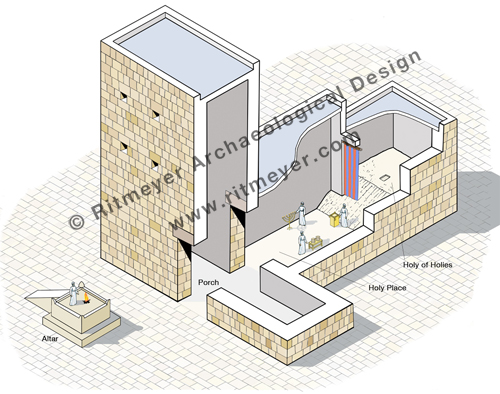
After the return from Babylonian Exile, a new temple was built in Jerusalem under the leadership of Jeshua and Zerubbabel. This temple is described in Ezra 6:3 as being 60 cubits high and wide. Although the stone work was inferior, it nevertheless functioned as a proper temple.
This drawing shows the newly rebuilt Temple that apparently was not as grand as the previous one, for Haggai (2.3) said: “Who is left among you that saw this house in her first glory? And how do ye see it now, is it not in your eyes in comparison of it as nothing?” The internal layout of the Temple undoubtedly remained the same and would therefore have been able to function normally, although the quality of the architecture must have appeared inferior in the minds of the ancient people who remembered the first Temple.
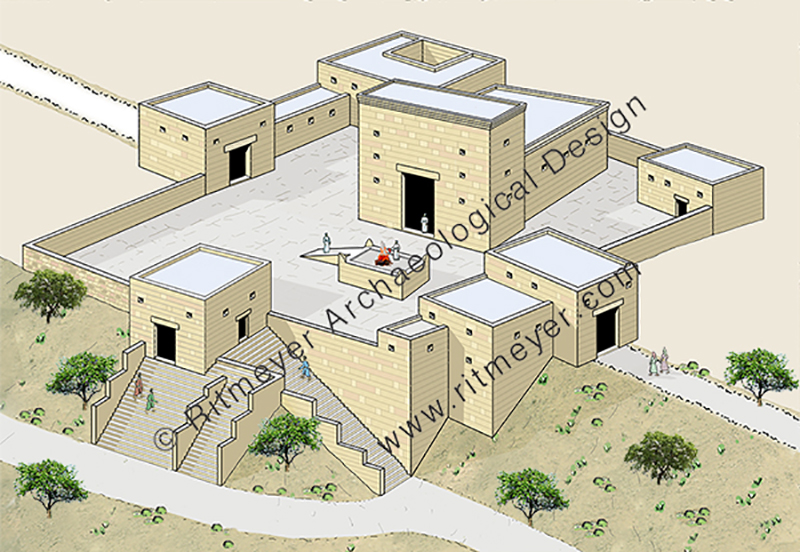
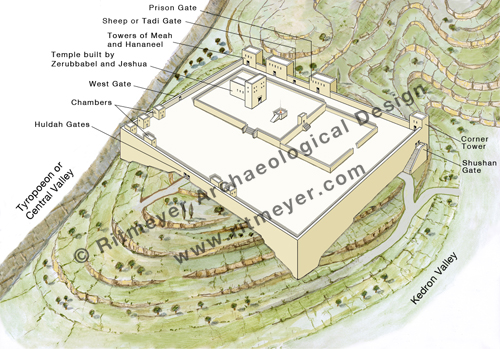
In the time of Nehemiah, the square precinct of the Temple Mount, previously built by King Hezekiah, was restored.
A view of the Temple Mount in the time of Nehemiah. Chapter 3 of the Book of Nehemiah indicates that the square Temple Mount, that was initially built by Hezekiah, was also restored.
During that time, Sanballat the Horonite was the leading figure among those who opposed the building of Jerusalem and the temple. It is generally believed that he was descended from the Babylonian settlers whom the Assyrians deported to Samaria (2 Kings 17:24). Sanballat, whose name means “Sin (the moon god) gives life”, was the governor of Samaria. During the absence of Nehemiah, a grandson of Eliashib the high priest named Manasseh, had become the son-in-law of Sanballat (Neh. 13:28). On his return, Nehemiah rejected Manasseh and sent him away. The vital additional information for our question was found in Josephus, who records that Sanballat then offered to make Manasseh high priest and build a new temple on Mount Gerizim similar to that in Jerusalem (Ant. 11:310).
The archaeological remains of the Samaritan sacred precinct indeed indicate that at this time a rival temple was built on this mountain by the Samaritans. A closed courtyard, that could be entered through three gates, was built around the Temple. No remains of a temple have been found, as, due to hostilities between the Jews and Samaritans, the temple and sacred precinct were destroyed in 128 BC by the Hasmonean ruler John Hyrcanus I. However, archaeological finds of inscriptions, finely cut ashlars and proto-Ionic capitals attest to the existence of a Samaritan temple.
The remains of a Samaritan sacred precinct dating from the mid-fifth century BC have been excavated on the highest point of Mount Gerizim. Tensions had developed between the Jews and the Samaritans when Nehemiah did not allow Sanballat, the leader of the Samaritans, and other adversaries to help them build the walls of Jerusalem and the Temple Mount. These remains show that a rival temple was built here by the Samaritans. A closed courtyard that could be entered through three gates, was built around the Temple. No descriptions or remains of this east-facing temple have been preserved, but it probably followed the well-known pattern of having a porch in front of the actual sanctuary.
The site remained unoccupied until the Byzantine period, but despite this, Mount Gerizim remained a sacred place for the Samaritans. That is why the woman of Samaria said to Jesus that her fathers worshiped on this mountain, while the Jews worshiped in Jerusalem. Jesus answered that God must be worshiped, not in a sacred space such as Mount Gerizim or Jerusalem, but in spirit and truth (John 4:20-24).
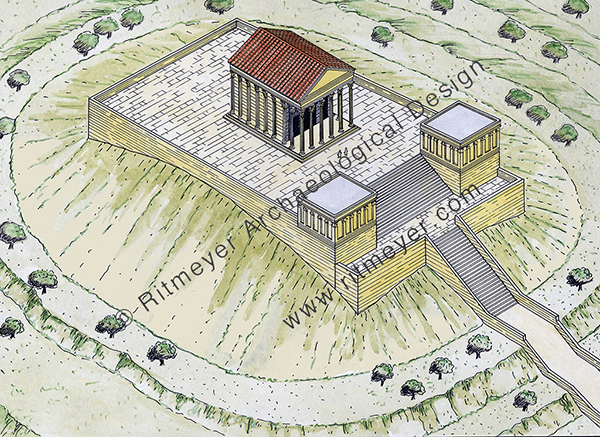
According to Samaritan sources, a temple of Zeus was built on the northern ridge of Mount Gerizim after the Roman destruction of 70CE. This temple, which was built in the mid-second century, stood on a podium measuring 64m long and 44m wide.
This Roman Temple was built on the northern peak of Mount Gerizim, probably during the reign of Hadrian. The temple stands on a large platform and was reached by a long stairway that ascended from the valley below, where Shechem is located.
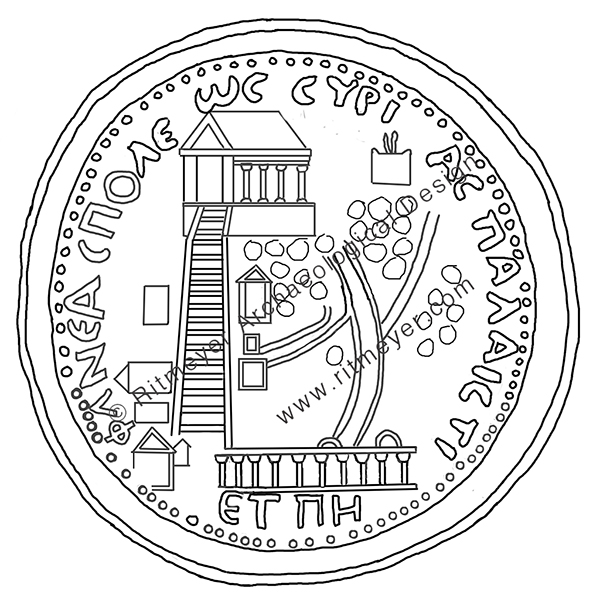
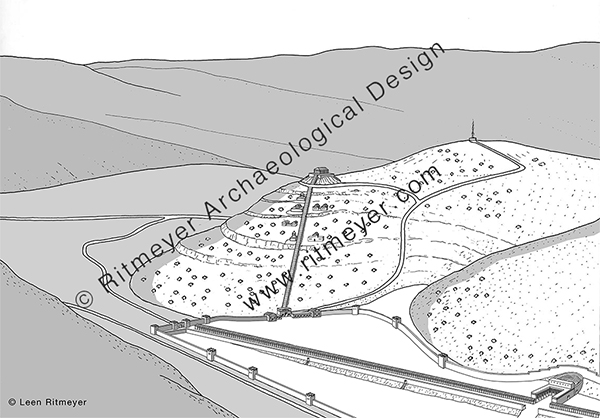
Coins from about 160CE depict a temple that overlooked the city of Neapolis (modern Shechem or Nablus), and that was reached from the city by a stairway of about 1500 steps. This temple continued in use until the fourth century.
A drawing of a coin from the reign of Antoninus depicting Mount Gerizim. At the top is the temple of Zeus with an altar further to the right. A road leads up the mountain on the right, and a stairway, lined with buildings on both sides, leads up to the temple from the city of Neapolis.
In the mid-second century CE, a temple of Zeus was constructed on the northern ridge of Mount Gerizim, while on the highest peak an altar was built. The temple overlooked the city of Neapolis (modern Shechem or Nablus), and was reached from the city by a stairway of about 1500 steps.
After that time, a large Byzantine complex surrounded by walls and towers was built on the highest summit of Mount Gerizim.
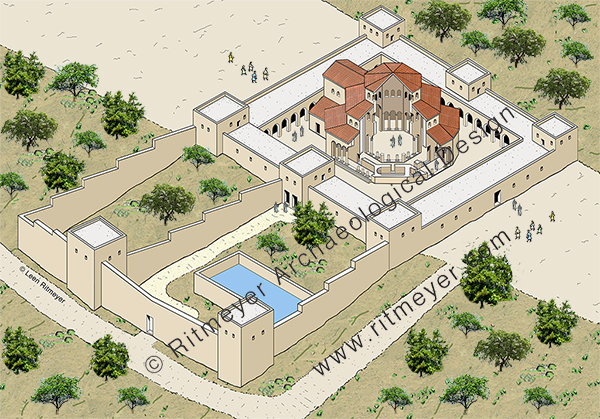
During the Byzantine period, in 484 CE, the octagonal Church of Mary Mother of God (Theotokos) was built on the summit of Mount Gerizim. This church was built on the same place where the previous Samaritan temple stood. The church is located inside a rectangular enclosure (71x56m) with a peristyle and towers at the four corners. The many rooms around the enclosure may indicate that the complex could have been used as a monastery. A gate house gave access to the northern enclosure which was divided into two parts. One part was used for agriculture and the other part contained a large water reservoir.
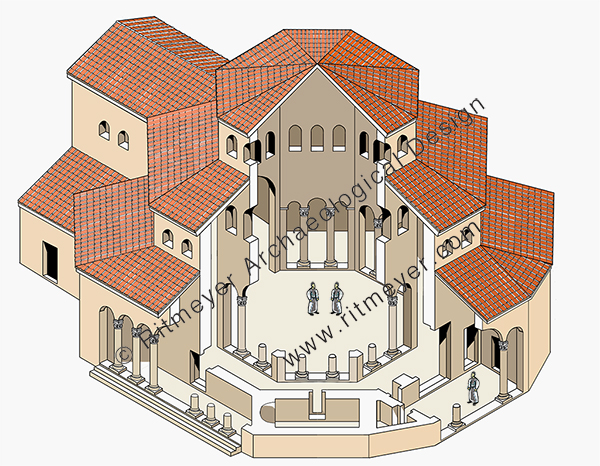
In the center of this walled complex stood an octagonal church, the Church of Mary Mother of God (Theotokos – literally God-bearer), which was established by Emperor Zenon in 484CE. Centrally designed churches are built to commemorate certain events, in this case, the Orthodox belief in Mary’s bodily resurrection before being taken up into heaven.
During the Byzantine period, in 484 CE, an octagonal church, the Church of Mary Mother of God (Theotokos),was built on the summit of Mount Gerizim. Its centralized form is typical of commemorative churches, known as martyria. Mount Gerizim is a sacred place for the Samaritans, and this building shows that many of them had converted to Christianity.
Mount Gerizim has been a sacred place for almost 2,500 years, and continues as such up to the present time. A large population of Samaritans lives on or near Mount Gerizim today and every year they celebrate the feast of Passover, with many pilgrims joining them. In this picture we see a priest holding up the Samaritan Pentateuch.
Samaritans marking Passover on Mount Gerizim (Wikipedia)
Bryan Windle loves interviewing archaeologists. In his blog Discussions with the Diggers, he says that he is learning from experts about different biblical sites.
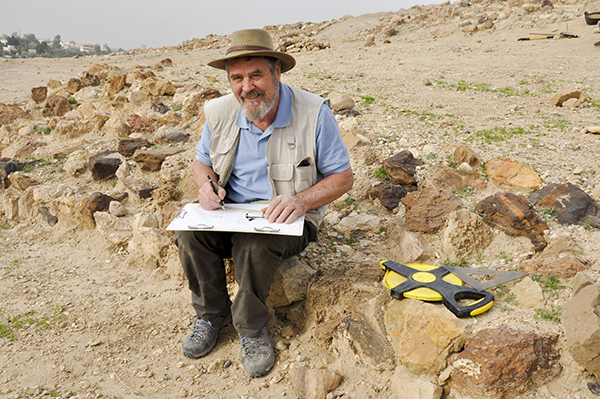
Although not officially a “digger”, I appear in his latest interview.
Josephus Flavius, also known as Yosef Ben Matityahu, was an eye-witness to the siege of Jerusalem. He somehow survived the siege of Yotvat in Galilee and with one of his soldiers surrendered to the Roman forces in July 67 CE. The Roman forces were led by Flavius Vespasian and his son Titus, both subsequently Roman emperors. Two years later, Josephus was released (cf. War IV.622-629) and according to his own account, he appears to have played a role as a negotiator with the defenders during the Siege of Jerusalem in 70 CE. The works of Josephus provide crucial information about this First Jewish-Roman War. Here, we would like specially to examine his account of the Roman destruction of the Temple Mount in Jerusalem.
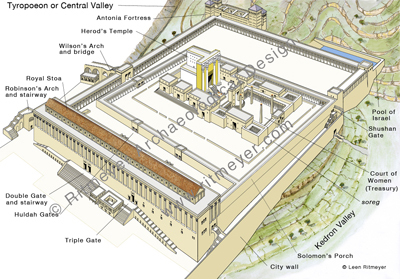
In 19 B.C.E. the master-builder, King Herod the Great, began the most ambitious building project of his life, the rebuilding of the Temple in lavish style. To facilitate this, he undertook a further expansion of the Hasmonean Temple Mount by extending it on three sides, to the north, west and south. The former extension required the filling in of a deep valley to the north of the pre-Herodian Temple Mount. The Shushan Gate remained the only gate in the Eastern Wall. Towers were erected at each corner and a large water reservoir was built at the northeast corner, the so-called Pool of Israel. At the northwest corner, the massive Antonia Fortress was built to protect the Temple against attacks coming from the north and to guard the mount in times of strife.
Josephus and the Mishnah, especially the book of Middot (Measurements) were the main historical sources we consulted. Initially, we read Josephus with some skepticism, as we found his measurements prone to exaggeration and his text not always easy to understand. However, after having worked out the layout of the Temple Mount, we could begin to visualize the events he described with the latter as a backdrop. We found his account of the siege of Jerusalem to be quite reliable, apart from his personal comments on the character and actions of Titus and others, especially when they conflict with other historical sources.
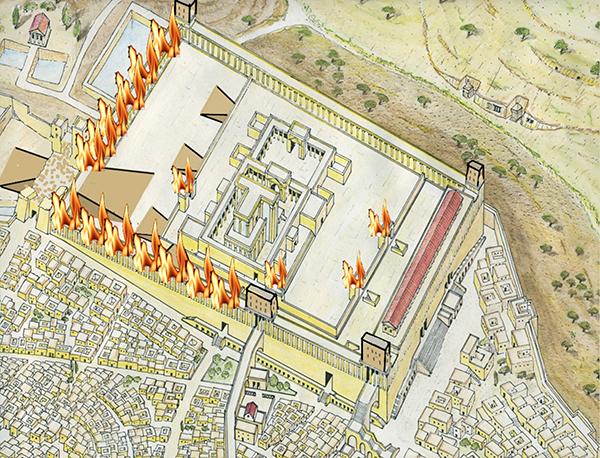
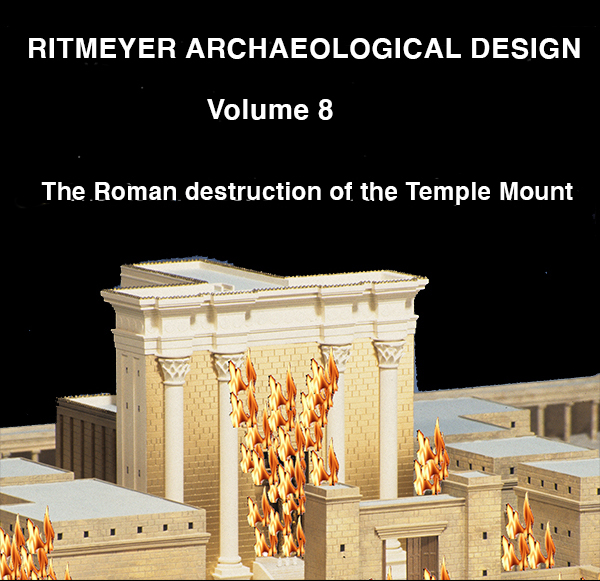
The Roman destruction of the Herodian Temple Mount was a tragedy that is still mourned today. Nevertheless, Josephus’ report about the battle for the Temple Mount, despite its many gruesome details, provides us with many helpful indications about the layout of the Sanctuary and its buildings, courts, porticoes and gates.
Seven different stages of this war can be observed which confirm the layout of the Temple Mount.
1. First unsuccessful attempt to capture the Antonia Fortress
2. Second successful attempt to capture the Antonia Fortress
3. Construction of a road into the Herodian Outer Court
4. Capture of the square Temple Mount
5. Capture of the Court of the Women
6. Capture of the Temple Court
7. The Destruction of the Temple
To make this information available, we have produced a new presentation consisting of 50 slides which follow these seven different stages of this battle.
The Location of the Music Chamber in the Court of the Women
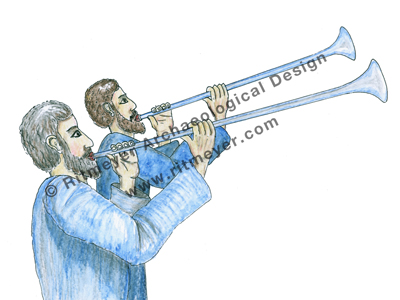
As noted in our previous post, music played an important role in the Temple services. Although the real service of praise in the Temple was done mainly by voice, this was often accompanied by the playing on musical instruments. Silver trumpets were blown by priests to accompany the sacrifices.
The Levites stood on the fifteen semi-circular steps to sing the Psalm of the day, and on other occasions, all of the fifteen Songs of the Steps, namely Psalms 120-134.
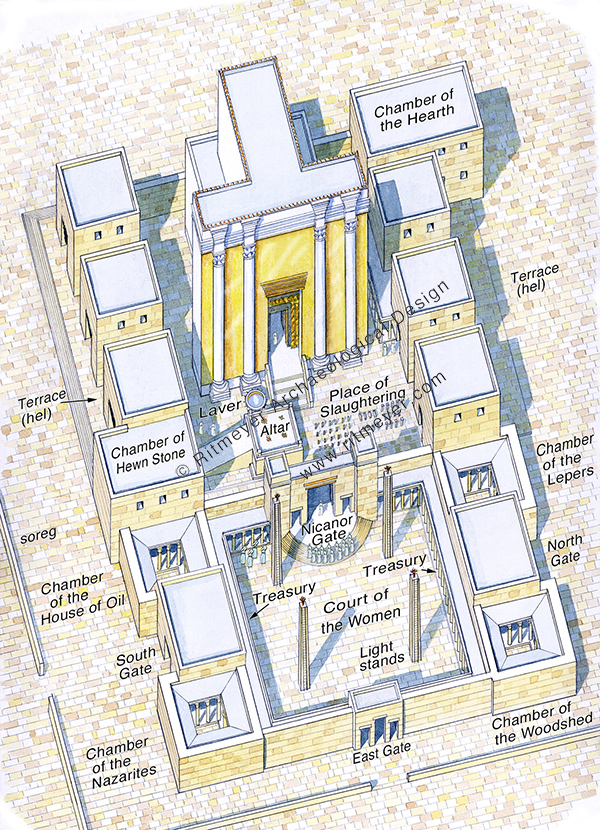
To the east of Herod’s Temple was the large Court of the Women, also known as the Treasury in the Gospels. This court was as far as women were allowed to proceed into the Temple. The Levitical Choir stands on the semi-circular steps.
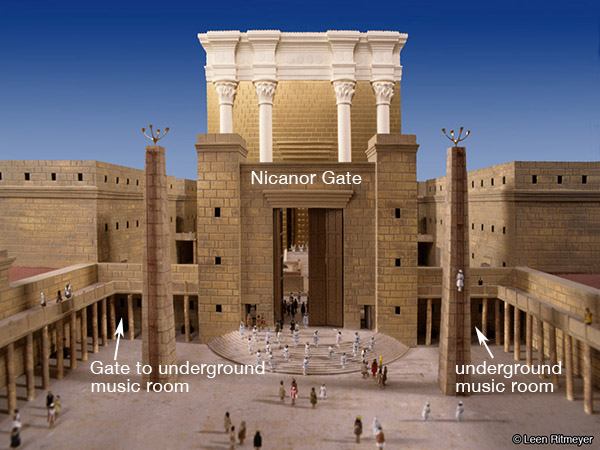
The number of instrumentalists was not limited, and not confined to Levites only. Middot Arakhin 2.4 indicates that some of these were from the families of Emmaus, another name for Bethel. The musical instruments were kept in a special underground chamber that opened to the Court of Women. We can imagine that when the Levites sang on the steps, the players on harps, trumpets and lyres, stood next to them in front of the Music Chamber.
This Chamber of Music is mentioned in Middot 2:6, “And there were chambers under the Court of Israel, which opened into the Court of the Women, where the Levites played upon harps and lyres and the cymbals and all instruments of music”. I previously speculated that some remains of this music chamber may have survived the Roman destruction of 70 CE.
So, let us examine the archaeological information.
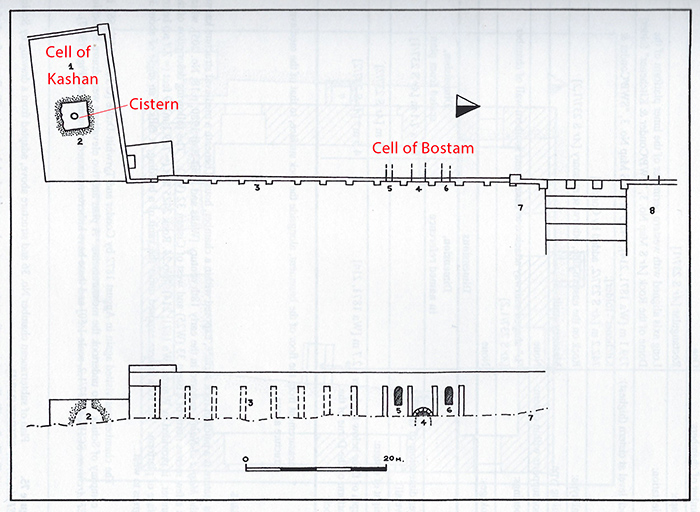
The three openings had already been noticed in the 19th century by Conrad Schick[1] and Warren[2]. Warren noted that there was a hollow space behind the wall, and called it the Cell of Bostam. The name ‘Bostam’ appears to be a corruption of ‘bustan’, a group of trees and vegetation that grew here and which can be seen in some Crusader illustrations. Warren wrote that “in 1881 an attempt was made to obtain permission to open this doorway and explore the unknown cells and vaults. This was not only refused, but a large heap of earth was soon after piled in front of the closed doorway.”
Adapted from Gibson and Jacobson, fig. 74.
For interest’s sake, the structure called Cell of Kashan to the south of the Raised Platform, has a cistern. Schick[3] noted that over this cistern (2 on the plan), the Kashan Mosque, which has long been demolished, once stood.
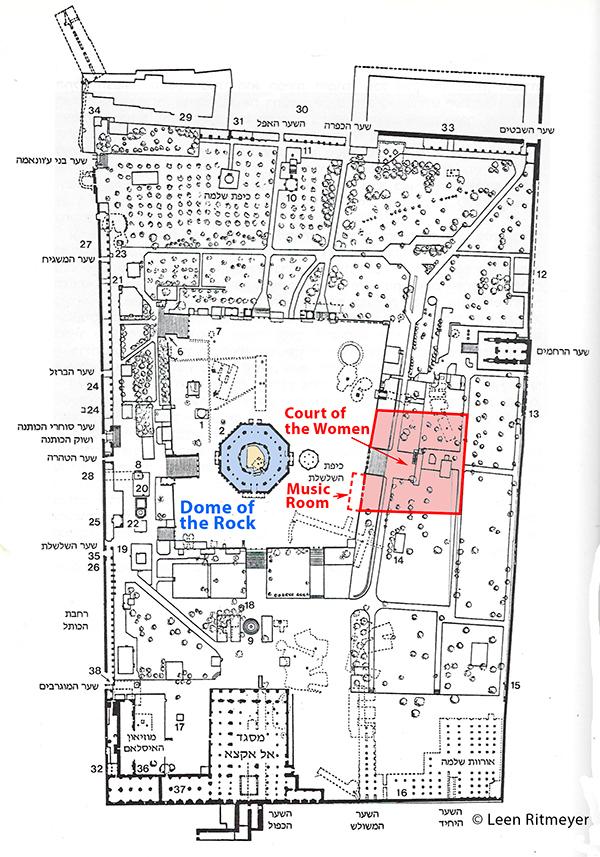
Below is a plan showing the location of the Court of the Women on the present day Temple Mount, followed by updated archaeological evidence we presented in our previous blog.
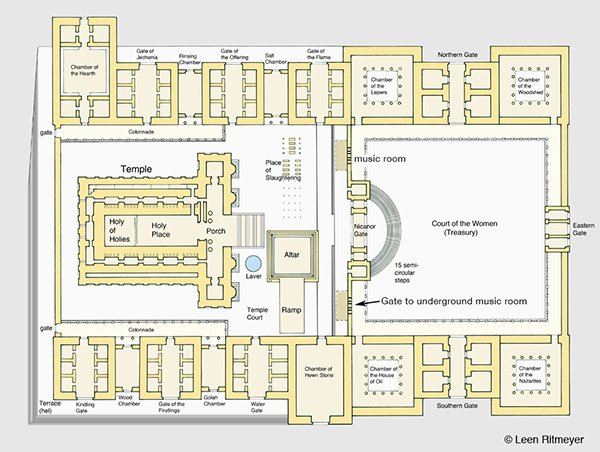
On this plan of the present Temple Mount, we have drawn the location of the Court of the Women and the underground Music Chamber, or Music Room.
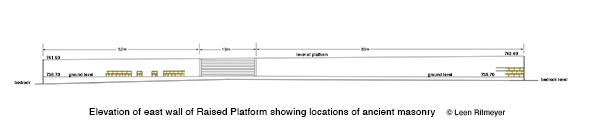
Next, I made an accurate elevation of the ancient stones in the eastern wall of the Raised Platform, showing the ancient stones at the northeast corner, and further to the south, the visible masonry on the sides of the previously mentioned arches.
The surviving stones of the western wall of the Court of the Women have been indicated in this elevation of the eastern wall of the Raised Platform.
To check if this discovery agreed with the description in Middot, I compared the location of this triple entrance with a reconstruction drawing I had made of the Court of the Women for a model I had designed many years ago.
After superimposing the newly discovered masonry on this drawing, I was pleasantly surprised to see that the central opening was exactly where I had drawn it earlier.
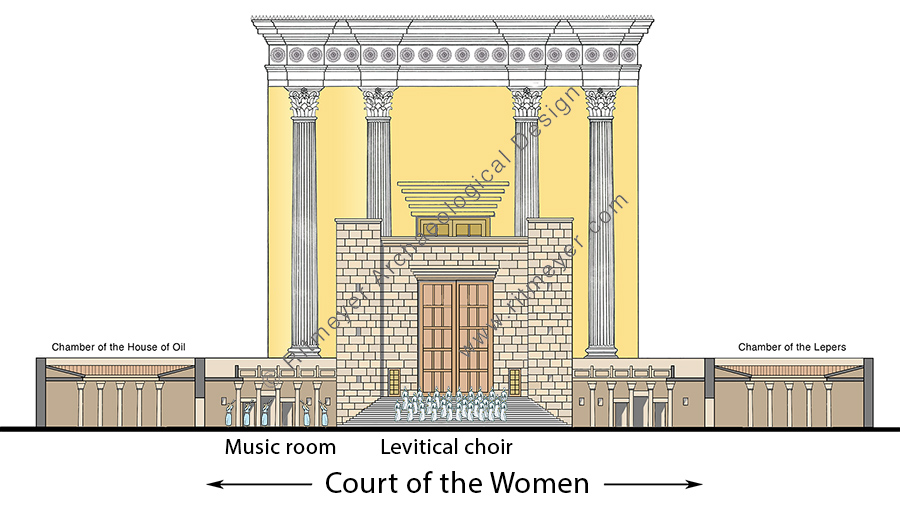
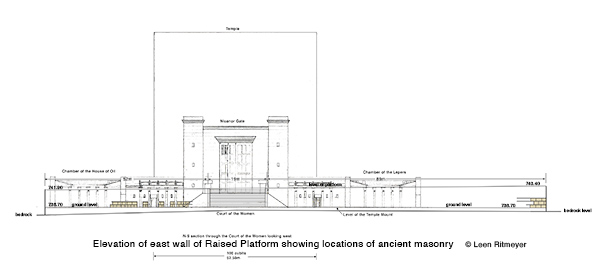
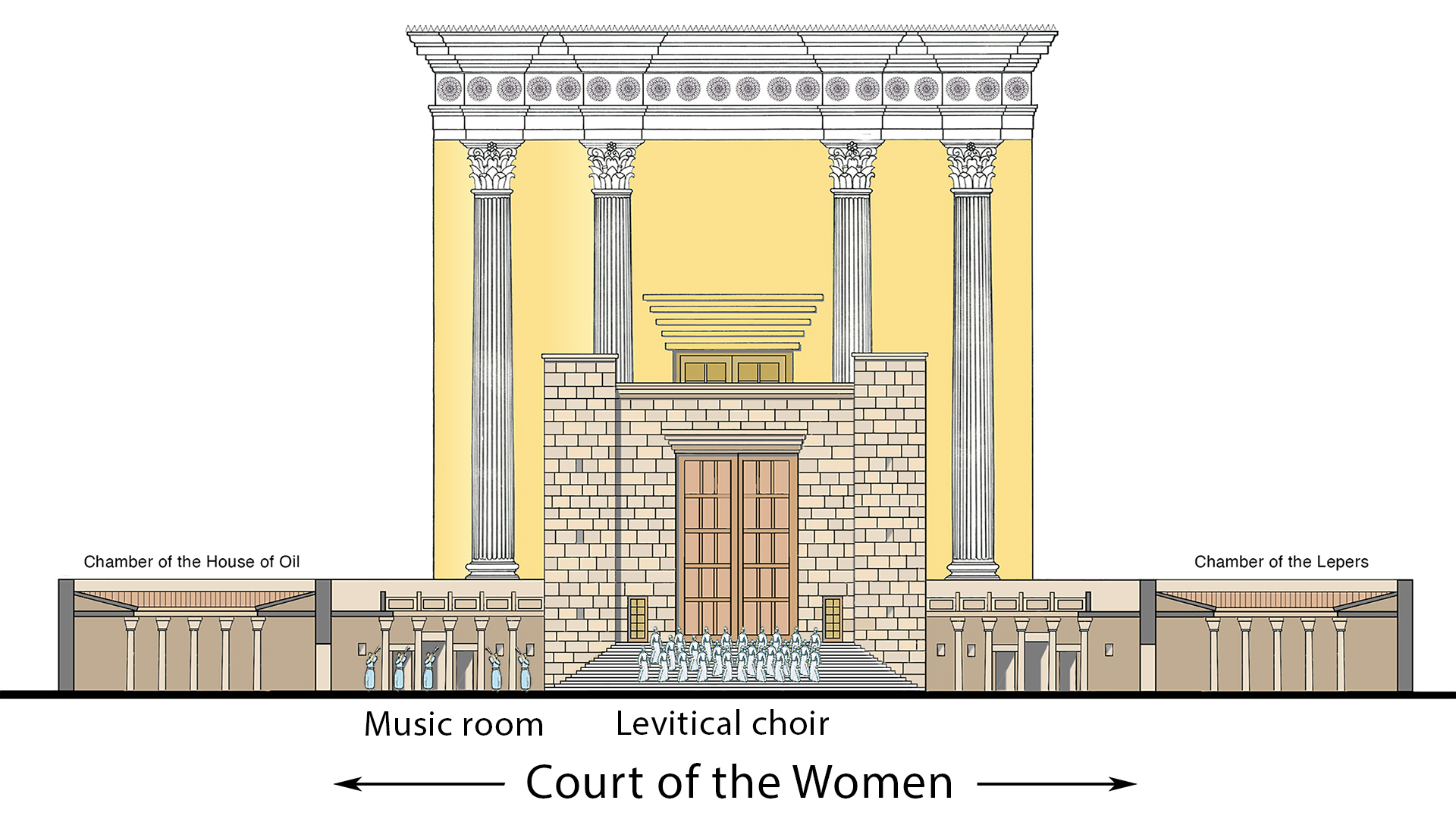
Putting this information together, I was able to draw a reconstruction of the Court of the Women and the Music Chamber, or Music Room. To the left (south) of the Court of the Women was the Chamber of the House of Oil, and on the right (north) was the Chamber of the Lepers.
This drawing shows how music was performed in the Temple of Jerusalem. The Levites stood on the fifteen semi-circular steps that were in front of the Nicanor Gate, to sing Psalms. They were accompanied by the players on harps, trumpets and lyres, who stood next to them in front of the Music Room.
Behind the Levitical choir is the Nicanor Gate, and the Temple towered in the background. The musicians that stood in front of the Music Chamber have now been added to a previous drawing of the Temple Courts.
To the east of the temple stood the Court of the Women (centre front). This large court was known in the Gospels as the Treasury. The Nicanor Gate stood in front of Herod’s Temple. It gave access to the Temple Courts from the Court of the Women. To the left of the Levites are some musicians, dressed in blue, standing in front of the Music Chamber.
It must have been very impressive to hear the choir, accompanied by the musicians playing on their instruments, praising God. They sang different Psalms each day, and on the Shabbat they sang Psalm 92, “It is good to give thanks unto the Lord”.
Now, of course, we can praise God wherever we like, at home or in a congregation, but it is good to remember that acceptable worship was first instituted by King David who wrote the Psalms, which were sung in the subsequent Temples of Jerusalem.
[1] Gibson, S. and Jacobson, D.M., Below the Temple Mount in Jerusalem (1996).
[2] Warren, Ch. and Conder, C.R., Survey of Western Palestine, Jerusalem Volume (Vol. 2), (1884, 219).
[3] Schick, C., Beit el Makdas oder der alte Tempelplatz zu Jerusalem; wir er jetzt ist. (1887, 86)
Could this be the remnant of the gate to the southern underground Music Room?
Here is my translation of an article written on the 4th of October 2020 by Arnon Segal for the Makor Rishon Hebrew newspaper with additional comments and illustrations.
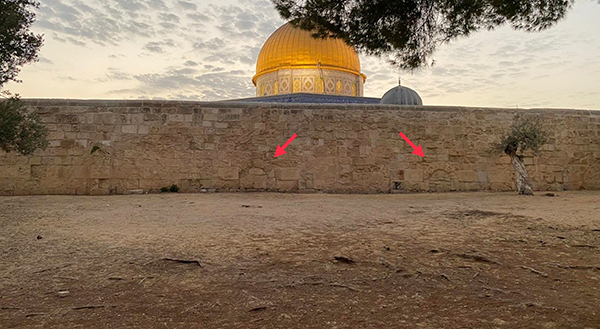
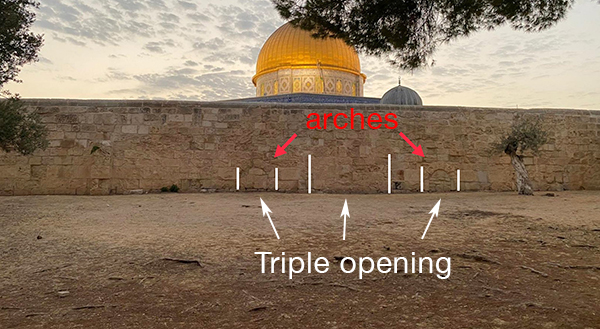
“In the eastern wall of the Raised Platform on which the Nikanor Gate stood during the days of the Temple, two arches were recently discovered that had been blocked at some point. Where did they lead to and who built them? And does this have anything to do with the holiday of Sukkot?”
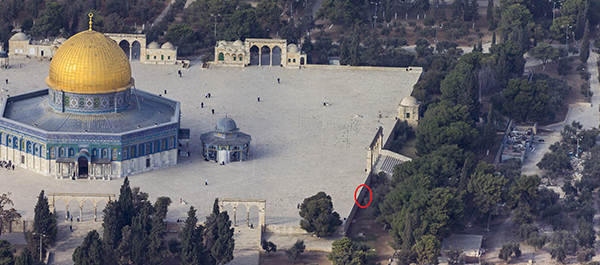
Location of the discovery. Photo: Eli David
“The eastern wall of the Raised Platform that supports the plaza around the Dome of the Rock, is closely connected with Sukkot (the Feast of Tabernacles, or Booths). According to the Jewish tradition that places the Holy of Holies in the center of the Dome of the Rock, the Nicanor Gate stood on this wall during the days of the Temple. The staircase that descends from it today numbers 25 steps, but originally there were only 15 steps. On the feast of Beit Hashoeva (the Water Drawing ceremony) on the feast of Sukkot, when they went down to draw water from the Pool of Siloam, the Levites stood on these steps and sang the 15 songs of the degrees in the Book of Psalms.”
“This wall is oriented in an almost precise north-south line (a half-degree deviation that may be explained by a certain change in the magnetic north for thousands of years), just as the Temple itself was oriented according to precise astronomical directions. This eastern wall preserves a memory of the most significant difference in height on the ancient Temple Mount, namely that which separated the higher Court of Israel from the lower Court of the Women.”
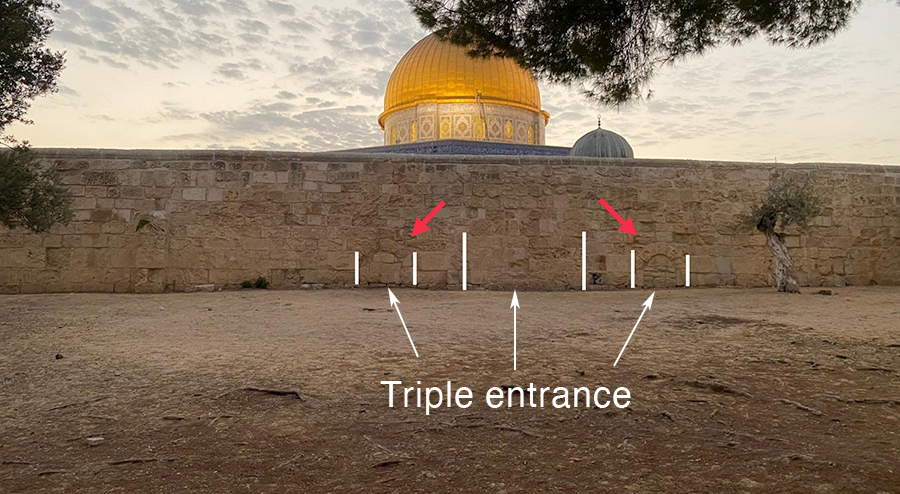
“In recent weeks, Dr. Eli David has noticed two blocked arches on this wall, which as far as is known, are not mentioned in the research literature of the Temple Mount from the 19th century. There seemed to be a passage here that had been blocked at some time in the past. Archaeologist Dr. Leen Ritmeyer, who has been researching the Temple Mount since the 1970s, also did not know these arches, but has now speculated that they were built during the Crusader period or even earlier.”
The arrows show the two arches pointed out by Dr. Eli David
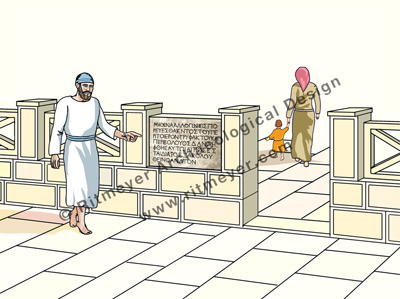
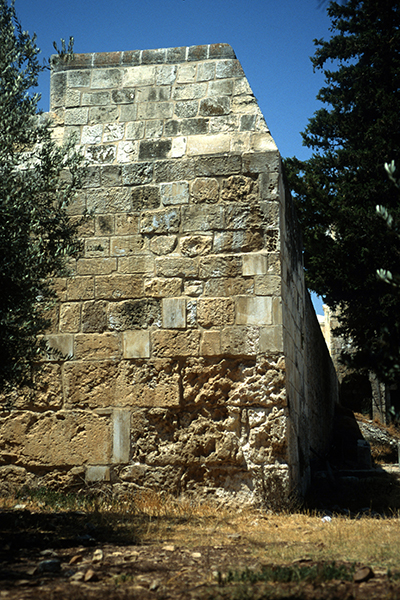
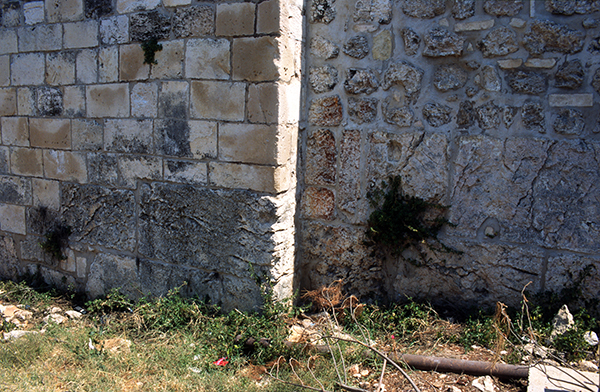
“According to Ritmeyer, the plaza round the Dome of the Rock was probably founded in the seventh or eighth century AD for the purpose of supporting the Dome of the Rock. And yet, it probably also incorporates much older components. At the northern end of this wall there are three courses of ancient construction that also extend along the northern wall of the Raised Platform. In his hypothesis it is possible that this corner served as an end to the soreg which marked the area beyond which foreigners and the unclean were forbidden to enter.”
Three ancient stone courses at the east side of the NE corner of the Raised Platform. Photo: Leen Ritmeyer
Ancient stone courses and offset at the north side of the NE corner of the raised Platform. Photo: Leen Ritmeyer
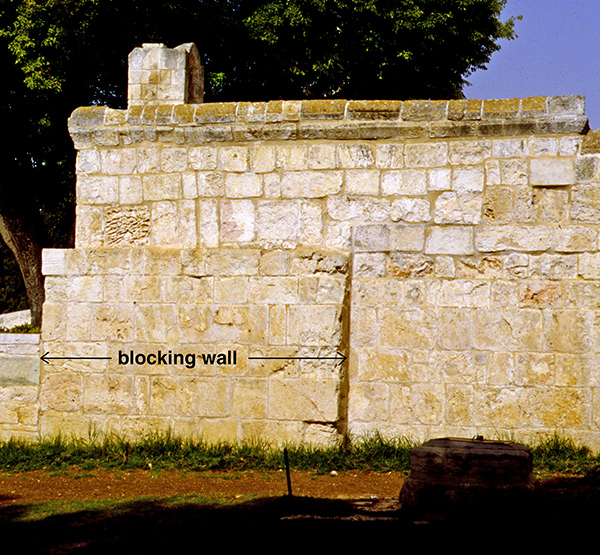
“At the southern end of the eastern wall, there are indications of the existence of additional underground spaces that have been sealed off. In the mid-19th century, the British expedition officer Charles Warren asked permission to explore this space, but the very next day a pile of earth was placed in front of the opening that prevented it, a pile that was later replaced by a stone blocking wall. According to Ritmeyer’s calculations, this was the place of the Chamber of Hewn Stone where the Sanhedrin used to hold court sessions.”
This blocking at the SE corner of the Raised Platform hides the entrance to an underground chamber, that Charles Warren was prevented from entering. Photo: Leen Ritmeyer
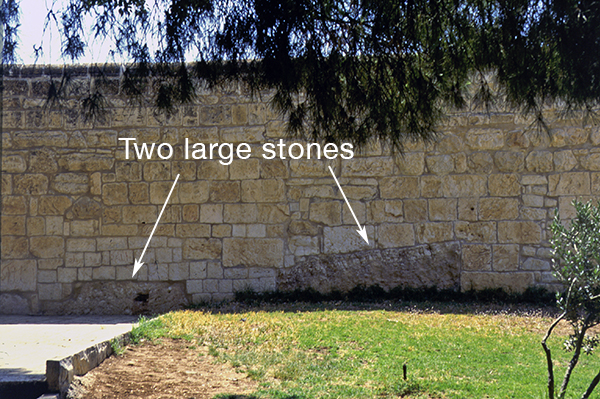
“And this wall has a few more things to tell us. At one point in the wall, north of the stairway, two large stones remain at the base of the wall, which Ritmeyer speculates may have been from the time of Herod and may have served as part of the retaining wall of the Court of the Women.”
Two very ancient large stones on which the smaller stones of the east wall of the Raised Platform were built. Photo: Leen Ritmeyer
“Going back to the blocked arch openings located by Dr. Eli David, Ritmeyer points out that on the sides of these two arches two large stones can be seen that seem to belong to a triple opening. According to Ritmeyer, it is difficult to date the exact style of construction, but in his opinion, these are stones are similar to the ancient stone courses mentioned before, which are located at the northeast corner of the eastern wall. In his estimation, the opening may be from the Crusader period or even earlier. “These architectural remains show that there is still much to explore and discover,” Ritmeyer admits, “not only around the outer walls of the Herodian Temple Mount, but also on the Temple Mount plaza itself.”
“Even if Dr. Ritmeyer assumes that the arches are from the Crusader period, they may have served as an opening to a much earlier underground space. When was it created and by whom?”
“It is not clear, but perhaps one should recall the words of Tractate Middot (2:6) regarding this very place, which indicates that this is the place where the musical instruments of the Temple were stored:
“And there were chambers under the Court of Israel, which opened to the Court of the Women, where the Levites played upon harps and lyres and the cymbals and all instruments of music”. At the Simchat Beit Hashoeva (the rejoicing of the Water Ceremony) that took place on the holiday nights, they played loudly.”
I find it very exciting to speculate that some remains of the entrance to this Music Room may have survived the Roman destruction of 70 AD. It is of special importance that this discovery was made during the days of Sukkot.
Music played an important role during the Feasts of Israel, especially during the present days of Sukkot. Trumpets were used to announce Rosh Hashanah, the beginning of the civil New Year, which fell on the 19th of August 2020. On the 10th of Tishrei, which was the 29th of September, was Yom Kippur, the Day of Atonement. During a Jubilee year, the trumpet of the Jubilee was sounded on the tenth day of the seventh month; on the Day of Atonement you shall make the trumpet to sound throughout all your land. And you shall consecrate the fiftieth year, and proclaim liberty throughout all the land to all its inhabitants. It shall be a Jubilee for you; and each of you shall return to his possession, and each of you shall return to his family (Leviticus 25:9,10).
Every morning of Sukkot at daybreak, a group of Levites and priests went down to the Siloam Pool, which is located south of the Temple Mount, and drew three log (a Talmudic liquid measurement) of fresh water to be poured on the altar after the daily morning sacrifice. Their arrival at the Temple with the water was accompanied by trumpet blasts. (For Shabbat, the water was collected before the onset of Shabbat and stored in a golden vessel in the Temple.) It says in the Talmud: He who has not seen the Water-Drawing Celebration has never seen joy in his life.
Jesus used this act to draw the attention of the spectators to this ceremony when he said in John 7.37–39: “If any man thirst, let him come unto me, and drink. He that believeth on me, as the scripture hath said, out of his belly shall flow rivers of living water.”
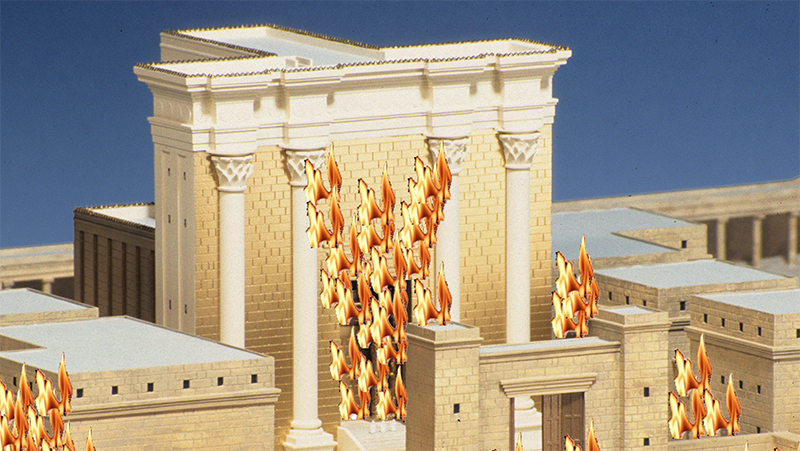
Yesterday was Tisha be’av, the Hebrew date on which the Jewish people remember the destruction of both the First and Second Temples.
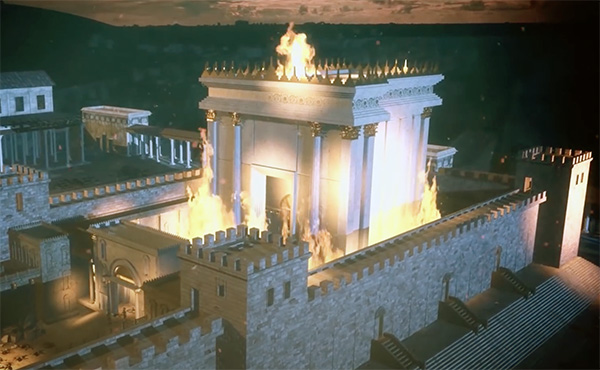
In honour of this occasion, Megalim, The City of David Institute for Jerusalem Studies, showed a dramatized recreation (2019) of the Roman destruction of Jerusalem in 70 AD, called:
A Temple in Flames The Final Battle for Jerusalem and the Destruction of the Second Temple. Here is the link to the YouTube video: https://www.youtube.com/watch?v=y5vuoX09ryw
So reads the headline in an Israeli newspaper reporting on an interview about the Temple Mount.
On the 11th of this month, I guided a group of Israeli visitors around the Temple Mount. All of them were highly interested in the Temple Mount for various reasons, some nationalistic and others religious. At the end of the tour, we had lunch together and a journalist interviewed me. His full-page report, with the above title, was published in the Hebrew Makor Rishon newspaper.
You can download the translation of this article with this link:
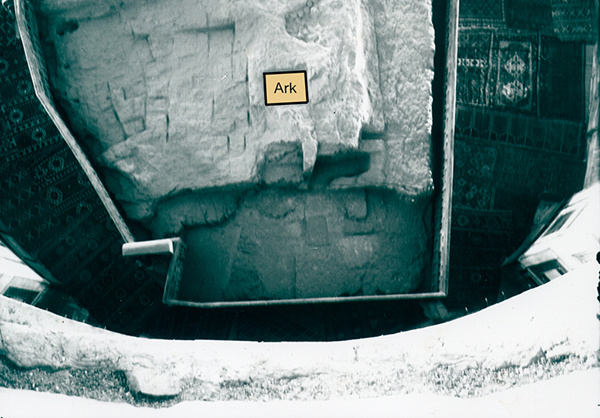
Their main interest was the location of the Temple and the Ark of the Covenant. And as we couldn’t enter the Dome of the Rock, I showed them an old photograph showing the indentation that King Solomon made for the Ark of the Covenant (1 Kings 8.21)
The location where the Ark of the Covenant stood.
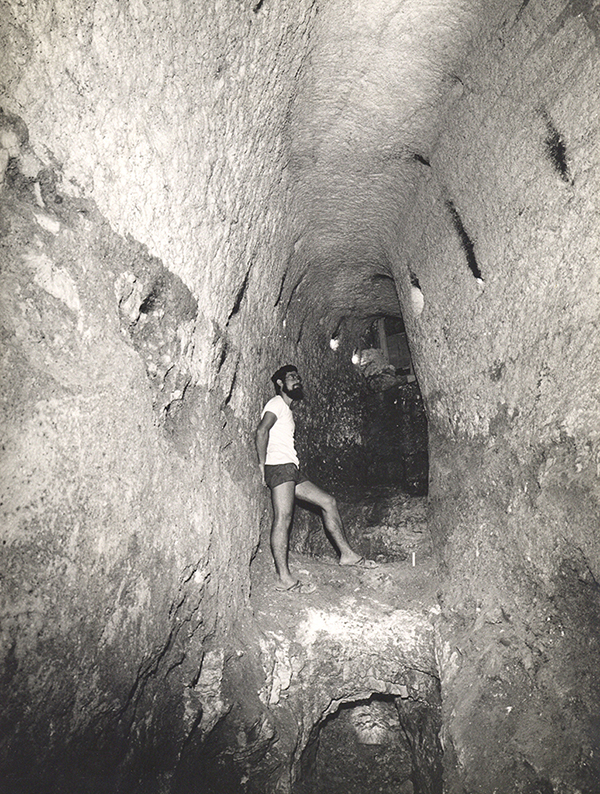
They were also very interested in the underground spaces beneath the mount and published in the newspaper a photograph of a tunnel that was found below the Triple Gate passageway. It was such a peaceful time in the 1970’s, that we had free access to these mysterious places. It was a real privilege to have seen, measured and photographed these spaces, something that would not be possible at present.
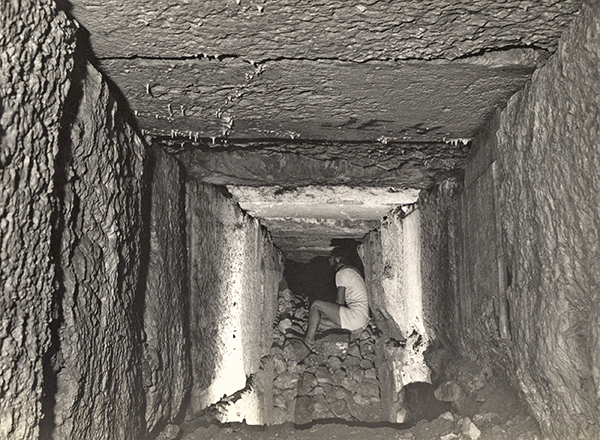
In the tunnel below the Triple Gate undeground passageway in 1974. The water that overflowed from an underground cistern was channelled out through this tunnel.
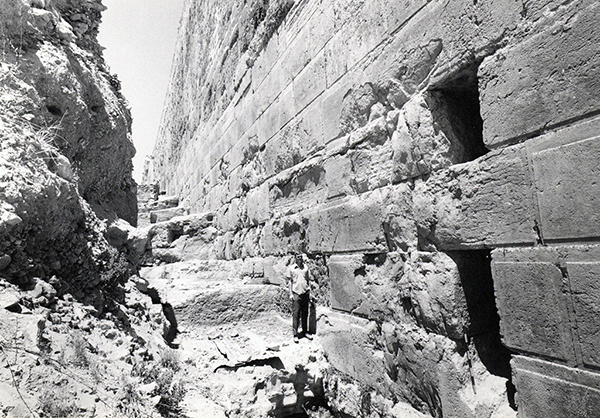
During that time, other tunnels were found running deep below the Double Gate. All these tunnels were closed off after thorough investigation.
This tunnel led from in front of the monumental stairway to the Double Gate to deep below the underground passageway of this gate.
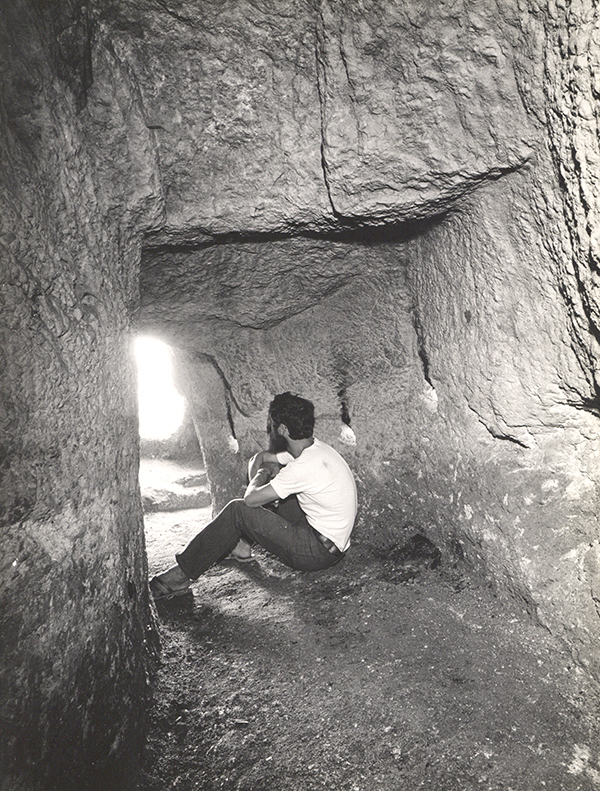
In between the Triple Gate and the southeast corner of the Temple Mount, below the Single Gate that dates from the Crusader period, is another secret tunnel that runs below Solomon’s Stables, that has been converted to a mosque, the El-Marwani Mosque. This tunnel reached to the centre of the Royal Stoa above and may have been used by the workmen who built this edifice.
The entrance to another secret tunnel that ran below Solomon’s Stables. This opening is now blocked up.Inside the tunnel below Solomon’s Stables
Afterwards we talked about the significance of the Temple Mount for Israeli and non-Jewish people alike. For one of the group, the Temple Mount was of nationalistic importance. He had come from Persia, but the reason was to get to know Jerusalem and the Temple Mount, without which, according to him, Israel had no significance.
Another religious Jew said that he couldn’t keep the Mosaic Law without the Temple Mount. I had to agree and said:
“If I were a Jew, I would like to sacrifice the Passover sacrifice on the Temple Mount. Jerusalem has no meaning without the Temple Mount. When I arrived in Israel in 1969, we lived in Gat Rimmon and rented a house from Russian immigrants who had lived in Israel for decades but never visited Jerusalem. I found that hard to understand. Why did you return here if not for Jerusalem and the Temple Mount?”
They wanted to know what, apart from its archaeological importance, the Temple Mount meant for me as a Christian. I answered that Mount Moriah was the place where Abraham was called to sacrifice his only-begotten son Isaac, which, as explained in the Letter to the Hebrews 11:19, was an example of the sacrifice and resurrection of Jesus Christ.
Interview with Eve Harow on her Rejuvenation program
Last week, Kathleen and I were in Jerusalem for the Shiloh Excavations which are directed by Dr. Scott Stripling. On one of the afternoons, Eve Harow of the Rejuvenation programme for The Land of Israel Network interviewed me.
She wrote:
Leen Ritmeyer’s extraordinary journey from Holland to the Temple Mount- and beyond -has defined his life and contributed immensely to ours. He speaks with Eve about the field of Biblical Architecture; how the study of ancient structures in the Land of Israel and Near East enhances our comprehension of history, archeology, the Bible and mankind’s connection to God. He has made an indelible mark in particular on our understanding of Temple Mount transformations thru the millennia and continues to interpret and redefine discoveries both recent and past. This Dutchman is still flying. Listen and learn.
If you have the patience, you can listen to this hour-long interview here:
The Golden Gate is very much in the news today, as it has become a point of conflict between Jews and Muslims, or Palestinians and Israelis.
But what do we know about this gate?
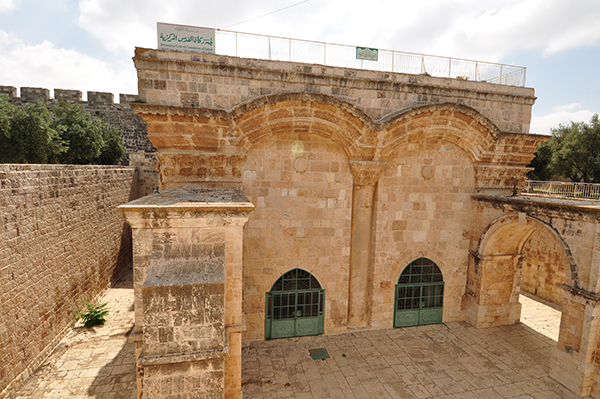
The Golden Gate, around which swirl various traditions, is the most intriguing of all the gates of the Temple Mount. In Jewish tradition, it is through this gate (Sha’ar haRachamim—Gate of Mercy), blocked since the ninth century, that Messiah will enter at the end of days, led in by the prophet Elijah. This is based on the prophecy of Ezekiel 44.1–3. Christians believe that Christ made his triumphal entry into Jerusalem (recorded in all four of the gospels) through this gate on the Sunday before his crucifixion (Palm Sunday). By riding on a donkey, he fulfilled the messianic prophecy recorded in Zechariah 9.9. Muslims refer to it as the Gate of Eternity (Bab-al-Dahariyeh) and believe it will be an important part of the last judgment of mankind. The Muslim cemetery along the Eastern Wall is thought to have been placed there in the belief that the forerunner of Messiah, Elijah, being of a priestly family, could not pass through the Golden Gate, thus preventing the coming of the Messiah.
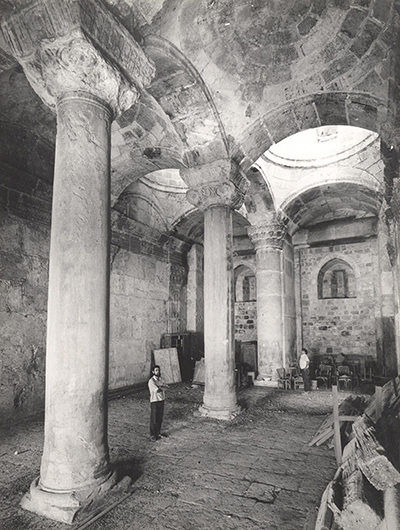
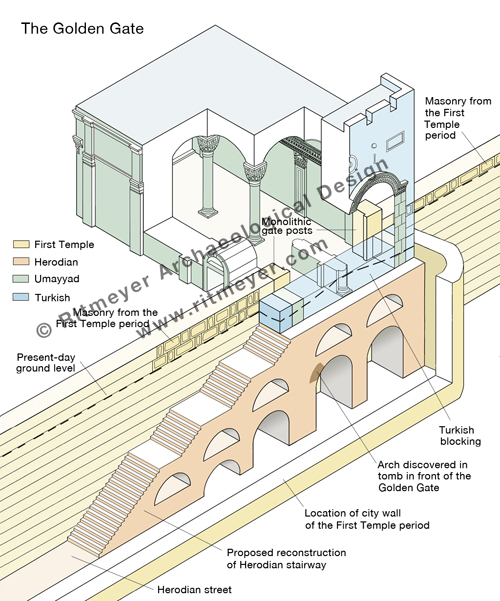
Some claim that the Golden Gate was built by the Byzantine emperor Heraclius after the expulsion of the Sassanians from Jerusalem. However, the absence in the architectural decorations of any Christian symbols, such as a cross makes that difficult to believe. There are actually four distinct historical phases represented in the architecture of this gate: Turkish, Umayyad, Herodian and First Temple period. In the 1970’s I was privileged to spend one week inside this gate, measuring and recording its plan and drawing accurate elevations of all the interior surfaces.
Standing in the middle of the Golden Gate interior. Two monolithic massive gateposts are visible in the far corners.
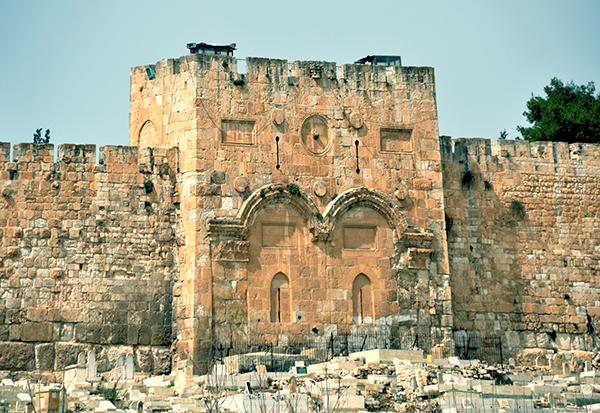
The Golden Gate’s outer façade is composed of two blocked-up gateways adorned with intricately carved relief arches. The decoration of the arches to the front and back of the gate are identical to the applied arches of the Double Gate which date from the Early Islamic period. The gate appears therefore to have been rebuilt in the Umayyad period, on the foundations of an earlier gate.
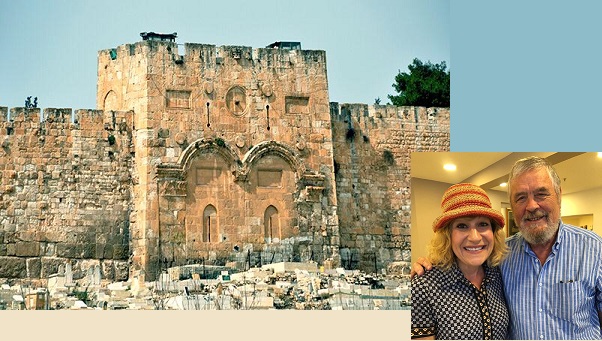
The exterior of the Golden Gate in the Eastern Wall of the Temple Mount in Jerusalem. Photo: Leen Ritmeyer
View of the Golden Gate from inside the Temple Mount. Photo: Nathaniel Ritmeyer
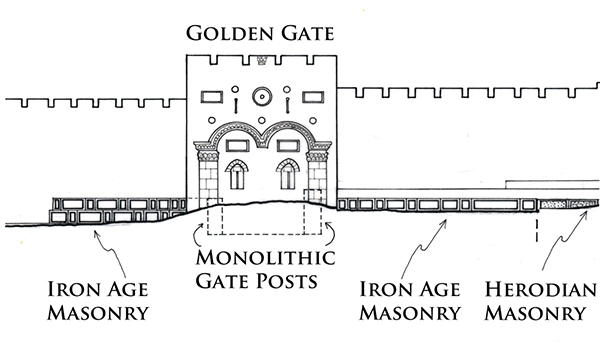
The remains of two massive monolithic gateposts are preserved inside this gate.
The gateposts are set in the same line as the Eastern Wall of the Temple Mount and line up with the massive masonry that can be seen on either side of the Golden Gate.
The gateposts and the two masonry sections appear therefore to be part of the same construction. The top of the southern gatepost is level with the top of the ancient masonry that can be seen south of the Golden Gate. The northern gatepost is one stone course higher and is located only one stone course below the surface of the Temple Mount. This means that the top of the original lintel would have been identical with the present-day level of the Temple Mount. The two gateposts belong to a gate that dates from the First Temple period and is most likely the Shushan Gate, mentioned in Mishnah Middot 1.3 as the only gate in the Eastern Wall.
The gate most probably was given this name by builders who had returned from exile in Babylon and for whom the Palace of Shushan lived on in their memories. However, if so there would have been a tradition of an eastern gate in this location from the time of the construction of the original Eastern Wall. It seems reasonable to suggest that the central section of the Eastern Wall dates from the First Temple period, in particular to the time of King Hezekiah. This square mount was extended south in the Hasmonean period, while both the southern and northern additions were made by King Herod the Great.
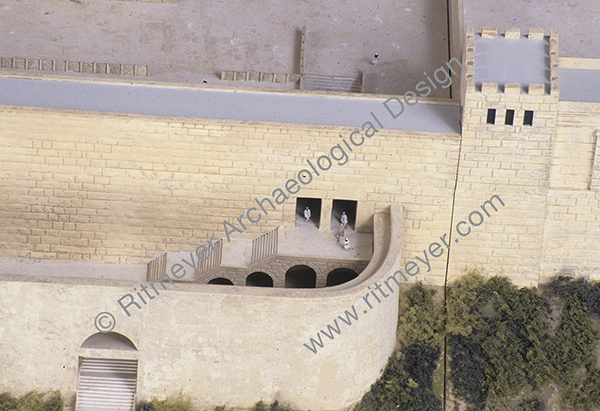
In 1969, the remains of an underground arch were discovered inside a grave in front of the Golden Gate. It was suggested that this may have been a pre-Herodian gateway. However, as the arch stones appear to be Herodian, it is more reasonable to suggest that this arch was part of a Herodian staircase leading up to the original gate. It is fascinating to contemplate that the stairway may still be intact under this gate, although hidden from sight by the Muslim Cemetery.
We do know that the remains of an ancient city wall lie under the present-day path that runs through the Muslim cemetery, which was discovered by Warren in the 1860s. The above-mentioned arched stairway led down through a gate in this city wall, the so-called Miphkad (Muster, or Inspection) Gate mentioned in Nehemiah 3.31, apparently still in use in the Second Temple period. During the latter period, it was through these gates that the Red Heifer was led out from the Temple Mount to the Mount of Olives (Mishnah, Parah). On the Day of Atonement, the scapegoat was led by the same route into the wilderness (Mishnah, Yoma).
It is therefore obvious that the Golden Gate is a very important historical building for the Jewish people, as reported by Arnon Segal of the Hebrew newspaper Makor Rishon Here is a translation of the article that refers to my research: