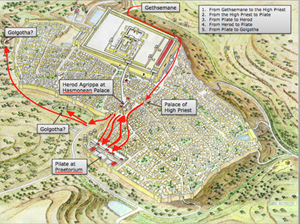
Our classic reconstruction drawing "Jerusalem in 30 A.D." has been used as a base on which to show the Way to Golgotha. Five stages in Christ's last journey can be identified, beginning at Gethsemane and culminating at either of the two sites identified as the place of the empty tomb.
1. After he was betrayed by Judas, Jesus was arrested in the Garden of Gethsemane. According to the Gospel of John 18.13, he was then brought first to the Palace of the High Priest, Annas, which we have tentatively identified with the Palatial Mansion, found in the excavations of the Jewish Quarter of Jerusalem. 2. Having been found worthy of death, Jesus was beaten and spat upon in the Palace of the High Priest, where Peter also denied that he knew him. Then, as the Jews had no authority to execute anybody, they sent Jesus to Pilate, who was Roman Governor at the time. Pilate’s official residence (or praetorium) in Jerusalem was Herod the Great’s Palace, which the Romans had appropriated after the latter’s death. 3. When the Roman Governor heard then that Jesus was from Galilee, he sent him to Herod Antipas, who was tetrarch of Galilee and Perea and in Jerusalem for the Passover season. His residence was the old Hasmonean Palace, which stood halfway between Herod’s Palace and the Temple Mount. 4. Although Herod Antipas treated Jesus with cruel derision, he could not find him guilty of the charges laid against him. After dressing him in an elegant robe, which mocked his claims to kingship, Herod Antipas had him retrace his steps back to Pilate in the Praetorium. 5. Standing again before Pilate, the chief priests and the elders accused Jesus of making himself a king. Pilate was under such pressure that he had to give in and deliver Jesus up to be crucified. Bearing the crushing weight of his own cross, until relieved by Simon of Cyrene, Jesus was led away to a place called Golgotha (Place of a Skull). There are two main proposals for the location of Golgotha: the Holy Sepulchre (half way down the left side of the drawing) and the Garden Tomb (on top left of drawing). Both sites are problematic, as the traditional Tomb of Christ in the Holy Sepulchre has been destroyed about 1000 years ago and the Garden Tomb was not a newly hewn tomb. Though the last resting place of Christ remains tantalizingly elusive however, there is no uncertainty as to the history-defining miracle that took place within it. As the angel said to the three women: “He has risen! He is not here.”