Protest over Western Wall Museum

Archaeologists are up in arms against the planning of a new Museum at the western side of the plaza area. See this report in Haaretz.
Some, like Yoram Tsafrir, are dead against it, while others, such as Uzi Dahari and Guy Stiebel are in favour.
Yoram’s comments sound a little dramatic:

The construction will cause generations of weeping over the serious damage to the site, Tsafrir said at the conference on archaeological findings in the Jerusalem area sponsored by the Hebrew University’s Institute of Archaeology and the Antiquities Authority.

As we have seen with the reconstruction and integration of the Byzantine Cardo in the Jewish Quarter, it is possible for preserved remains to be incorporated into modern buildings.

Source: Joe Lauer

Posted in Excavations, Jerusalem, News | 1 Comment

ESV Bible Atlas by Crossway

A few months ago, we received a pre-press copy of the ESV Bible Atlas to review:

Already then, we were very impressed with this atlas and wrote the following endorsement:

“I had the privilege of being involved in the production of drawings based on the latest research for the ESV Study Bible. It is a joy to see these drawings plus the original ESV Study Bible maps, woven together with numerous new maps, brilliantly evocative photographs and useful indexes to make up the new Crossway Bible Atlas. This volume will become an indispensable companion for Bible students, fulfilling every expectation you might have of such a tool. Particularly innovative is the use of terrain imagery to facilitate the reader’s understanding of such Biblical viewpoints as that of Abraham from Hebron over the cities of the plain or Moses from Mt. Nebo.”

Justin Taylor, who was the managing editor of the ESV Study Bible, wrote this in his blog:

“One of the neat things for me is being able to see the ESVSB illustrations—of the tabernacle, the temples, Jerusalem at various times, etc—in great detail over a two-page spread on glossy paper.”

We agree that on this glossy paper, the reconstruction drawings look even better than in the Study Bible. We are further told that

The new Crossway ESV Bible Atlas (352 pages) will be shipping soon from Amazon.

The text of the Atlas was written by Professor John Currid (RTS-Charlotte, NC). The maps were done by David Barrett, who also served as the cartographer for the ESV Study Bible. Here’s what it contains:

175 full-color maps
70 full-color photographs
3-D re-creations of biblical objects and sites
indexes
timelines
65,000 words of narrative description.
“The atlas uniquely features regional maps detailing biblically significant areas such as Egypt, Mesopotamia, Italy, and Greece. It also includes a CD with searchable indexes and digital maps, and a removable, 16.5 x 22-inch map of Palestine.”

You can flip through some of its pages here

As he lives in the USA, Todd Bolen received his copy yesterday, we can’t wait to receive ours in the UK soon as well.

Posted in History, News, Products | 2 Comments

Visit to Turkey

Apologies for my failure to blog in recent months. A research visit to Turkey and its subsequent recording, together with protracted happy family celebrations, account for this. Hope to make the results of our research available for educational use in the near future. In the meantime, however, must just mention the uncanny experience of finding myself in a site which I had drawn up from a distance some 15 years ago.

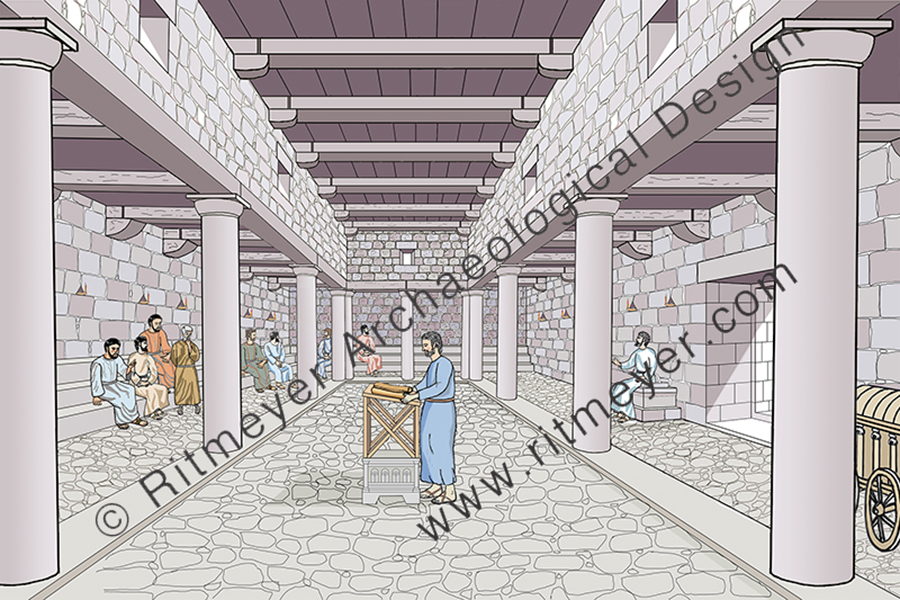
In 1996, Hershel Shanks, Editor of Biblical Archaeology Review, asked me to illustrate an article by John S. Crawford, entitled “Multiculturalism at Sardis” (BAR, Sept/Oct 1996 pp. 38 – 47). This involved drawing up a complex dating from the Byzantine period, which had been excavated in the city (originally mentioned as one of the 7 churches of Revelation). The complex comprised a colonnade of shops, some owned by Jews and some by Christians, an adjacent synagogue and adjoining this, an elaborate bath-gymnasium, with a marble forecourt:

He also requested a detailed drawing of the shops, where symbols carved on the stones revealed the differing religious affiliation of the owners. The whole point of the article, was, as its title implies, to show how Christians and Jews lived in Sardis side by side, in full tolerance of each other. I distinctly remembered drawing the two menorot incised on the doorjamb of the shop identified as belonging to Jacob the dyer. On the drawing, the two menorot are drawn on the outside of the shop, although in reality they are carved on a stone of the inside door jamb:

On our recent visit to the site, however, there was no indication of these evocative symbols, only numbers labelling each shop. Knowing that they must be there, we peered and felt around and it was deeply satisfying to find one and then another lampstand carved into the stone, just as I had drawn them up from original photos, taken by the Harvard-Cornell excavations in the 1960s and 70s. A large menorah can be seen on the right side of the stone, while a smaller one is visible to the left of the same stone:

We were blown away by the richness of Turkey’s Biblical heritage and are astounded at the recent direction taken by the country. Whither the “Other Holy Land?”

Posted in Excavations, History, Research | Leave a comment

GLO Easter Experience

The new digital GLO Bible illustrates the events surrounding the Passion Week of Jesus Christ with samples of the media that accompanies scripture. Some of the reconstructions and animated maps that are shown are based on designs by Ritmeyer Archaeological Design:

The Palatial Mansion, excavated by Prof. Nahman Avigad in the Jewish Quarter of the Old City of Jerusalem, may have been the Palace of the High Priest where Jesus stood before Caiaphas, the son-in-law of Annas.

Posted in Excavations, History, Jerusalem, News, Research | Leave a comment

The Messiah in the Temple

In a previous report we commented on a new project called The Messiah in the Temple. A lot of progress has been made, especially in developing this new poster:

Martin Severin, the project manager wrote:

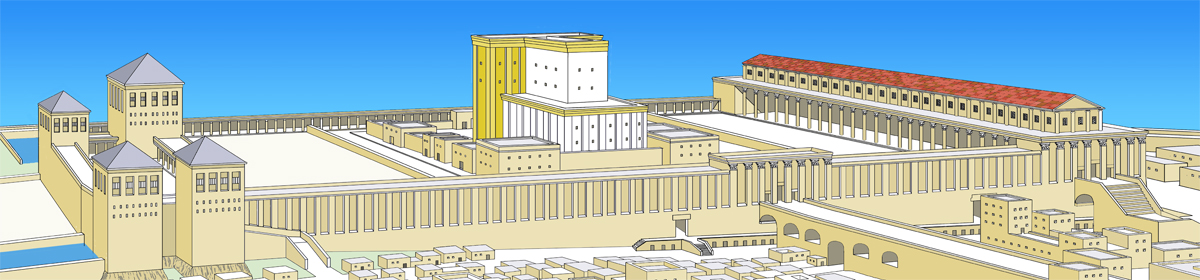
After months of detailed work we have succeeded in producing a photographic rendition of the Herodian Temple in the time of Jesus with 20.000 x 6000 pixels (that is 120 mega pixels). This makes it possible to get pin sharp prints which are several meters long. There is an astonishing amount of detail to be seen. We have tried to present everything as authentically and true to the original as possible. We even photographed the unique light quality and some single stones on-site at the remains of the temple to make the result as authentic as possible. Everything was based on the excellent building plans by Dr. Leen Ritmeyer. More than 2000 digital people were painstakingly included in the picture so that the end result is very realistic.
It’s only the beginning, but this is the kind of quality we intend to stick to for the rest of the project. In the photograph above you can see the first small version of this picture. The idea is to reproduce the final photograph in poster size which can be sold to raise further funds for the project.

Posted in Jerusalem, News, Temple Mount | 3 Comments

The Temple Mount on a bus

Who would have thought to see a reconstruction drawing of the Jerusalem Temple on a bus? Reconstruction drawings usually appear in books, magazines and occasionally on stamps, but on a bus? I don’t normally comment on politics, but this is different, see this Jerusalem Post report:

While tensions continue to simmer around the Temple Mount after riots in and around the capital’s Old City earlier this month, a new campaign calling for the construction of the Third Temple atop the holy site has made its way to the sides of 200 Egged buses in the city, which now sport posters featuring a picture of a rebuilt temple on the Mount, and nothing else.

The posters, which contain the phrase, “May the Bais Hamikdosh be rebuilt speedily and within our days,” were sponsored by the Our Land of Israel group, which is led by Rabbi Shalom Dov Volpo and activist Baruch Marzel, leave out the site’s current structures – namely the the Aksa Mosque and the Dome of the Rock.
The campaign’s organizers chose to plaster the posters on buses whose routes take them through predominately Arab neighborhoods of east Jerusalem.
With regards to the campaign, Volpo said Israel is waiting breathlessly for the coming of the messiah and the rebuilding of the temple.

“The Arabs and President Obama know that the Temple will be built on the Temple Mount,” he said. “Instead of the temporary buildings that are there today.”

Speaking to The Jerusalem Post on Sunday, Marzel said it was no mistake that the Islamic shrines were left out of the picture.

“We’re representing the truth, in front of everyone, and saying out loud what every Jew believes,” Marzel said. “That the Third Temple needs to be built immediately on the Temple Mount and that the mosque should not be there.”

“When we reach the end of the Pessah Seder tomorrow night, he continued, “we’ll say, ‘Next year in a rebuilt Jerusalem.’ What does ‘rebuilt’ mean? It means with the Third temple intact.”

Marzel brushed off the furor the ads might elicit from the capital’s Muslims, saying, “It upsets them that we’re alive, and that we’re living here.”

Posted in Jerusalem, News, Temple Mount | Leave a comment

The Dead Sea Scrolls in Minnesota

A few months ago, I was asked to supply reconstruction drawings for the new Dead Sea Scroll exhibition in the Science Museum of Minnesota. The exhibition is now open and I encourage you to visit if your are in the area. Here is part of a report which appeared in the St. Louis Post:

“By incorporating new archaeological finds and recent scholarship, the exhibit is the first to fully present two competing theories: Were the scrolls written and collected by an ultra-religious Jewish group living in the desert? Or were the manuscripts smuggled out of Jerusalem on the eve of the Roman invasion in A.D. 70 and hidden for safekeeping in the wilderness?

“We could just tell one side and create a tight little story about who created the scrolls, but that wouldn’t be telling the science,” said Ed Fleming, the museum’s curator of archaeology, who worked with other staff and Israeli authorities to design the exhibit.

Even without the lively debate over their origins, the scrolls have massive appeal. They include the oldest known copies of the Hebrew Bible, what Christians refer to as the Old Testament.

Some have called their discovery the most important archaeological find of the 20th century. During the next seven months, “The Dead Sea Scrolls: Words That Changed the World” will display 15 scroll fragments on loan from the Israeli Antiquities Authority, along with dozens of ancient artifacts — many on public display for the first time — that illustrate daily and religious life in first-century Israel.

Churches and other groups reserved tickets months in advance. Still, more than half a century after their discovery in the Judean Desert, no one knows who copied these ancient texts or how they got there.

It took decades for the scrolls to be pieced together, studied and published. About a quarter of them were identified as portions of the Bible. Every book in the Old Testament is represented with the exception of Esther.”

Posted in News | Leave a comment

“Solomonic Wall” found in Jerusalem

The confusion in the reporting on this wall was summed up in one sentence by Neil Silberman: “Dr. Eilat Mazar is at it again– running to the press before properly submitting her finds to serious archaeological scrutiny.” This has been my personal experience going back to 1986.

I do believe that she is a good archaeologist, but this running to the press, without giving scientific reasons for her conclusions is totally unacceptable. People are no longer prepared to believe statements that are not backed up with facts. It gives Biblical Archaeology a bad name.

Barnea Levi Selavan of the Foundation Stone organisation, which, together with Ateret haCohanim, has the aim of purchasing and restoring “ancient homes in the Old City which are occupied by young and idealistic yeshiva families and students who have breathed new life into the heart of Yerushalayim”, wrote this to me:

“Eilat explained to the press that she reached bedrock, she dug under the floor and found 10th century pottery in the fill under the floors. most media reports did not quote this. she said no evidence of Canaanite structure earlier here. Typology of pottery distinctively Israelite. Original floor preserved in two places.”

So, all that was done, as I already presumed, was digging down deeper in previously excavated areas and finding 10th century material. How that fill relates to the wall segments is still unclear.

Posted in Uncategorized | Leave a comment

First Temple period wall found in Jerusalem

It was reported this morning by the Israel Ministry of Foreign Affairs and Arutz 7 that “a section of an ancient city wall of Jerusalem from the 10th century bce—possibly built by King Solomon—has been revealed in archaeological excavations directed by Dr. Eilat Mazar and conducted under the auspices of the Hebrew University of Jerusalem. The wall, 70 meters long and 6 meters high, is located in the area known as the Ophel, between the City of David and the southern wall of the Temple Mount.” Todd Bolen, in two reports, gives a good site map and overview of the wall remains that have been found in the Ophel area and the problems of their identification.

Although it is not entirely clear from the report where the excavated wall is located, it can only be a continuation of the city wall (or a deepening of the previously excavated area next to it) that was earlier discovered, first in the 1970′s and continued in 1985-7 under the auspices of the late Prof. Benjamin Mazar and his granddaughter Eilat. This city wall is attached to a monumental building and a possible gateway and large tower, which was already explored by Charles Warren in the 1860′s.

The possibility of having found an Iron Age gateway was proposed confidentially to Eilat Mazar by myself, but it was reported to the press before I was given a chance to explore this hypothesis (Jerusalem Post, April 22, 1986). The difficulty of identifying the building that was excavated by the late Prof. Benjamin Mazar with a gateway is that the chambers are constructed very differently from gate chambers of that period.

Whether this “newly” found wall belongs to the Solomonic or a later period in the Iron Age remains to be seen. What is interesting, however, is the construction of the wall. Most of the stones have roughly hewn bosses and irregular margins. The ashlars in the stone courses are laid in a header-and-stretcher construction. The masonry looks, in fact, identical to that of the “Extra Tower” or “Projecting Tower”, as Warren referred to this construction. This area was excavated by the late Dame Kathleen Kenyon (Area SII) in the 1960′s, who dated this tower, based on the archaeological finds, to the eighth century B.C. (Digging Up Jerusalem, p. 115). It appears therefore to be a strengthening of the fortifications in this area during that time. The masonry in the newly reported wall looks identical and therefore may date to the eighth century B.C. as well and may be a reconstruction of an earlier wall section.

Additionally, as I plan to explain in an upcoming article on the Golden Gate, this masonry is identical to the lower courses on either side of this gate in the Eastern Wall of the Temple Mount. I have argued before that the monolithic gate posts inside the Golden Gate belong to the original Shushan Gate, the gate in the Eastern Wall of the Temple Mount of the First Temple period, which was constructed by King Hezekiah in the eighth century B.C.

Despite the lack of clarity in the reporting on the excavation results of this wall, it is nevertheless exciting to have more evidence of the city of Jerusalem during the First Temple period.

UPDATE: “Everything speaks for itself” … is the remark made repeatedly by Eilat Mazar in this video on the Arutz 7 website.
However, all it speaks to me of is … that she dug deeper in previously excavated areas and did not discover anything major that wasn’t known before.
The picture of the wall with the header-and-stretcher construction belongs to the “Projecting or Corner Tower” and not to the “new” city wall, as the first reports appeared to indicate. This tower was already dated by Kenyon to the 8th century B.C., as noted above. More pictures can be seen on the Hebrew University’s Facebook.

Posted in Excavations, Jerusalem, News | 11 Comments

Ancient street found in Jerusalem

A few days ago an ancient street was found in Jerusalem in an archaeological excavation inside the Jaffa Gate, next to the remains of the Hippicus Tower. This exciting find has been reported by many commentators. This CBN news item, however, shows an interesting video of the excavated street. The excavators have pointed out that this street was shown on the Madaba map:

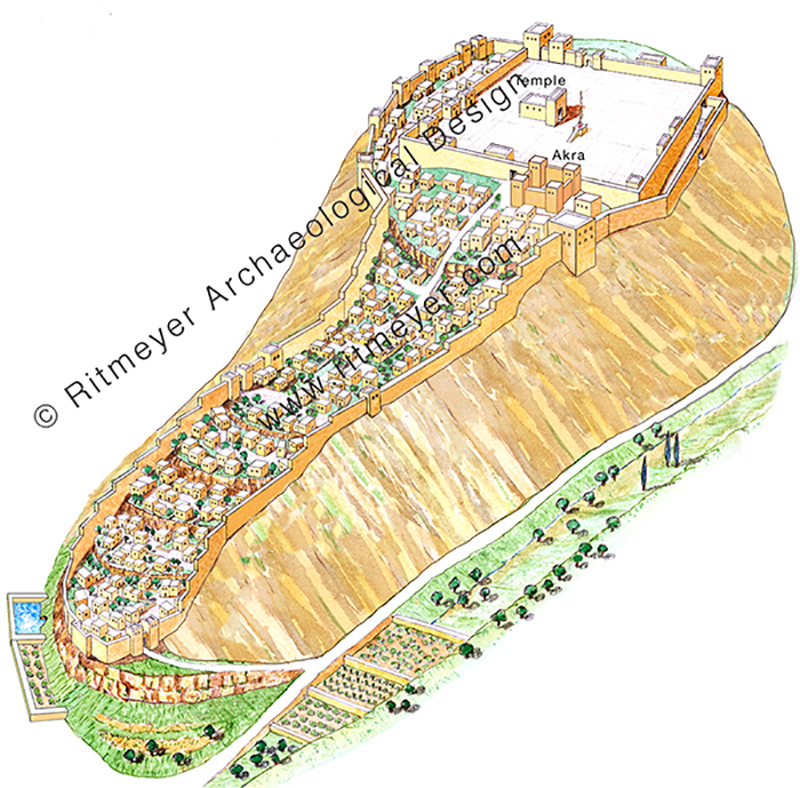
This map also guided the late Prof. Nahman Avigad to find the Byzantine Cardo in the Jewish Quarter of the Old City of Jerusalem. Using this map as a basis and taking all the Byzantine remains found in Jerusalem into consideration, I was able to make a reconstruction drawing of the city during that time. This then is a view of Jerusalem during the Byzantine period, showing the street complex and the many the Christian churches that were built at that time. Many Christians lived in Jerusalem, which was also visited throughout the year by Christian pilgrims.

Posted in Uncategorized | 8 Comments