Some posts are pure pleasure to put up. This is one of them! Our resident computer expert (son Nat, who is also an experienced digger!), has given our website a facelift for the new academic year. Over a memorable few weekends, he has managed to combine all the sections of our website, made it easier to subscribe to RSS and also easier to find our products. To celebrate this event, we are offering massive discounts on many items. Take a few minutes to check these out before the academic year gets underway.
The Temple Mount is Jewish
Arutz-7 has this interesting report on a guide to the Temple Mount, published by the Supreme Moslim Council in 1925. On page 4, it states this about the historical importance of the Temple Mount: “Its identity with the site of Solomon’s Temple is beyond dispute. This, too, is the spot, according to universal belief, on which “David built there an altar unto the Lord, and offered burnt offerings and peace offerings”. (2 Sam. 24.25).
A facsimile of the 16-page booklet can be downloaded from the Temple Institute website.
So, all the recent Palestinian hype about the Temple Denial (meaning that there never stood a Jewish Temple on the Temple Mount) holds no water, but is political posturing only.
As long as Muslims and rabbis (see previous post) ignore archaeological evidence, there will be no end to political and religious arguments.
Temple Mount ban
Here you can read one of the latest articles on “Jews in the Temple Area: A ‘Mount’-ing Controversy”. Three rabbis, Rabbi Yoseph, Rabbi Elyashiv and Kanievsky, demand a complete ban on Jews entering any part of the Temple Mount on the grounds that the ritual purity of the area might be violated.
On the other hand, there are a growing number of rabbis, such as Rabbi Moshe Tendler, Rabbi Yehuda Kreuzer and the rabbis of the Temple Institute, who believe that Jews should be allowed to enter onto the Temple Mount, and in an interview with IsraelNationalNews, Rabbi Kreutzer cited a well-known rabbinical source: “In short, the Radbaz [a leading halachic authority from the 1500s] ruled that the Dome of the Rock is the Foundation Stone in the Holy of Holies…. He wrote that without a doubt this is the identity of the place. He wrote in a definite way the definite identity of the place,” Kreuzner reiterated. “If so, it’s possible to do the measurements.”
The “measurements” have been done already, for there is so much archaeological evidence to show that the Rock inside the Dome of the Rock is the Foundation Stone, that is indeed possible to set out the precise location of the Temple and its courts. For the last 30 years, I have used the information of Middot, Josephus and archaeology to analyze the Temple Mount.
The pre-Herodian Temple Mount was a square platform of 500 cubits, inside of which was the soreg, a partition screen to keep out Gentiles and Jews who were disqualified from entering the inner courts. Further inside was the Court of the Women and the Azarah, the court around the temple itself, which was accessible to priests only.
The location of the soreg in the southern court depends on the location of two Temple Mount mikvaot, Cisterns 6 and 36 according to Warren’s enumeration, and the soreg should be located just to the north of them. Mikvaot were used for ritual bathing, which, of course, needs to be done before entering the holy area. Even if the rabbis would stay outside of the soreg, there is ample space on the Temple Mount for them to walk on.
The Court of the Women was located east of the raised Muslim platform and the Azarah was located on this platform. By staying off the platform, rabbis could never defile the Holy of Holies, which was located inside the Dome of the Rock. Even walking on the raised platform, there is no danger of trespassing on the Holy of Holies.
If the fear of the rabbis is to tread of the area of the Holy of Holies alone, then they should stay outside of the Dome of the Rock and the rest of the Temple Mount should be accessible to them.
On the detailed plan below, the pre-Herodian Temple Mount is indicated in yellow. and the soreg in the southern court is just north of the two mikvaot. The raised Muslim platform is grey and the Herodian Temple Complex is in red.

… under construction …
Over the next couple of days we are going to be making changes to the layout of the blog and online store… if something stops working, don’t worry; we’ll be back online soon!
The Gamla Synagogue
The ESV Study Bible has now started a blog and today an interesting post was put up about the Gamla Synagogue. When I first started to work for the ESV Study Bible, I was shown a beautiful reconstruction painting of this synagogue which had a red tiled roof. The artist did not know that roof tiles were only introduced to the Land of Israel in the Roman period and were much used in the Byzantine period. Most of the roofs of churches and synagogues at that time had pitched roofs, covered with tiles.
Not so, however, during the Herodian period, when the Gamla Synagogue was built. Some tiles may have been imported for large public buildings, but most of the roofs were flat, especially in the Golan where wood is scarce. In 1973, just after the Yom Kippur War, I was asked to accompany a group of IDF archaeologists, who were doing a survey in the territory that had been newly captured from Syria. It was here that I was first introduced to buildings made of basalt blocks. Not only the walls, but the door and window frames were all made of basalt stones and the roof was made of long basalt slabs, which rested on corbels which projected from the walls.
I was quite sure that the Gamla Synagogue had a similar flat roof and that is what it shown in the drawing below (used by permission). As an interesting aside and as mentioned in a previous blog, this type of roof construction would explain how the paralytic man could have been let down through the “tiling” (Luke 5.19) in order to be healed by Jesus. It is more than likely that the roof of the house in Capernaum, where the houses were also made of basalt, was made of long basalt slabs laid at a short distance from each other and which were then covered with flat basalt tiles. After removing these tiles and taking away the basalt cross beams, a space would have been created large enough to let a man down through.
A similar flat roof construction would have been used in the Gamla Synagogue. It has been a privilege to have worked with the ESV Study Bible and Maltings Partnership and the painting below is the result of our joint endeavors:
Jerusalem reconstruction drawings
In the middle of this promotional movie for the new ESV Study Bible (available from 15 October, 2008), you can see my reconstructions of Jerusalem and the Temple in the various periods and which have been painted beautifully by Maltings Partnership, U.K.
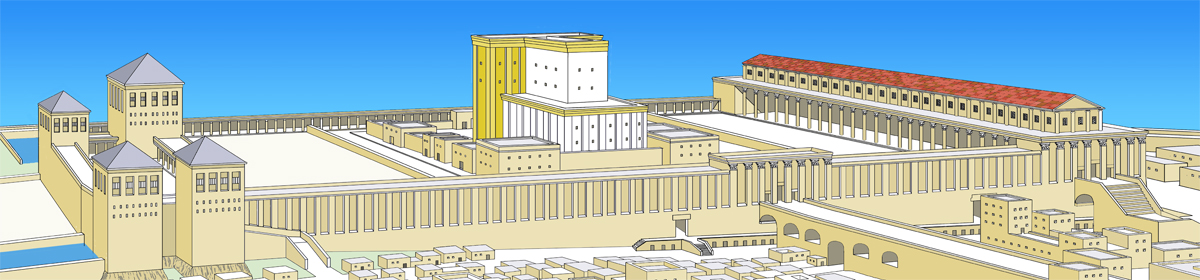
First you see the City of David, followed by Solomon’s Jerusalem and Temple. You can then view Jerusalem in the time of Nehemiah, followed by Herodian Jerusalem and the spectacular Temple Mount and also zoom in to the Temple itself.
Here is the video:
The Temple Mount gates
Tonight, Friday the 1st of August, is also the beginning of the Hebrew month Ab. On the 9th of this month the Jews remember the destruction of the two temples that stood on Mount Moriah, but tonight, they march around the gates of the Temple Mount to express their desire is to build a new Temple.
The ceremony is called “Sivuv She’arim” – going round the gates – and this is the seventh year that they have marched round the gates of the Temple Mount. You can read the Jerusalem Post report here.
The founder of Sivuv She’arim, Rabbi Tzvi Rogin, used to visit our home, when we lived in Yorkshire, and we had many animated discussions about the Temple Mount. Our family once participated in this ceremony and it was an exhilarating experience.
For those of you who don’t know all the Temple Mount gates, here is a drawing showing their location:

The original names of the gates of the Herodian Temple Mount walls are not known. They possibly never had names.
Today we refer to the gates in the Western Wall (from north to south) as Warren’s Gate, Wilson’s Arch (which was part of a bridge and led to a gate which was built into the western portico), Barclay’s Gate and Robinson’s Arch – which supported a stairway leading to a gate, which was also built into the western portico. Warren, Wilson, Barclay and Robinson were explorers, who worked in Jerusalem in the late 1800’s.
There are two Herodian gates in the Southern Wall, the Double Gate and the Triple Gate. These gates are sometimes erroneously called the Huldah Gates, for these were located on the Temple Mount and were not part of the Herodian retaining walls.
There were two gates in the Eastern Wall, a small gate near the south-east corner, which led into what is now called the Solomon’s Stables and the main eastern gate, which was located where the Golden Gate now stands. Inside this gate are two monolithic gate posts which belonged to the earlier Shushan Gate.
There may have been another Herodian gate in the northern wall, but no remains have been found and it is only once mentioned by Josephus.
The earlier square Temple Mount, which was originally constructed by King Hezekiah, had five gates and their names are known. In the west was the Coponius Gate, the two gates in the southern wall were called the Huldah Gates. We have already mentioned the Shushan Gate in the eastern wall and the gate in the northern wall was called the Tadi Gate. This gate may have been buried underground by the Herodian expansion to the north.
Golgotha and the Tomb of Christ
Over the last 9 months, I have been working as archaeological and architectural editor for the new ESV Study Bible, which will be available from 15 October 2008. Most of my contacts have been with Justin Taylor, who was the Project Director and Managing Editor. Recently, he interviewed me concerning two drawings, which I had been asked to prepare for the Study Bible.
The two-part interview concerning Calvary and the Tomb of Christ can be viewed on his blog here and here.
Israel in June
Before our visit recedes into memory, we must put down some of the impressions that readers have asked for. June was a good time to visit the Land from the point of view of not having to compete with other groups for space on site visits – on some sites such as Kursi and Gamla in the Galilee, we had the place totally to ourselves. And, our northern base of Ein Gev was pure rest and rejuvenation (when we returned from our days out!), as the place had not yet been transformed into a hive of family activity for the school holidays. However, the light is harsher for photography than earlier in the year and this is perhaps the downside to going in early summer, which is otherwise so good, being the prime time for digging and, of course, great for swimming in the Dead, the Med and the Red. We did get some great pics however. Here is our group at the Ophir Observation Point, high above the Sea of Galilee:

Below is the Tel Gezer dig we visited and where we met up with archaeologist Daniel Warner (in green shirt) among others:


Jerusalem was even more chaotic than we remembered, with honking, hooting and sirens 24/7. We were very thankful to have an oasis of calm in the midst of it with a jumbo-sized balcony offering panoramic, golden, views of Mount Zion and the Old City. On the left is the night view from our balcony and on the right the view from the arched entrance to our guesthouse:


From the perspective of an archaeological architect, the thing that made the most impression on me was the much greater prevalence of reconstruction drawings on sites than in times past. Knowing how much these enhance any visit to an archaeological site, this was deeply satisfying.
We saw good reconstructions at the City of David, the Temple Mount Excavations, Masada, Tel Gezer, Bethsaida, etc, but the sparkler in the crown was definitely the new Time Trek at the Caesarea Harbor Experience, which so enthralled the young folk in our party. You have to pay extra on top of the normal site fees in order to visit this, but the NIS17 is definitely worth it. Here, with funds from a trust set up by Baron Edmond de Rothschild in the early twentieth century, a new, whiz-bang, multi-media experience, takes you through episodes of the city’s dramatic history.


Reconstructions showing things like a horse race in Herod’s hippodrome and ships entering his magnificent harbour create an unforgettable evocation of another time. (The site’s website seems to only work in Hebrew <www.caesarea.org.il>). Hopefully, other sites in the country will benefit from such an injection of funds and vision.

The Temple Mount – new discoveries from the time of King Hezekiah (cont.)
The drawing below explains the location of the stones I blogged about yesterday. The drawing shows the eastern wall of the Temple Mount as it existed in the time of King Herod. The black line at the bottom of the drawing shows the suggested ground level at that time. The green line indicates the ground level of today and the colored parts show the existing remains. The northern and southern parts (yellow) of the eastern wall are Herodian, the red section dates to the Hasmonean period and the central (blue) section is the oldest part of the wall.

On either side of the Golden Gate, two stones courses can be seen, which, according to my analysis of the Temple Mount, date to the time of King Hezekiah, who expanded not only the city, but the Temple Mount as well. The two newly identified stones in the southern part are only 4 stone courses lower than those near the Golden Gate. The stone courses below must therefore belong to that period as well, if not earlier.
This drawing also shows that the general level of preservation dips from north to south and that the preserved remains of the central and oldest section of the eastern wall are most likely located just below ground level.