Israel in June

Before our visit recedes into memory, we must put down some of the impressions that readers have asked for. June was a good time to visit the Land from the point of view of not having to compete with other groups for space on site visits – on some sites such as Kursi and Gamla in the Galilee, we had the place totally to ourselves. And, our northern base of Ein Gev was pure rest and rejuvenation (when we returned from our days out!), as the place had not yet been transformed into a hive of family activity for the school holidays. However, the light is harsher for photography than earlier in the year and this is perhaps the downside to going in early summer, which is otherwise so good, being the prime time for digging and, of course, great for swimming in the Dead, the Med and the Red. We did get some great pics however. Here is our group at the Ophir Observation Point, high above the Sea of Galilee:

fam.gif

Below is the Tel Gezer dig we visited and where we met up with archaeologist Daniel Warner (in green shirt) among others:

gezer1.gif withdan.gif

Jerusalem was even more chaotic than we remembered, with honking, hooting and sirens 24/7. We were very thankful to have an oasis of calm in the midst of it with a jumbo-sized balcony offering panoramic, golden, views of Mount Zion and the Old City. On the left is the night view from our balcony and on the right the view from the arched entrance to our guesthouse:

nightjoel1.gif

archmd.gif

From the perspective of an archaeological architect, the thing that made the most impression on me was the much greater prevalence of reconstruction drawings on sites than in times past. Knowing how much these enhance any visit to an archaeological site, this was deeply satisfying.

We saw good reconstructions at the City of David, the Temple Mount Excavations, Masada, Tel Gezer, Bethsaida, etc, but the sparkler in the crown was definitely the new Time Trek at the Caesarea Harbor Experience, which so enthralled the young folk in our party. You have to pay extra on top of the normal site fees in order to visit this, but the NIS17 is definitely worth it. Here, with funds from a trust set up by Baron Edmond de Rothschild in the early twentieth century, a new, whiz-bang, multi-media experience, takes you through episodes of the city’s dramatic history.

timetrek.gif havaiot_1.jpg

Reconstructions showing things like a horse race in Herod’s hippodrome and ships entering his magnificent harbour create an unforgettable evocation of another time. (The site’s website seems to only work in Hebrew <www.caesarea.org.il>). Hopefully, other sites in the country will benefit from such an injection of funds and vision.

riding.gif

The Temple Mount – new discoveries from the time of King Hezekiah (cont.)

The drawing below explains the location of the stones I blogged about yesterday. The drawing shows the eastern wall of the Temple Mount as it existed in the time of King Herod. The black line at the bottom of the drawing shows the suggested ground level at that time. The green line indicates the ground level of today and the colored parts show the existing remains. The northern and southern parts (yellow) of the eastern wall are Herodian, the red section dates to the Hasmonean period and the central (blue) section is the oldest part of the wall.

eastwall2008.gif
On either side of the Golden Gate, two stones courses can be seen, which, according to my analysis of the Temple Mount, date to the time of King Hezekiah, who expanded not only the city, but the Temple Mount as well. The two newly identified stones in the southern part are only 4 stone courses lower than those near the Golden Gate. The stone courses below must therefore belong to that period as well, if not earlier.
This drawing also shows that the general level of preservation dips from north to south and that the preserved remains of the central and oldest section of the eastern wall are most likely located just below ground level.

The Temple Mount – new discoveries from the time of King Hezekiah

A couple of weeks ago, we spent some time in Israel with our family, visiting places which are dear to us. Following up on a lead, I used some of that time to investigate a particular section in the eastern wall of the Temple Mount. In the picture below, you can see me photographing two massive stones, which are located 77m (253 feet) north of the south east corner. These stones are similar in size and shape to the ones that can be seen on either side of the Golden Gate. I have dated this masonry to the time of King Hezekiah’s expansion of the Temple Mount in about 700 B.C. (See The Quest, p. 174-178; 191-193). King Hezekiah had built massive retaining walls round the courtyards of King Solomon’s Temple to create a square platform of 500 cubits.

lphoto.gif

We were being watched from above by a policeman, who was not too happy as he thought that we might be desecrating some tombs.

bolice.gif

On the first stone, in the picture below left, you can clearly see the margin and the rough bulging boss which is typical of Iron Age Temple Mount masonry. The two stones are resting on other similar stones, as far as one can see. The stones are located 4 m (13 feet) north of the so-called Mohammed’s Pillar, where I had placed the south east corner of King Hezekiah’s square Temple platform (see picture below right). It is exciting to be so close to the original south east corner and yet so far away. If one only could excavate a few meters down at that point, I’m sure that the south east corner of the square Temple Mount will be found!

sideviewboss11.gif stonespillaryellow2.gif

The diagram below shows all the accumulated archaeological evidence for the outer walls of the 500 cubit square Temple Mount:

blog-new-stones-ewall.gif

The discovery of this new section of ancient stones in the eastern wall of the Temple Mount confirms the location of the pre-Herodian Temple Mount and is an exciting addition to the many new discoveries being made these days to show that the Temple Mount, as we know it today, is indeed the place where the Temples of Solomon, Hezekiah, Zerubbabel and Herod once stood.

Temple Mount quarry found

It was reported today that another quarry has been found in Jerusalem, whose stones may have been used in the construction of Herod’s Temple Mount. The largest stone is said to measure 0.69 x 0.94 x 1.65 m. It has been suggested that these stones may have been used to build the Western Wall, but that is doubtful. The measurements given are of an unfinished stone. These quarry blocks needed trimming to make them suitable for building and that would make them smaller. The average height of the stone courses in the Temple Mount walls is 104-112 cm and the unfinished stone is only 94 cm high. It is possible, however, that stones coming from this quarry may have been used for the buildings and porticoes that stood on top of the Temple Mount and that is very exciting.

Last year, a quarry was found which produced much larger stones and these may indeed have been used in the construction of the Temple Mount walls. Although archaeologists are quick to claim that these stones were used in the Western Wall, we need to realize that identical stones were built in the southern, eastern and northern walls of the Temple Mount as well. There is no way of knowing where the stones of these quarries have been placed.

How were stones quarried? I have written extensively about the quarrying and transportation of these large stones in The Quest, pp. 132-137 and also in Secrets of Jerusalem’s Temple Mount, pp. 53-58.

The two illustrations below show how it was done.

Quarrying was done by digging channels in the rock, which were later filled with dry wooden beams. Once these were wedged into place, water was poured over the dry wood, causing it to swell. The expanding wood caused the stone to split off the quarry bed.

quarrying.jpg

Projections were left on either side of the stones, which were used to lift the stones sufficiently high to put a roller underneath. Using oxen and replacing the rollers, the stones were brought to the building site.

transport.jpg

One can see how much work was involved in the quarrying and transportation of one stone! It is amazing to realize that it took only eight years to build all the retaining walls of the Temple Mount. Truly, whatever one might say about Herod’s character, he was a master builder!

The Temple of Jerusalem: From Moses to Messiah

The Temple of Jerusalem: From Moses to Messiah
Conference at the Yeshiva University, Centre for Israel Studies, New York
May 11-12, 2008

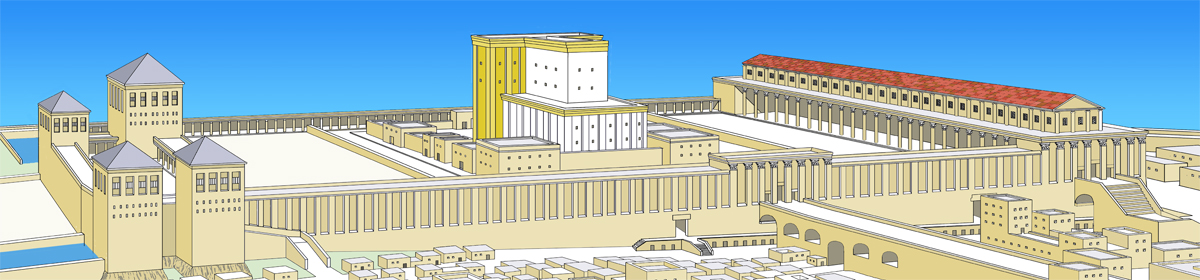
Needless to say, I was delighted to see my “babies” (the models of the Tabernacle, Solomon’s Temple, Herod’s Temple and Herod’s Temple Mount) again, after a separation of 12 years! I was also pleased that Steven Fine organised a conference around this exhibition of models commissioned by the late Ben Adelman of Silver Spring, M.D. Mr Adelman’s estate had bequeathed the models to the Yeshiva University.

Mr. Ben Adelman and myself in 1996

Mr. Ben Adelman (right) and myself in 1996

modelny.jpg

Exhibition of models at Yeshiva University Museum, New York

My personal highlights from the two-day conference were:

• Meeting Professor Louis Feldman, who contributed to the Loeb translation of Josephus, that I use almost every day. The conference was held in his honour. He has worked at the Yeshiva University for the last 55 years.

• Hearing Lawrence Schiffman speak on the Temple Scroll. He put forward the idea that the temple design of the Temple Scroll was based on the layout of the Camp of Israel in the wilderness. The inner square court represented the Divine Presence, the middle court the Levites and the outer court all of Israel. I was particularly interested in this as I was asked by the late Professor Yigael Yadin to make a reconstruction drawing of this temple – see his book: Y. Yadin (1985), The Temple Scroll, (London).

• Discussing with Joshua Schwartz, the many problems – textual and architectural – which had to be considered in the reconstruction of the Herodian Temple and its courtyards for the UCLA virtual temple model.

• Seeing over 250 people from totally different backgrounds, ranging from Orthodox Jewish scholars and Israeli academics to Christian theologians, mingling around the Temple models and talking together when normally they would have little in common.

The exhibition, IMAGINING THE TEMPLE: THE MODELS OF LEEN RITMEYER, continues until August 31, this year. The next project of the Center for Israel Studies is the publication of the lectures in volume form.

The Israel Museum’s Archaeology Wing is closed

The Israel Museum’s Archaeology Wing is currently closed for comprehensive renewal and will reopen to the public in 2009-2010. This is done with the support of the Bronfman family, after whom the wing is named.

Their website gives an overview of some of the most important finds that were exhibited in the Archaeology Wing. One of the finds shown here is the partially broken “Trumpeting Stone” which was found near the southwest corner of the Temple Mount during the 1968-78 excavations, led by the late Prof. Benjamin Mazar. Here is a reconstruction drawing of the “Trumpeting Stone”, which was placed at the top of this corner of the Temple Mount.

trumpeting-stone.jpg

The Hebrew inscription, which was found on the stone, reads “l’bet hatqia l’hakh…” The most likely translation of this incomplete inscription is “to the place of trumpeting to announce”. This stone was originally located some 42m or 138 feet above street level and from that elevated position a trumpet call could be heard all over the city.
I have reason to believe that the stone was broken, not by the Romans in 70AD, but some 140 years ago. If you want to know ‘whodunit’, read my book The Quest, pp. 57-60.

ESV Study Bible

I was interested to see, in my daily Google Alert for the Temple Mount, on James Grant’s blog, that the new ESV Study Bible, for which I have been providing illustrations, now has its own webpage, launched by Crossways, its publisher. It is worthwhile having a look at the sample pages. Having worked with Justin Taylor, the Project Director and Managing Editor, for the last half year, with graphics winging their way for checking and correction from Wheaton, Illinois to Adelaide in Australia, and latterly to Cardiff in Wales, I can’t wait to see the final product, due out in October of this year.

The whole “painstaking process of research and refinement”, to use Justin’s words, has caused me to look into problems which I had not previously addressed. In particular, the discoveries in Jerusalem over the last few years, especially in the City of David, made it necessary for me to produce completely new reconstruction drawings of Jerusalem in the various periods – a very exciting project indeed! I have also enjoyed working with Maltings Partnership, who have rendered my drawings into works of tremendous beauty.

Western Wall stones crumbling

It has been reported here and here that some of the small stones near the top of the Western Wall are crumbling. One wonders why this is happening and what can be done about it.

Let us first examine the wall. There are three different layers of stone courses visible, see illustration below (a similar picture appears in Todd Bolen’s blog). The lowest courses are Herodian. They were built by King Herod the Great, who began building the new Temple Mount in 19 B.C. Seven courses can be seen above ground, but there are many more below the surface. Above these stones are four courses of large stones which were laid in the Umayyad period (around 700 A.D.). Both types of masonry are so strong and well built that, up till now, no earthquake has been able to move these walls. The big earthquake of 1927 caused the destruction of the El Aqsa mosque, but not even a crack appeared in the Herodian masonry! The upper third part of the Western Wall is made up of small stones. It is in this section that some stones are crumbling.

westwall2.jpg

There are legends about this upper section of the wall, one of which claims that it was built in the 19th century by Sir Moses Montefiore, a Jewish philantropist. He indeed tried to buy the Western Wall and the adjacent area to facilitate Jewish prayers, but his efforts came to nothing.

It is difficult to say when this upper portion was built, as it has no distinctive masonry. It could date from any period after the Early Muslim time, i.e. Fatimid, Crusader, Mamluk or Turkish. The top three courses were added by the Muslim Religious Council as part of general repair work. This upper third part of the wall is, of course, the back wall of the western colonnade.

We must ask ourselves the question why the upper parts of the Temple Mount walls suffer so much from crumbling and/or bulging. Very large bulging parts in the southern and eastern walls had to be rebuilt a couple of years ago.

I believe that it is caused by the renewal and renovation programme undertaken on the Temple Mount by the Muslim Religious Council. Many walls and pavements have been “repaired” by pointing in between the stone courses. If this is not done properly, it can cause problems such as bulging and the subsequent collapse of walls.

Ancient walls were built with stone courses on both sides of the wall and a fill in between. This fill should have been made up of a hard core fill of broken stones set in lime, but often soil was mixed in with it. When it rains the walls get wet, including the inner fill. The ancient mortar, made of lime and an aggregate, such as sand, gravel or sometimes ground up pottery, is porous and lets the water seep out through the gaps in between the stones. Such walls can ‘breathe’ as it were.

Over the last 30 years or so, an extensive programme has been going on on the Temple Mount, where old walls were refaced with new stone and the joints in between stone courses of old buildings have been filled with Portland cement. This modern cement is very hard and seals off the spaces in between the stones. Walls still absorb rain water, because stone is porous. However, once the inner core is wet, the water cannot seep out, causing a swelling inside the wall itself. Over time, more water is absorbed until the swelling is so large that it causes one of the sides of the wall to bulge, usually the outer side, as there is no counter pressure. Individual stones can be crushed by the movement of the stones. This is the cause of the crumbling and bulging of the upper parts of the Temple Mount walls and also of other buildings on the mount itself. If this situation remains unchecked, more sections of the walls will bulge, crumble and eventually collapse. So, watch your head when you stand at the foot of the Western Wall!

Conference in New York on The Temple of Jerusalem

Here is the official program. Please note that attendance is free, but registration is required, see below.
The Temple of Jerusalem: From Moses to the Messiah
May 11 – 12, 2008

The Inaugural conference of the Yeshiva University Center for Israel Studies,
Honoring Professor Louis H. Feldman
May 11 • Noon – 6:00 pm
Yeshiva University Museum at the Center for Jewish History
15 West 16th Street
Noon – 1:00 pm • Viewing of “Imagining the Temple: The Models of Leen Ritmeyer”

Session 1, 1: 00 – 3:30 pm

From the Tabernacle to the Dead Sea Scrolls
Chair: David Horwitz, Yeshiva University

Gary A. Anderson, University of Notre Dame
The Inauguration of the Tabernacle Service at Sinai

Shawn Zelig Aster, Yeshiva University
Centralization of Worship in the First Temple and Israelite Religious Belief

Shalom Holtz, Yeshiva University
Temple as Asylum and God as Asylum in the Psalms

Lawrence H. Schiffman, New York University
The Temple Scroll: A Utopian Temple Plan from Second Temple Times

Session 2, 3:45 – 6:00 pm

The Second Temple: Between Rome and Eternity
Chair: Moshe Bernstein, Yeshiva University

Menachem Mor, Haifa University
The Jewish and Samaritan Temples: Religious Competition in the Second Temple Period

Miriam Pucci Ben Zeev, Ben Gurion University
From Tolerance to Destruction: Roman Policy and Jewish Temple

Joshua Schwartz and Yehoshua Peleg, Bar Ilan University
Notes on the Virtual Reconstruction of the Herodian Period Temple and Courtyards

Leen Ritmeyer, Trinity Southwest University
Envisioning the Sanctuaries of Israel—The Academic and Creative Process of Archaeological Model Making

May 12 • 9:00 am – 5:30 pm
Stern College for Women
Geraldine Schottenstein Cultural Center
239 East 34th Street (between 2nd and 3rd Avenues)

Session 3, 9:00 – 11:30 am

The Jerusalem Temple in Medieval Christianity and Islam
Chair: David Berger, Yeshiva University

Frank Peters, New York University
Ruined Expectations: Christians and Muslims and the Jerusalem Temple

Moshe Sokolow, Yeshiva University
Fadai’l al-Quds: Jerusalem, The Temple and The Rock in Muslim Literature

Vivian B. Mann, Jewish Theological Seminary of America
Imagining the Temple in Late Medieval Spanish Altarpieces

Session 4, 12:30 – 2:45 pm

The Jerusalem Temple in Medieval and Early Modern Thought
Chair: Elisheva Carlebach, Queens College and the Graduate Center, CUNY

Jonathan Dauber, Yeshiva University
Images of the Temple in Sefer ha-Bahir

Mordechai Z. Cohen, Yeshiva University
God Dwelling in the Sanctuary? Interpretive Strategies of Maimonides, Nahmanides and Sefer ha-Hinnukh

Jacob J. Schacter, Yeshiva University
Remembering the Temple: Commemoration and Catastrophe in Medieval Ashkenazi Culture

Matt Goldish, Ohio State University
The Temple of Jerusalem from the Renaissance to the Enlightenment

Session 5, 3:00 – 5:30 pm

The Jerusalem Temple in the Modern World
Chair: Joshua Zimmerman, Yeshiva University

Jess Olson, Yeshiva University,
“Jerusalem Rebuilt”: The Temple in the Fin-de-siècle Zionist Imagination

Maya Balakirsky Katz, Touro College
The Second Temple in Contemporary Orthodox Visual Culture

Ann Killebrew, Pennsylvania State University
Recent Excavations and Discoveries On and Near the Temple Mount

Robert O. Freedman, Johns Hopkins University
Digging the Temple Mount: Archaeology and the Arab-Israeli Conflict from the British Mandate to the Present

Concluding Remarks

Louis H. Feldman, Yeshiva University
Steven Fine, Yeshiva University

Attendance is free and open to the public.
Register at http://www.yu.edu/cis
or call (212) 960-0189

International Conference on the Temple of Jerusalem in New York

During May 11-12, 2008, a conference is planned in New York on the Temple of Jerusalem. The models of the Tabernacle, Solomon’s and Herod’s Temples, which I designed, will be displayed there. I am also one of the speakers, giving a lecture on “The Academic and Creative Process of Archaeological Model Making.”

More info later.