The barbaric Bondi Beach massacre that happened on the 14th of December 2025 as the Jewish community was celebrating the first day of Hanukkah was universally condemned and rightly so. 15 people unfortunately lost their lives, including a child and many suffered gunshot wounds. For the Jews, Hanukkah was a feast of lights, but while discussing this with some people, very few knew what Hanukkah was all about and when this festival began to be celebrated?
The Hebrew word Hanukkah means dedication. In Numbers 7:10, 84, 88 and 2 Chron. 7:9 this word is used for the dedication of the altar, first of the Tabernacle and then of the Temple. Psalm 30 is a song for the dedication of the house of David; and in the post-exilic period it is used for the dedication of the House of God (Ezra 6:16) and of the repaired city wall (Nehemiah 12:27).
So, what is the origin of the Feast of Hanukkah and which dedication does it refer to? Most of the historical information comes from the intertestamental books of First and Second Maccabees. Historical documents from this time are known as the deuterocanonical literature. Six other books are accepted as deuterocanonical by some ancient churches: Tobit, Judith, Baruch, Ecclesiasticus, and Wisdom. Other sources are the Works of Flavius Josephus, History of the Jewish War, The Antiquities of the Jews, and Against Apion.
Josephus records in a somewhat fanciful manner (Ant. 11.325–339) a visit to the Temple by Alexander the Great after his capture of Gaza in 332 BCE. Here, the Jewish historian has him sacrificing in the Temple under the guidance of the High Priest. Although this may be mere legend, the story points to the perpetuation of the Temple services following their revival after the return from exile in Babylon.
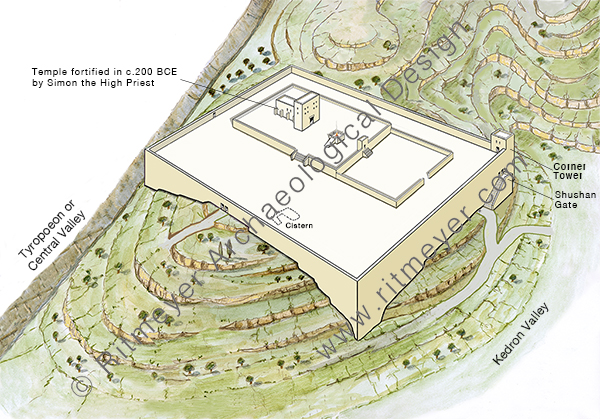
Around the end of the third century BCE, restoration work was carried out on the Temple Mount by the High Priest Simon, son of Onias. According to the apocryphal work of Ben Sira called Ecclesiasticus (50.1–3), the work is described as follows:
“It was the High Priest Simon son of Onias who repaired the Temple during his lifetime and in his day fortified the sanctuary. He laid the foundations of the double height, the high buttresses of the Temple precincts. In his day the water cistern was excavated, a reservoir as huge as the sea.”
It is clear from the text that the bulk of these works consisted of the repair and strengthening of existing structures.
After the death of Alexander the Great in 332 BCE, Judea came under Ptolemaic rule from 301-200 BCE. The Ptolemies were benevolent toward the Jews. Ptolemy Philadelphus II of Egypt (285-246 BCE) commissioned a translation of the Hebrew Bible in c. 250 BCE. A tradition (recorded in the Letter of Aristeas) says that scholars from Jerusalem translated the Torah, the five books of Moses, into Greek for Ptolemy’s library in Alexandria. The term Septuagint derives from the Latin for “seventy” (septuaginta) and refers to the seventy-two translators involved in this work. During the following century, the rest of the Hebrew Bible was translated into Greek, with the entire Greek version retaining this name.
During the 3rd century BCE, many battles took place between the Ptolemies in the south and the Seleucids in the north. In 200 BC, a final battle between the two forces took place in Panion (modern Banias) which was lost by the Ptolemies. The Seleucids then controlled the Holy Land. Whereas the Ptolemies were benevolent rulers, the Seleucids were the very opposite.
The most infamous of the Seleucid rulers, Antiochus Epiphanes (1 Maccabees 1:10; 2 Maccabees 4:7), tried to impose Hellenistic culture on the Jewish people, forbidding worship on the Temple Mount. In 169 BCE, Antiochus Epiphanes went to Jerusalem, where he plundered the Temple and took all the furniture and treasures away to Antioch (1 Maccabees 1:21-23; 2 Maccabees 5:11-20). The altar was defiled by sacrificing a pig, and the Temple was dedicated to Olympian Zeus. The Jews were forbidden to practice their religion, including rituals such as sacrificing and circumcision, the observance of the Sabbath, and were compelled to accept the new pagan rituals. Some renegade Jews, under leadership of Jason the high priest, accepted the new religion.
The next year, in 168 BCE, a strong fortress, the Seleucid Akra, was built to the south of the Temple Mount and east of the Huldah Gates. These were the main gates that were used by people that went up from the Lower City to the Temple. The garrison that was stationed inside the fortress, could easily control access to the Temple Mount, and the Book of Maccabees 1:38 documented that it became an ambush for the sanctuary much resented by the Jews.
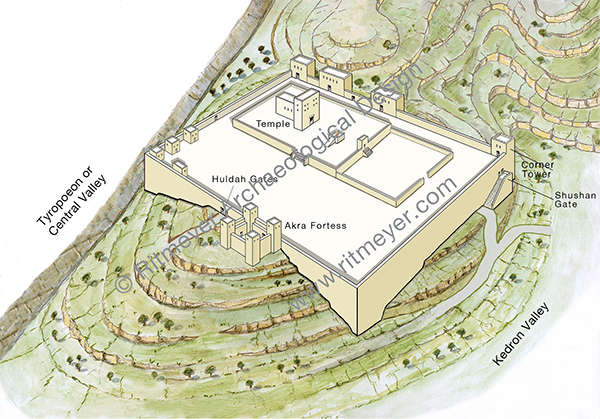
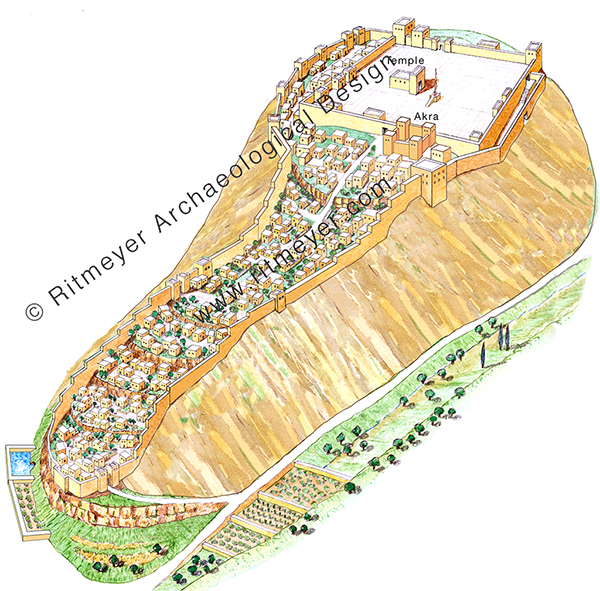
The desecration of the Jerusalem Temple and the construction of the Akra Fortress eventually led to the Maccabean revolt which lasted from 167 to 160 BCE. In 164 BCE, Judas defeated the Seleucid forces at the battle of Bethzur. Five years earlier, the Temple had been defiled by Antiochus IV Epiphanes, but now Judas the Maccabee and his men could go up to Jerusalem to purify and dedicate the sanctuary. When they found the Temple in a shocking state of neglect and its buildings in ruin, they mourned and prayed to God.
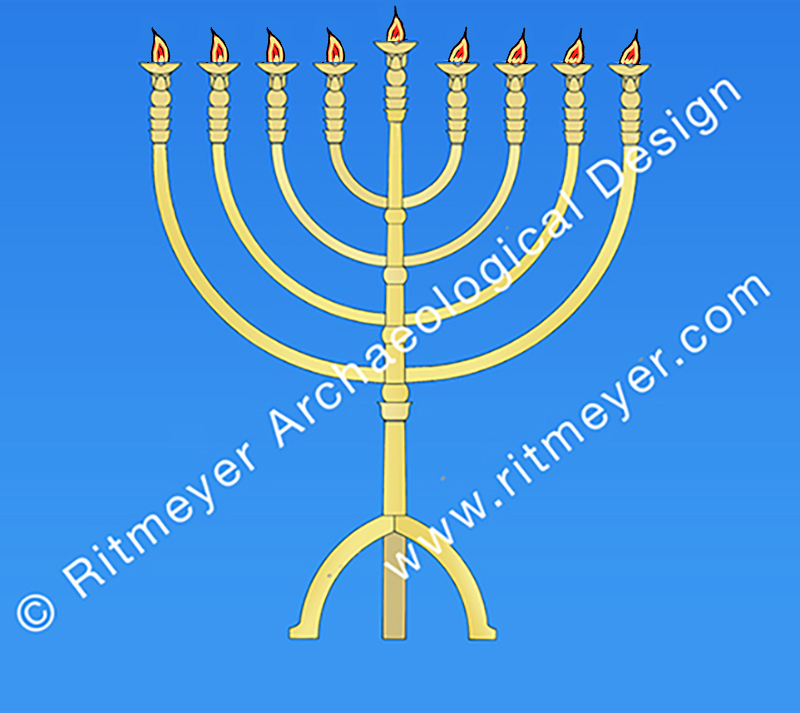
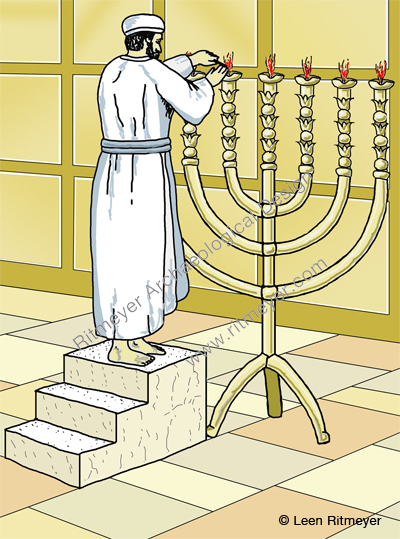
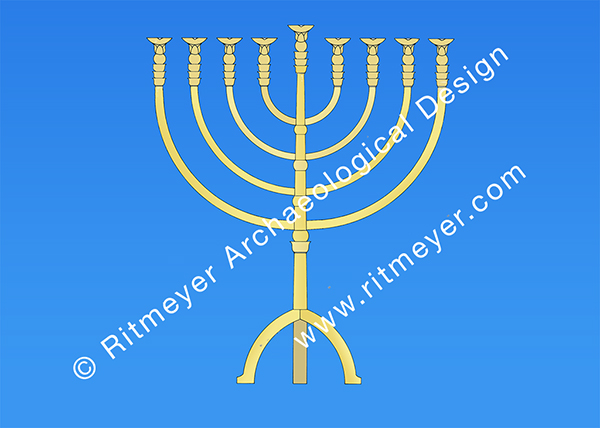
While cleaning the Temple, a small jug with olive oil was found under the seal of the High priest that was used to fill the lamps of the Lampstand (Menorah). There was only oil sufficient for one day, but, miraculously it lasted for eight days. That is where the idea of the Hanukkiah comes from.
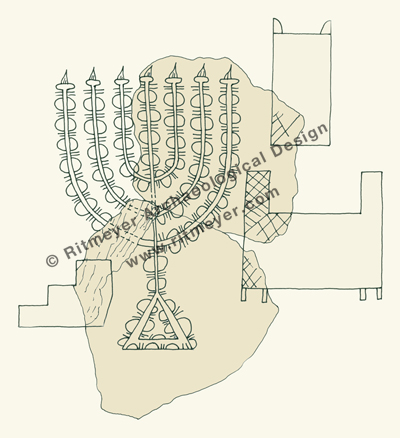
Priests were selected to remove the defiled altar stones which were kept in a special place until they knew what to do with them (1Maccabees 4:45,46). They were eventually placed in a special room in the Chamber of the Hearth in Herod’s Temple.
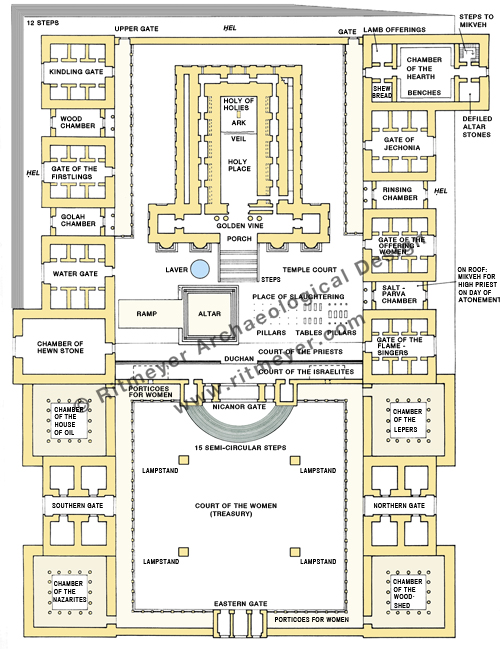
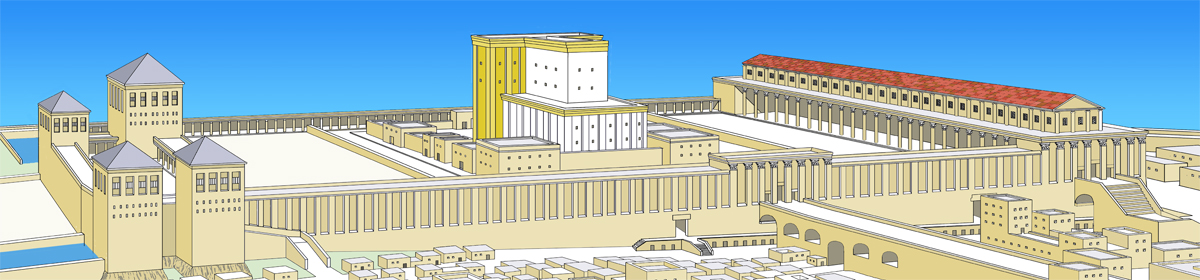
A flight of twelve steps according to Middot 2.3. led up to a terrace known as the Hel, which bordered the Temple on the south and west. The Sanctuary itself consisted of three courts, each higher than the former, and beyond them, the Temple with the Holy and Most Holy Places. One could enter via the Eastern Gate, first into the Court of the Women or Treasury.
From the Court of the Women, men could advance through the Nicanor Gate into the Court of the Israelites and priest were allowed into the Court of the Priests. Three gate buildings were located on both the north and south side of the Temple. The Chamber of the Hearth was in the northwest corner of the Temple Court and the Chamber of Hewn Stone in the southeast. A small chamber in the northeast corner of the Chamber of the Hearth was used to place the altar stones that were defiled by the Seleucids.
A new altar was built from unhewn stones, the Temple was cleaned, new furniture brought in, and the Lampstand was lit. The Temple and altar were dedicated and there was great rejoicing. It was then decided to make a law that the keeping of this feast of dedication (Hanukkah) would be kept every year for eight days (1Maccabees 4:36-61; 2 Maccabees 10:1-8).
The Gospel of John records that Jesus too kept the Feast of Hanukkah (John 10:22). But where on the Temple Mount was Jesus? There are some unique locations in the Land of the Bible where you really get a sense of place. One of these is inside the Eastern Wall of the Temple Mount in Jerusalem. Here the record of Jesus’ visit to the Temple precincts in John 10.22-39 comes to vibrant life. We are told:
And it was the feast of the dedication at Jerusalem: it was winter; and Jesus was walking in the Temple in Solomon’s Porch (John 10:22,23).
Jesus had come to keep Hanukkah, the Feast of Lights. This feast commemorates the dedication of the Temple in 164 BC, after it had been defiled by Antiochus IV Epiphanes, who, three years earlier, had ordered a pig to be sacrificed on the Temple altar.
But why does this place evoke the Gospel story so powerfully? It is surely because this side of the Temple Mount is closest to the original, with minimal additional construction. The Eastern Wall of the Temple Mount was the only one that was not moved by King Herod the Great when he carried out his monumental expansion of the Temple Mount in the first century.
At present there are no porticoes along the Eastern and Southern Walls of the Temple Mount. In the Herodian period, however, there were porticoes on all sides. The eastern stoa pre-dated the others and was already colonnaded in the Hasmonean period. This Porch, or stoa, stood directly over the wall of the earlier square Temple Mount and at the time of Herod the Great, was known as Solomon’s Porch.
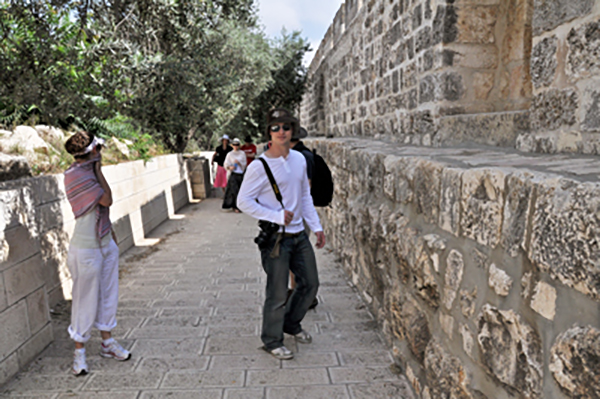
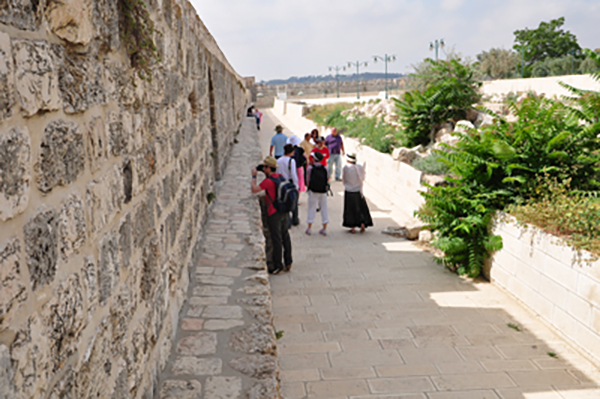
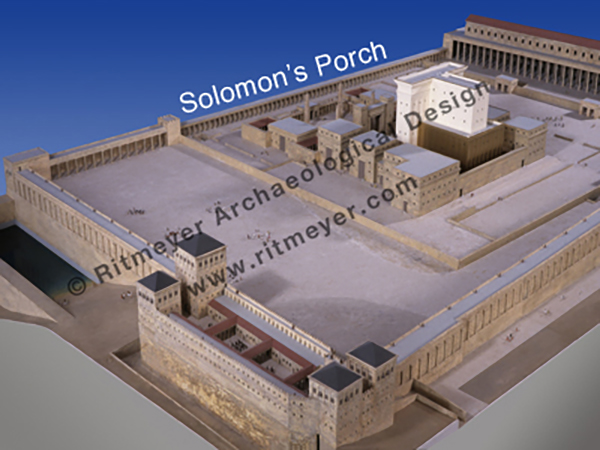
This does not necessarily mean that this porch was built by this famous king, but certainly by Herod’s predecessors. Offering welcome shelter from sun, wind and rain, it was obviously used as a place of congregation. Josephus provides us with an evocative description:
The porticoes, all in double rows, were supported by columns five and twenty cubits high—each a single block of the purest white marble—and ceiled with panels of cedar. The natural magnificence of these columns, their excellent polish and fine adjustment presented a striking spectacle (War 5.190–192).
While Jesus was walking in the Porch of Solomon, the eastern portico of the Temple Mount, he was asked if he was the Messiah. Despite the works that God had given Jesus to do, he was met with unbelief and was almost stoned to death one wintry day during the feast of Hanukkah (John 10.31). Acts 3.11 and 5.12 also provide us with images of the time when the disciples used to congregate and teach here after the death of their master. Peter and James healed the man who was lame at the Beautiful Gate after which he went to Solomon’s Porch.
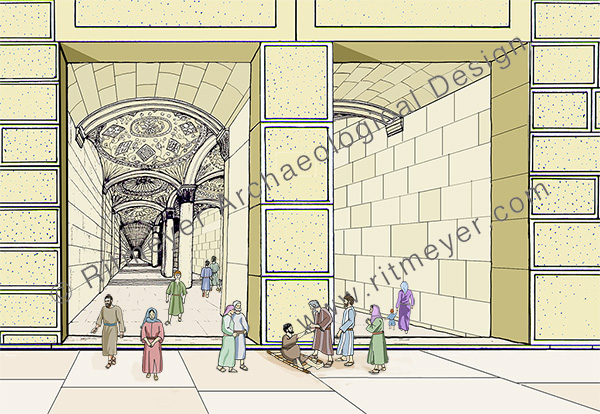
In the reconstruction drawing, people are entering the tunnel on the right side and exiting on the left. The best place for a lame beggar to get the attention of the worshipers would be if he was placed between the two entrances.
Sadly, anti-semitism is still with us today. However, we are waiting for a new heavens and a new earth in which righteousness dwells (2 Peter 3:13). Soon Christmas will be celebrated and we remember that the angel Gabriel said to Mary that her son Jesus shall be great and shall be called the Son of the highest and the Lord God will give him the throne of his father David .. and of his kingdom there shall be no end (Luke 1:32,33).