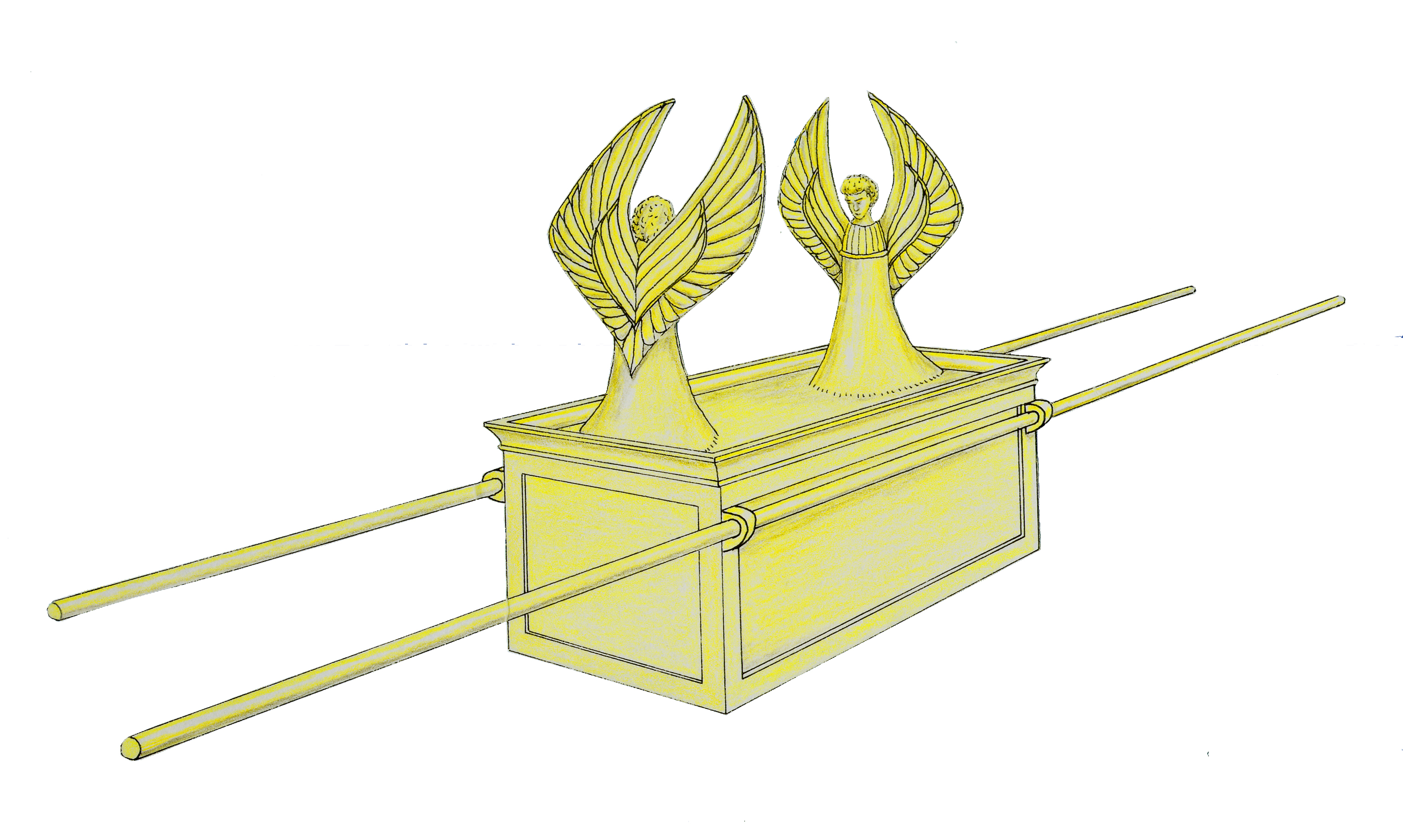
The Ark of the Covenant was undoubtedly the most holy piece of furniture ever made, if it can be referred to as such. It consisted of a rectangular chest made of shittim wood and covered over with gold.
The word Ark, aron in Hebrew, means merely a chest and has been translated as ‘coffin’ in Gen. 50.26. God had commanded Moses to make the Ark of the Covenant (Exodus 25.10-22) and inside it, Moses placed the two tables of the law. Later, Aaron’s rod that budded was placed in it (Numbers 17.10), together with the golden pot that had the manna (Exodus 16.33; Hebrews 9.4).
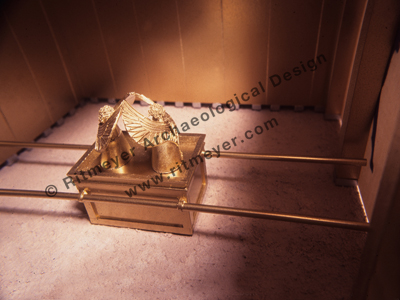
The mercy seat was a kind of lid, which closed the chest from above. It was made of pure gold and was held in place by a golden ridge or crown. Beaten out of this mercy seat were two cherubim, which with their wings overshadowed the mercy seat. They were beaten out of the same piece of pure gold as the mercy seat.
The Ark was made in Sinai by Bezaleel ben Uri, whose name appropriately means, “In the Shadow of El (God), the Son of my Light”. After the Ark of the Covenant was made, it was placed in the Tabernacle. After a long journey it was eventually placed in the Holy of Holies of Solomon’s Temple.
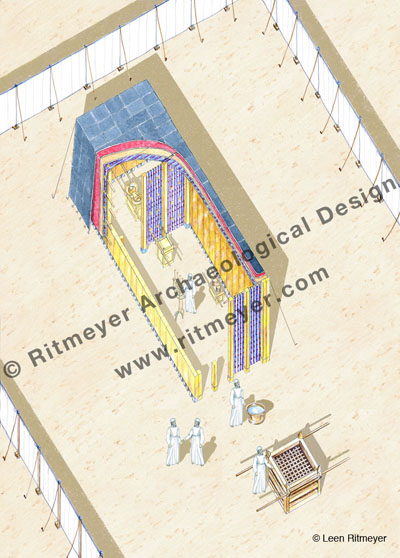
In this drawing, we see the inside of the Tabernacle. Inside the Holy Place was the Lampstand (menorah), the Table of Shewbread and the Altar of Incense. The Ark of the Covenant stood in the Holy of Holies.
The question many people have tried to answer is where the Ark of the Covenant is now. Was the Ark destroyed by the Babylonians or perhaps hidden somewhere. It is almost unthinkable that such an important and unique object which represented the dwelling place of God himself would have been destroyed.
From the Biblical record, it appears that the Ark remained in the Holy of Holies of Solomon’s Temple until the reign of King Manasseh, who set a wooden statue of the Asherah (goddess) which he had made in the Temple (2 Kings 21.7; 2 Chronicles 33.5). During the reign of Josiah, we read that the king commanded the Levites to “Put the holy ark in the house which Solomon the son of David, king of Israel built. It shall no longer be a burden on your shoulders” (2 Chronicles 35.3). This would imply that the Ark had been removed for safe keeping by the Levites, very likely because of the sacrilege of Josiah’s grandfather Manasseh. After Josiah had cleansed the Temple, we hear no more of the Ark. There is no mention of it in the list of Temple treasures carried off to Babylon when the city fell in 586 B.C. (2 Kings 25.13-17). Neither does it appear on the Arch of Titus in Rome, which depicts the triumphant procession of the Romans with the spoils of the Jerusalem Temple following its destruction in 70 A.D.
In recent years, there has been a surge of interest in the location of the Ark of the Covenant. According to the Second Book of Maccabees (2.1-8), Jeremiah hid the Ark on Mount Nebo in Jordan, while many rabbis believe that it is still hidden somewhere under the Temple Mount. This belief is based mainly on 1 Kings 8:8: “And the poles extended so that the ends of the poles could be seen from the holy place, in front of the inner sanctuary; but they could not be seen from outside. So, they are there to this day”. The phrase “to this day” is supposed to be the key indicator that the Ark is still hidden somewhere under the Temple Mount. In 1981, workers of the Religious Affairs Ministry carried out a dig under the Temple Mount in search of the Ark. However, when this caused disturbances among the Arab population, the project was aborted. The Ethiopian Orthodox Church claims that the Ark is kept safe and secure in the Church of Our Lady Mary of Zion in Axum. In the early years of the twentieth century, British Israelites carried out excavations at the Hill of Tara in Ireland, believing that the Ark was brought to Ireland by an Israelite princess. And there are many more suggestions which are difficult to prove.
British Israelites and the Ark of the Covenant
We had our own encounter with one of these supposed hiding places of the Ark of the Covenant. In 1998 Kathleen and I visited the Hill of Tara, an ancient ceremonial site which some claim to have been the seat of the High Kings of Ireland. We were surprised to see that excavation squares had been opened and filled in again on the side of the hill.
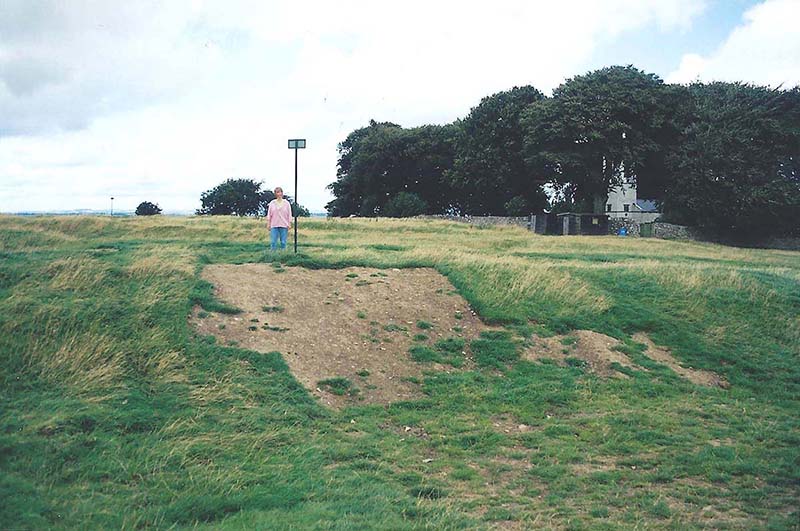
At that time, we were unaware of the connection between British Israelites and the Ark of the Covenant. We found out that between 1899 and 1902, members of the British-Israel Association of London travelled to County Meath, Ireland, in search of the Ark of the Covenant. British Israelites claim that the peoples of the British Isles (including the Anglo-Saxons) are the direct genetic and spiritual descendants of the Ten Lost Tribes of Israel.
These British Israelites believed that the Prophet Jeremiah had fled to Ireland with the daughters of King Zedekiah and that the Ark of the Covenant was buried at the Hill of Tara. They dug up and damaged parts of the historic site but after three years of digging, the Ark of the Covenant remained as elusive as ever.
In the 1955, several notable discoveries were made at Tara, including an undisturbed passage grave. Apparently four historical phases dating from the middle-late Iron Age to 400 A.D. were discovered.
In 1997, some of the excavation squares were reopened and nothing of note was found, apart from an ancient industrial bowl furnace and iron slag to the disappointment of those who view the Hill of Tara as a ritual centre. We weren’t surprised that nothing was found.
These above-mentioned theories, often based on legends, were soon dismissed. This shows that one must develop a methodology to get some indication of where the Ark of the Covenant might be. Unfortunately, there is no further information given in the Tanakh (Old Testament) regarding the location of the Ark after its last mention in 2 Chronicles. 35:3 where Josiah ordered the Levites to put the holy ark back in the Temple. After that the Ark disappeared from history. In this brief text of 2 Chronicles. 35:3, we have information that, combining biblical texts with archaeology and geography, may lift a small corner of the veil that hides its location.
This passage of 2 Chronicles 35.3 may be worth exploring as it contains several clues as to the whereabouts of the Ark. This passage elicits several questions. Firstly, Josiah commanded Levites to carry the Ark of the Covenant which begs the question which group of Levites were they? Secondly, why had the Ark to be carried on the shoulders ? Thirdly, from which hiding place did these Levites bring the Ark back and where did they live? Pondering these questions may be a fruitful avenue to follow. It may not point to the exact location of the Ark, but we may come very close to it.
Firstly, there was one specific Levitical family that had been put in charge of the Ark of the Covenant, namely Elizaphan (Numbers 3:30), also known as Elzaphan (Exodus 6:22). When Nadab and Abihu, the sons of Aaron offered strange incense, they were struck down. Moses then called Elzaphan and his brother Mishael to carry the corpses out of the camp of Israel (Leviticus 10:4,5). Elizaphan became the first leader of the Kohathite clan and was given an important task.
“The leader of the fathers’ house of the families of the Kohathites was Elizaphan the son of Uzziel. Their duty included the ark, the table, the lampstand, the altars, the utensils of the sanctuary with which they ministered, the screen, and all the work relating to them” (Numbers 3:30,31)
So, the first person ever to have been put in charge of the Ark of the Covenant, was called Elizaphan ben Uzziel. His name means “My El (God) has hidden” and he was the son of Uzziel, which means “My Strength is El (God)”. It is a comforting thought that if the Ark still exists and has a future role to play, then it must have been hidden with the knowledge of God himself and that it will be found when it will suit Him best. Nevertheless, we believe that it is important to continue our search.
Secondly, when the Tabernacle had to be transported, wagons were given to the Levites, two wagons and their oxen to the sons of Gershom and four to the sons of Merari. These wagons were used to transport the heavy parts of the tabernacle, such as the pillars, the curtains, the boards, etc. But to the sons of Kohath, Moses gave no wagons as they looked after the holy things of the Tabernacle, such as the Ark, the Table, the Menorah and the Veil, which they were told had to be carried on their shoulders (Numbers 7:2-9). The Kohathite family of Elizaphan continues to be mentioned in the Tanakh. In our next post we will try to find out how far Elizaphan’s family can be traced in the Scriptures.