In 1994 my archaeologist-wife Kathleen and I wrote an article in Biblical Archaeology Review (Nov/Dec 1994) called “Akeldama – Potter’s Field or Priestly Cemetery?” Akaldama is mentioned in the Bible as a burial place for strangers, bought with the money given to Judas to betray Jesus (Acts 1.19). Akeldama means Field of Blood, for Judas, while trying to hang himself, fell down and his body burst open.
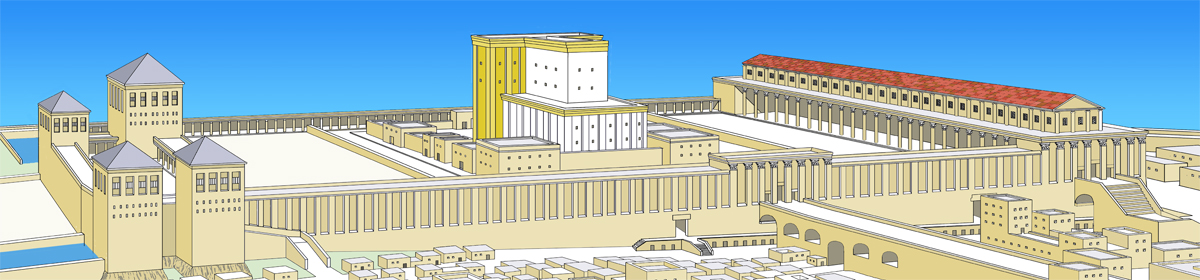
We then suggested that a small, but beautifully decorated tomb in the area below St. Onuphrius Monastery might have belonged to Annas the High Priest, who condemned Jesus to death, for the Temple Mount could be viewed from this tomb and the architectural decoration of the tomb has been copied from the Temple Mount. There are other decorated tombs in this area. Instead of a burial place for strangers, this area was most likely the cemetery of priestly families.
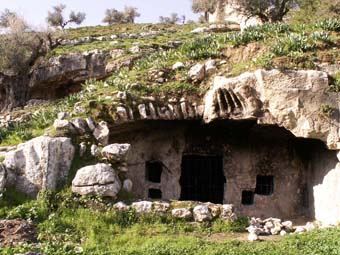
Entrance to the Tomb of Annas the High Priest
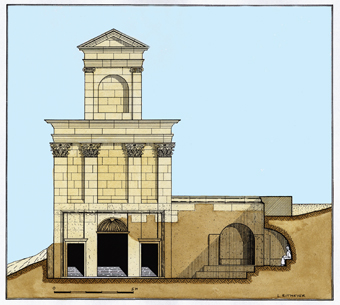
Reconstruction of the Tomb of Annas (© Ritmeyer Archaeological Design)
In June 2000, another tomb was accidentally found, which contained bones and remains of a linen shroud. The tomb is located next to the tomb which we had identified as Tomb of Annas. Carbon-14 dating showed that the shroud dated from the first half of the first century AD. It has been reported that a new analysis has now showed that the man to whom the shroud belonged suffered from leprosy. Leprosy is mentioned in the Bible, but this is the first time that archaeological evidence has proved that it actually existed. Joe Lauer pointed me to an article in the Daily Mail, which has several photographs of the tomb.
It is interesting to note that this shroud doesn’t look at all like the Turin Shroud. The shroud in Jerusalem was made up of several wrappings and there was a separate wrapping for the head. This would, of course, be in harmony with the burial of Jesus, whose body was buried with a separate head cloth (John 20.27).
I am trying to figure out how the priests and Levites refilled the brazen sea and the 10 smaller lavers every night.
1- Edersheim in his book on “The Temple It’s Ministry and Service” in Cpt 11 (my version, p.159)says “the sound of the machinery, as it filled the laver with water, admonished the others to be in readiness.
This machinery had been made by Ben Catin, who also altered the laver so that 12 priests could at the same time perform their ablutions.”
Could there have been a shaft descending down to the cisterns underneath whereby a contraption of ropes and buckets could have hauled water up to the Brazen Sea? Was this the “machinery”?
If not, how were they refilled?
2-
Water to the Temple 10 02 26
Copied
“The Lower Aqueduct”
The “artery” we are dealing with here is the Lower Aqueduct of Jerusalem, which ran for 21.5 km from Solomon’s Pools (765m ASL) to the Temple Mount (735m ASL). In that distance, it dropped a mere 30 meters, for a gradient of 0.14% (1:700+). Put another way, in the length of a football field, the floor of the channel dropped only 14 cm!
The original Lower Aqueduct has now been firmly dated to the Hasmonean period. This is based not only on ceramics and coins related to its construction but also similarities to the water systems of the Hasmonean desert fortresses, including a distinctive type of plaster. Thus, along with one or more of the Solomon’s Pools, it is (in its original form) the oldest part of Jerusalem’s aqueduct system. It is mentioned a number of places in the Talmud, which says that “an aqueduct ran to [the Temple] from Eitam [a spring located near Solomon’s Pools],” and a midrash states that the same aqueduct was destroyed by the sicarii during the Great Revolt.
…
The aqueduct continues around the slopes of Mt. Zion and then beneath (outside) the present-day city walls [PHOTO ▼]. Entering the Old City west of Dung Gate, it proceeds through today’s Jewish Quarter, along the scarp of the Western Hill opposite the Kotel plaza area (where traces have been documented but not preserved).
…
Via the Wilson’s Arch bridge, the Lower Aqueduct led onto the Temple Mount to its ultimate (original) destination, the cisterns beneath the Haram platform
…
Very nearby is the largest of the Temple Mount cisterns, the one the explorers dubbed “The Great Sea.” Accompanying Warren in 1869, the English artist William “Crimea” Simpson sketched this cavernous reservoir by the light of a burning magnesium wire, and later produced this watercolor. (Photo) It is still not known whether (or how) these various cisterns might be connected.
[It appears from the map that the aqueduct did deliver water to the Temple Mount over Wilson’s arch, and into the huge cisterns beneath the Temple, to be hauled to the various locations, such as refilling the Brazen Sea as needed. I speak only as one trying to understand something from a far, both in place and time, which I have never seen. — rar]
Warm regards,
Ray Riley
the quotation is not John 20:27, but John 20:7
thanks!
You’re right! Thanks.
Hi- I just saw this post as I was doing some research on the topic of leprosy in Ancient Jerusalem.
I was wondering if you might be able to expand a little on the topic of leprosy.
Do we know if lepers were quarantined in Jerusalem? Would others have been worried about contamination (moral and physical?) Would they have been imprisoned? If The temple contained a Chamber of the Lepers in the Court of the Women does that imply that lepers would have been allowed to coexist in normal society?
According to the articles, evidence suggested that the remains of the man (first known case of leprosy) belong to a man who was probably affluent. Would this have affected the response to his leprosy.
Any help would be useful. Not much seems to be written on this topic.
Thanks so much!!
Rosie,
The Chamber of the Lepers was for lepers who have been healed. They stayed there for one week after which they are examined. If healed, then they could return to society.