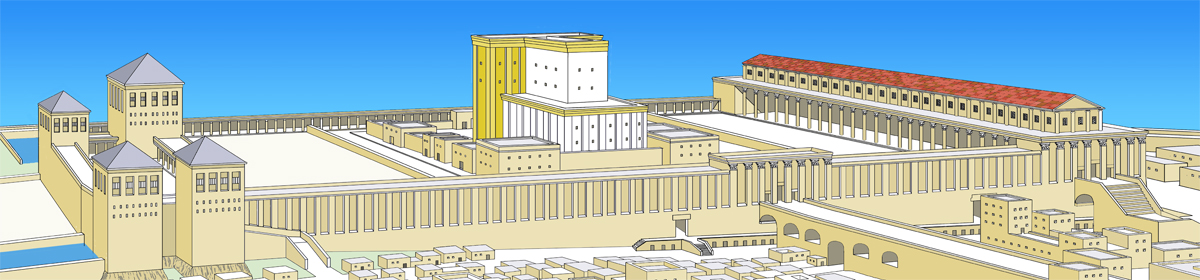
Building the Second Temple

Zeev Lewy published an interesting article about the use of stone from Solomon’s Quarries during the building of Herod’s Temple. These underground quarries are located near the Damascus Gate in Jerusalem. At the conclusion of his article he wrote:

Subsurface quarrying of building stones in biblical times which formed the Zedekiah Cave in Jerusalem while numerous quarries operated nearby on the ground is explained by geological criteria and religious aspects which also date the opening of the cave as a quarry. The peculiar qualities of this rock type in subsurface facilitated its rapid quarrying in blocks of different sizes and shapes for the grandiose construction of the Second Temple by King Herod. These could be fitted to each other on the Temple Mount without using metal tools according to the religious restrictions. The combined experience of Jewish quarrymen and Roman engineers enabled them to keep the religious spirit in this holy mission and complete the monumental construction of the Second Temple in a short time (Lewy, 2005).

Several quarries have been found in the last few years, but they were all surface quarries. There are many references in the Bible to stones and stone cutting, e.g. 1 Kings 5.17, Matthew 21.42 and 1 Peter 2.5. The mountains around Jerusalem are composed of limestone that has a characteristic layering. To quarry this limestone, the face of the stone first had to be straightened.

Surface quarrying. © Leen Ritmeyer

In the picture, we see the stonecutter on the right cutting 4-inch wide channels on all sides of the rock except the bottom. Another worker pours water over dry wooden logs that have been jammed into the channels. The water causes the wood to swell and the lateral pressure on the stone block makes it split away from the rock. Because the limestone lies in natural horizontal layers, the blocks would split along relatively clean horizontal lines.

HT: Bible and Interpretation

Jewish Book Week in London

Beginning next Saturday, February 26th and lasting for 9 days, the JBW2011 has a sparkling programme. There are two talks that I would love to attend:

Jerusalem, the Biography, by Simon Sebag Montefiore (the great-great nephew of the founder of modern Jerusalem), giving a taster of his new book.

Blackwell’s review of the book reads as follows:

Jerusalem lies at the centre of the world, the capital of three faiths, the prize of many conquerors, the jewel of many empires, and the eye of the storm of today’s battle of civilisations.

But the city lacks a biography. It lacks a secret history. Simon Sebag Montefiore’s epic account is seen through kings, conquerors, emperors and soldiers; Muslims, Jews, Christians, Macedonians, Romans and Greeks; Palestinians and Israelis; from King David via Nebuchadnezzar, Alexander the Great, Herod, Caesar, Cleopatra, Jesus and Saladin, to Churchill, King Hussein, Anwar Sadat and Ariel Sharon. Their individual stories combine to form the biography of a city – a gritty, dramatic, violent tale of power, empire, love, vanity, luxury and death, bringing three thousand years of history vividly to life.

In the course of its history, Jerusalem has been destroyed twice, besieged 23 times, attacked 52 times, and captured and recaptured 44 times. It has been Arab, Persian, Jewish, Roman, Greek, Babylonian, Turkish, Mameluke, British, Byzantine, Crusader, Ottoman; Napoleon almost took it but marched past, Kaiser William visited, the Allied forces fought for it in the First World War. The extraordinarily rich history of this small city in the Judean hills forms nothing less than a history of the world.

The epic story of Jerusalem told through the lives of the men and women who created, ruled and inhabited it.

and:

• Fifty Year Reflections of a Jewish Historian, by Martin Gilbert

Martin Gilbert

The JBW website describes his much anticipated lecture as follows:

With consummate skill, patience and brilliance in equal measure, Martin Gilbert has recounted most of the major events of the 20th century. His work encompasses both world wars; the definitive set of Churchill biographies; chronicles of the Jewish people; and accounts of their adversaries and saviours. He has also created 12 pioneering historical atlases on everything from Russian history to the Arab-Israel conflict. We are delighted that Martin Gilbert will share with us some of his most historic discoveries over a lifetime of outstanding scholarship, culminating in his latest work: In Ishmael’s House: A History of Jews.

The full programme is here

Our youngest son Joel will be filming the event.

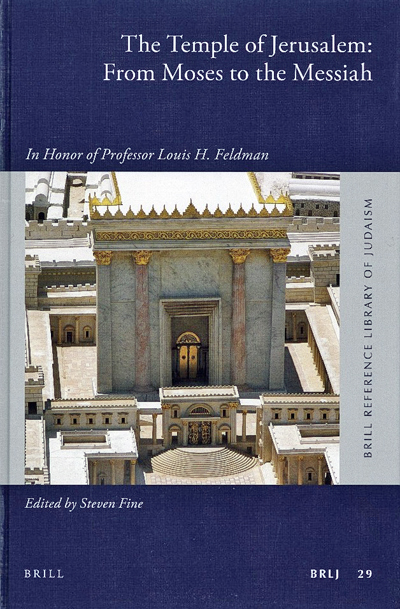
Volume on The Temple in Jerusalem in honour of Prof. Louis Feldman now out

The Temple of Jerusalem: From Moses to the Messiah: Studies in Honor of Professor Louis H. Feldman (Brill Reference Library of Judaism) [Hardcover]

On the weekend of May 11 – 12, 2008, I attended a conference at the Yeshiva University, New York, on The Temple of Jerusalem: From Moses to the Messiah. This conference was in honour of Prof. Louis Feldman, who I knew as a contributing translator of the Loeb translation of Josephus, which I use constantly. In Yeshiva University, he is revered as a brilliant scholar and mentor of generations of students – he has taught there for the last 56 years.

This conference was the inaugural gathering of the university’s Center for Israel Studies , which: “nurtures excellence in interdisciplinary scholarship and the teaching of Israel throughout history and across disciplines, with a keen focus upon the longue durée and the modern state.” Professor Steven Fine, director of the centre, organised a stimulating Programme of Lectures around an exhibition of models of the Tabernacle, Solomon’s Temple, Herod’s Temple and Herod’s Temple Mount. I was commissioned to design these models by the late Ben Adelman of Silver Spring, M.D. Mr Adelman’s estate bequeathed the models to the Yeshiva University. You can read my blog where I record the highlights of the conference here.

Last Friday, the postman brought a new book for our shelf, the volume which documents the conference – a welcome addition to our Temple section! The publisher’s blurb is as follows:

“The Temple of Jerusalem: From Moses to the Messiah brings together an interdisciplinary and broad-ranging international community of scholars to discuss aspects of the history and continued life of the Jerusalem Temple in Western culture, from biblical times to the present.”

Subjects covered in the essays range from: The Tabernacle at Sinai to the Temple Scroll, my own essay on the process of model making, the Temple in late Medieval Spanish Altarpieces, and Archaeology and the Arab-Israeli conflict.

Of particular interest to me because of my background are the essays:

“See, I Have Called by the Renowned Name of Bezalel, Son of Uri …”: Josephus’ Portrayal of the Biblical “Architect” …      by Steven Fine, Yeshiva University

“Notes on the Virtual Reconstruction of the Herodian Period Temple and Courtyards” by Joshua Schwartz and Yehoshua Peleg, Bar-Ilan University

“Some Trends in Temple Studies from the Renaissance to the Enlightenment” by Matt Goldish, The Ohio State University (a masterful survey of this compelling subject)

“Avi-Yonah’s Model of Second Temple Jerusalem and the Development of Israeli Visual Culture” by Maya Balakirsky Katz, Touro College

“Jerusalem during the First and Second Temple Periods: Recent Excavations and Discoveries on and near the Temple Mount” by Ann Killebrew

Steven Fine is to be congratulated on the production of this most useful volume. The involvement of Yeshiva University students in the editing process and bringing the book to production is especially commendable.

Did digging on the Temple Mount Erase Traces of the Jewish Altar?

Gil Ronen of Israel National News (Arutz 7) published this report about renovation work being carried out at the Dome of the Chain:

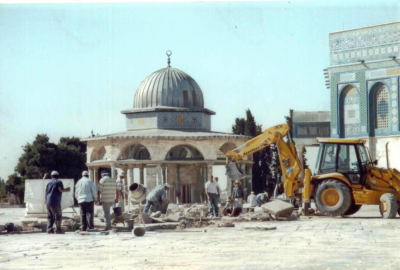
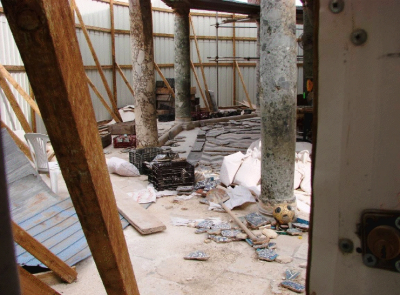
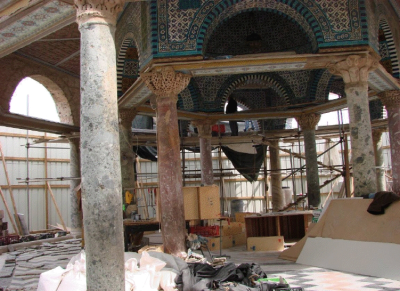
Muslim religious authorities are concluding a clandestine eight-month dig on the Temple Mount that is intended to erase traces of the Jewish Temple’s Altar, Temple activists charge.

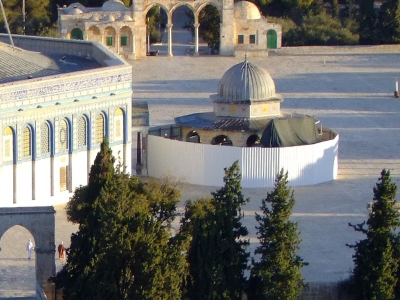
The digs have been taking place under the Dome of the Chain, believed to have been built over 1300 years ago. For eight months, the dome – which has a diameter of 14 meters – has been surrounded by a metal fence and black cloth, which hide whatever activity has been going on there from outside inspection. The Muslim Waqf religious authority has claimed the activity is simply a refurbishing of the structure, but refuses adamantly to let Jews or tourists near.
Jewish activists made various attempts to enter the Dome, but met with no success. In the end, the Our Temple Mount news outlet found an Arab who was willing to take photos inside the compound in return for a handsome fee (see below). The man said that it appears the Waqf has already completed its digs and is now covering the dig with dirt.
Our Temple Mount notes that according to Jewish tradition, the place where the Dome of the Chain is located is the spot upon which the sacrificial Altar stood in Temple times. Temple activists said that the Muslim digs are intended to erase the Jewish connection to the Temple Mount.

Jewish activists paid an Arab to take these photos of illegal digging on the supposed site of the Jewish Temple Altar:

A bulldozer ripping up pavement on the Temple Mount
The screen around the Dome of the Chain.
View of work carried out inside of the Dome of the Chain.
Another view of work carried out inside of the Dome of the Chain.

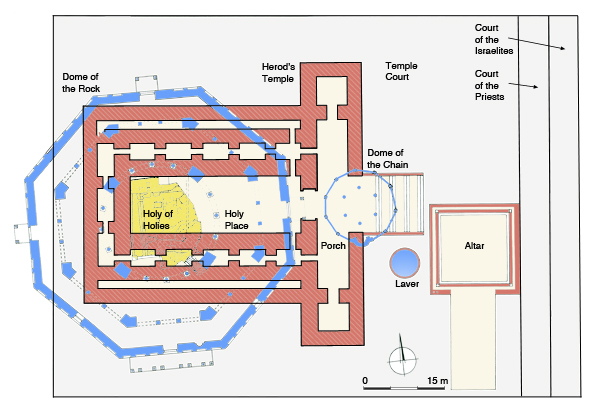
Although it is deplorable that this much needed renovation work was done without archaeological supervision, no digging to any depth appears to have been carried out, as the paving of the Dome of the Chain appears to be still intact. If the doubtful aim was “to Erase Traces of Jewish Altar”, then the work wouldn’t have succeeded in any case, as the altar stood to the southeast of the Dome of the Chain. If  The Rock inside the Dome of the Rock is the location of the Holy of Holies, then according to my plan of the Herodian Temple Mount, the Dome of the Chain stands where once the Porch of the Temple was located.

This plan shows the Dome of the Rock and the Dome of the Chain (blue) superimposed on the plan of the Herodian Temple and its Porch (red). As can be seen from the plan, the Altar stood to the southeast of the Dome of the Chain. © Leen Ritmeyer

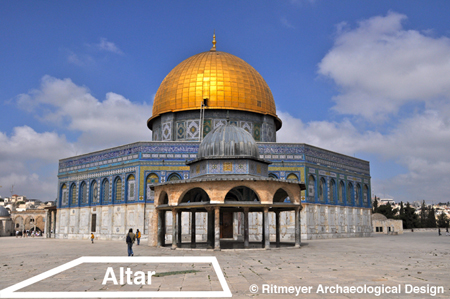
In a previous post, I published this photograph of the Dome of the Chain with the location of the Altar outlined in white:

The location of the Altar in relation to the Dome of the Chain and the Dome of the Rock, looking west. © Leen Ritmeyer

HT: Joe Lauer

Tunnel-vision politics in Jerusalem (cont.)

Tom Powers, a well-known Jerusalem based tour guide, commented on my previous post:

This is very helpful for understanding the vaulted vs. slabbed sections of the drain channel, which I had not grasped before (the latter is what is seen in the now-open section in Silwan). So, it seems the Herodian vaulted section is relatively short — a “bypass” around the SW corner of the Temple Mount — and that most of the length of the drain is actually Hasmonean, yes?

I though that my reply may be interesting to others as well.

That’s right, Tom. The Hasmonean section continued to the south, but also to the north of the Herodian “by-pass”. There is, however, another more ancient drain some 20 meters to the east of the present southwest corner of the Temple Mount. On the map below I plotted the two drains together with the respective southwest corners of three phases in the development of the Temple Mount.

Plan of the drains at the southwest corner, as discovered by Warren, and their relationship to the square Temple Mount and the subsequent extensions. From: The Quest, Revealing the Temple Mount in Jerusalem, p. 234.

The early (possibly First Temple period) eastern drain follows the Tyropoeon Valley and passes the southwest corner of the square Temple Mount (yellow) to the west. This drain appears to be contemporary with the square Temple Mount, which dates from the time of Hezekiah.

The southwest corner of the Hasmonean extension of the Temple Mount (orange) cut this early drain and a new drain with flat covering stones was constructed to the west of this corner. We need to remember that drains usually ran below streets and therefore these drains are important indicators of the city plan in the different periods.

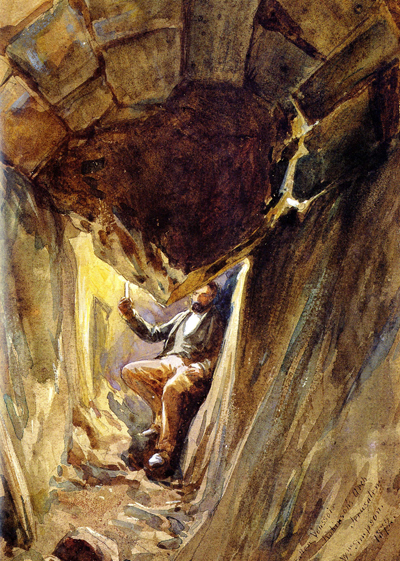
The Herodian southwest corner (green) cut this Hasmonean drain and a vaulted “by-pass” was created to connect the two severed sections of the Hasmonean drain. This by-pass was constructed while Robinson’s Arch was built, for two arch stones fell on the open drain and were left there by the builders.

One of the two fallen stones, discovered by Warren, which was left where it fell during the construction of Robinson's Arch and was incorporated in the vaulted roof. Painting by William Simpson in 1872.

The vaults were built up against and slightly over the arch stones, which were then covered up quickly, I suppose, before the inspectors discovered what had happened!

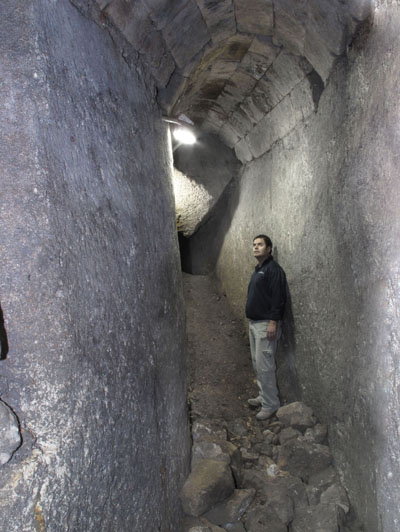
The Herodian drain during the recent clearing operations. Picture: Israel Antiquities Authority.

Here is a modern picture with the same fallen arch stone in the background.

Tunnel-vision politics in Jerusalem

On my return from Jordan, I found that it was and still is widely reported that an underground tunnel has been opened in Jerusalem and, as expected, some outrageous Palestinian comments made about the supposed danger to the Temple Mount, such as these:

The tunnel leading from the City of David in Silwan to beneath the walls of Jerusalem’s Old City, excavated by the Israel Antiquities Authority and announced to media fanfare Sunday, is drawing fire from Palestinians who claim it will damage the Temple Mount.

Fatah Revolutionary Council member Dimitri Diliani accused the Jerusalem municipality of Judaizing East Jerusalem and said the digging constituted a “direct danger to al-Aqsa.”

The tunnel in question was first discovered by Charles Warren in the 1870’s, recorded by subsequent excavators such as Bliss and Dickie, Johns and Kathleen Kenyon. A large section below Robinson’s Arch was cleared during Benjamin Mazar’s excavations in the 1970’s. Not only did Warren publish a plan of the tunnel, but in the 1970’s the Irish architect David Sheehan together with my late sister Martha made a detailed survey of the tunnel. The tunnel was constructed as a drain below the street that ran above it.

This plan is based on Warren’s drawing and is published in my book The Quest, p. 56:

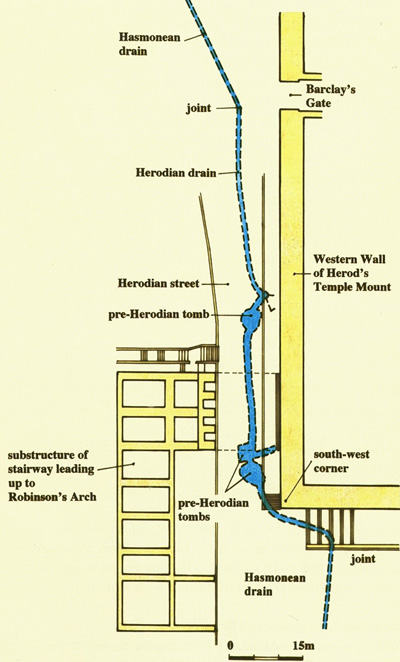
Plan of the drain, shown in blue, at the southwest corner of the Temple Mount as discovered by Charles Warren. This plan makes it clear that the drain-tunnel skirts the Temple Mount and poses no danger to it.

There are two distinct phases to be discerned in the tunnel. The older sections to the north and to the south on the plan are roofed with flat slabs, while the central section has a vaulted roof. The flat roofed sections used to belong to one and the same Pre-Herodian, possibly Hasmonean period, while the vaulted section is Herodian.

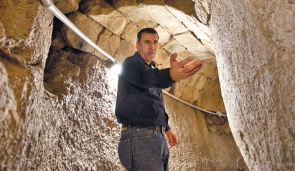
This picture shows the vaulted Herodian section of the drain below Robinson's Arch. Photo: Tomer Appelbaum

It is clear from the above plan that the construction of the Herodian southwest corner of the Temple Mount cut the earlier drain and a detour was constructed going round this corner, using short sections of vaulting, to reconnect the drain again. This Herodian section also cut through some First Temple period tombs:

A First Temple period tomb, cut through by the Herodian drain. Photo: Marc Israel Sellem

Even Israeli commentators don’t get the purpose of this tunnel right. According to this report:

Visitors are now able to walk from the center of Silwan to the Western Wall plaza within several minutes, via a shaft that researchers believe was used for drawing water from the tunnel. The shaft is in the area of the Davidson Archaeological Park and Center, between the southern wall of the Temple Mount and the Dung Gate, and when the work is completed it will serve as the entrance to the tunnel.

The purpose of this tunnel was not to supply water, but to drain away rainwater that fell on the street and to drain off the sewage of adjacent buildings into the drain:

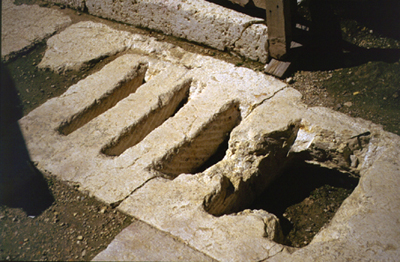
Manhole with five slots in the Herodian street, leading rain water into the drain below. Photo: Leen Ritmeyer

During the Mazar excavations, this tunnel was visited many times by staff and volunteers alike. It is great to hear that the full length of this drain has been opened all the way down to the Siloam Pool. It will be exciting to walk again through this tunnel, but while doing so, one should also remember that in 70 AD many Jerusalemites tried to escape through this same tunnel, but were cruelly killed by the Romans when they were discovered.

“Small Kotel” near the Temple Mount in Jerusalem opened for Jewish prayer

It was reported a few days ago that renovation work was taking place at the Kotel haKatan (the Small Wall) in preparation for opening the small courtyard for Jewish prayer. Today, Haaretz reports that the site has been opened.

Here is a description of the site:

The Kotel Ha-Katan is a small portion of the Western Wall of the Temple Mount, which is exposed (with no houses covering it).  It is located approximately 200 meters north of the Western Wall Plaza, and next to Sha’ar Ha-Barzel (the Iron Gate).  The Kotel Ha-Katan is close to the middle point of the Western Wall of the Temple Mount, and it is the place second closest to the Holy of Holies (outside of the Temple Mount) where Jews can pray.  The closest location is within the Kotel Tunnels, and is exactly facing the Holy of Holies.

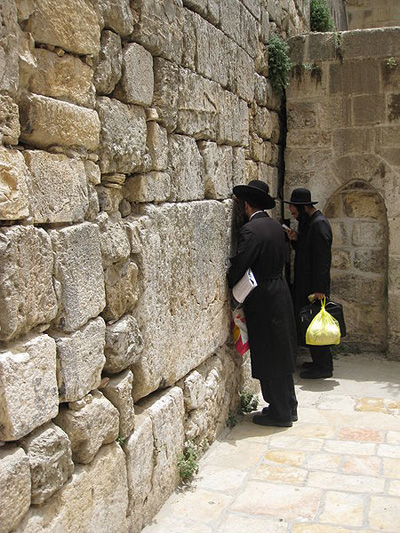
Orthodox Jews praying at the Kotel haKatan - photo Dror Avi

The wall shown in the picture is certainly part of the Western Wall, but the large stones are not Herodian. The Western Wall tunnel runs below this plaza and there Herodian stones can be seen. In most places along the Temple Mount walls these Umayyad (Early Muslim period) stones are visible above the Herodian masonry, see this previous post. They were placed there in the beginning of the eighth century AD, after the El Aqsa mosque and the Dome of the Rock were built. During that time the destroyed Herodian walls were repaired with large stone blocks, which lack the typical Herodian margins. These stones were often reused ashlars taken from large Byzantine churches nearby, such as the Nea Church.

It is ironic to see that Haaretz is worried about a strong reaction from the Waqf (the Muslim religious trust), while the praying Jews are apparently oblivious to the fact that they are touching stones laid by Muslims, which may have been taken from a destroyed Christian church, in order to repair the ancient Jewish Temple Mount walls.

Oleg Grabar

Yesterday, 8 January, 2011, Oleg Grabar, Professor Emeritus in the School of Historical Studies at Princeton University, passed away.

Oleg Grabar’s research has had a profound and far-reaching influence on the study of Islamic art and architecture. His extensive archaeological expeditions and research trips cover the vast expanse of the Islamic world in Africa, the Middle East, and Muslim Asia.

Interior view of the Dome of the Rock - photo © Saïd Nuseibeh, The Shape of the Holy, p. 75.

His book, The Shape of the Holy: Early Islamic Jerusalem (1996), details the role of Islam in defining the “look” of Jerusalem that remained largely intact until the twentieth century. A great part of the book is taken up with a description of the beautiful mosaics of the Dome of the Rock, complemented by a set of splendid photographs.

A brief overview of his career can be viewed here.

Source: Jack Sasson

Herod’s Palace as a Cultural Center

Having returned from Canada, where we gave a series of lectures on places mentioned in the Gospels, we bring this news item to your attention.

A former prison, locally known as the Kishle, that was built over the ruins of Herod’s Palace in Jerusalem, will soon feature a concert as “one of many performances and exhibits that the Tower of David Museum plans to hold in the Ottoman compound, once it turns it into a hall that it seeks to open to the public by June”.

The new hall will host summertime cultural events that are part of the Jerusalem Season of Culture, sponsored by the Schusterman Foundation, with temporary platforms to be built over the ongoing archaeological excavations. In the future, the Tower of David Museum, which had 300,000 visitors in 2010, plans to use the Kishle compound to house temporary exhibits and shows while allowing visitors to take a look at the archaeological finds beneath their feet.

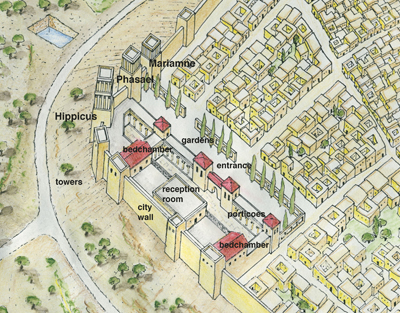
Herod's palace stood at the northwest corner of the First Wall, which was fortified by the Towers of Hippicus, Phasael and Mariamne. Only the remians of the Hippicus Tower have been found.

The Tower of David Museum, which is housed in the Citadel, is an excellent place to visit as one can trace the history of Jerusalem through well-designed exhibits. The remains of the massive Hippicus Tower can still be seen today near the Jaffa Gate.

This is a reconstruction drawing of the First Wall near Herod's Palace with the towers discovered inside the courtyard of the Citadel, which is shown in light color. In the foreground are the original Hasmonean Southern and Middle Towers which Herod strengthened. The Hippicus Tower stands at the north-west corner of the First Wall.

Building Solomon’s Temple

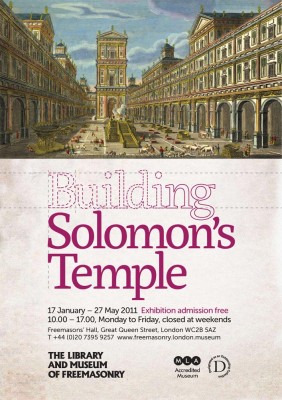
An exhibition “Building Solomon’s Temple” will be held from January 17 – May 27, 2011, in The Library and Museum of Freemasonry, Freemasons’ Hall, 60 Great Queen Street, London WC2B 5AZ, UK. Hopefully the snow will have disappeared by then.

For more than 200 years, the concept of Solomon’s Temple in Jerusalem had been central to organised freemasonry and had influenced its symbolism, architecture and ceremonies. Biblical scholars and early freemasons had only been able to use the few biblical references to construct their images of the Temple on paper and later on ceramics, textiles and glass. Napoleon’s expedition to Egypt reawakened interest in the Middle East.

The formation of an English lodge in Jerusalem was the result of the opening up of the area to archaeology and tourism from the middle of the nineteenth century in which many freemasons were involved. Freemasons such as the American Rob Morris and Sir Charles Warren journeyed to Jerusalem on archaeological excavations and wrote about their visits. The recovery of archaeological remains and the development of tourism enabled them to bring back tangible fragments to furnish English lodge rooms and reinforce the imaginary Masonic temple.

During his work in Jerusalem, Charles Warren discovered an underground hall near Wilson’s Arch, which he called the “Masonic Hall”. In his book Recovery of Jerusalem, p.87, Warren writes:

This chamber acquired the name of the Masonic Hall from some circumstances connected with its discovery.

This is a reconstruction drawing of the Masonic Hall that was discovered by Charles Warren. The remains on which the drawing is based form part of a complex system of vaults lying to the west of Wilson's Arch beneath the present-day Street of the Chain.

It is not difficult to imagine what these circumstances were. The above-mentioned Dr. Robert Morris was Past Grand Master of the Grand Lodge of Kentucky, who, on the 13th of May, 1868, during a freemason’s convention in Jerusalem directed a Secret Monitor Ceremony in the Cave of Zedekiah, popularly known as King Solomon’s Quarries, deep under the walls of the old city of Jerusalem. This ceremony took place at the time when Warren had just discovered this underground hall. Being a freemason himself, Warren called this building the Masonic Hall in honor of the ceremony.

The building has been identified as the Council Chamber, mentioned by Josephus in his description of the First Wall (War 5.142-144). It was one of the buildings where the Sanhedrin met.