Will the walls of the Old City of Jerusalem indeed be breached for first time in a century?

Haaretz has the following report about another planned underground tunnel in the Jewish Quarter of the Old City in Jerusalem:

A wide-ranging plan for renovation of parts of the Old City of Jerusalem envisions a new gate being broken in the city walls for the first time in 112 years.

The plan, prepared by architect David Shriki as part of a greater plan for renovation of the Western Wall area drawn up by architect Gavriel Kertesz, was presented Tuesday to the municipal Planning and Building Committee and aims to renovate the Jewish Quarter and in particular ease access to the Western Wall Plaza.

The new gate will be an entry to a tunnel that would be hewn through the rock under all the layers of the city, beginning between Zion Gate and Dung Gate, leading to a four-story parking garage under the current parking lot not far from the Western Wall. The planners said both tunnel and garage will be hewn in rock deep beneath the city, leaving its numerous archaeological layers intact.

The last time a new opening was breached in the city walls was in 1898, when Ottoman authorities destroyed part of the wall near Jaffa Gate. The purpose was to allow the passage of the imperial carriage of Germany’s Kaiser Wilhelm II, who was then visiting the city.

This time, the plan is meant to accommodate the tens of thousands of visitors to the Western Wall, as well as residents of the Jewish Quarter. The parking garage would hold 600 cars, planners said.

The main technical obstacle to the plan is its high cost, raised by the need to cut through solid rock, estimated at hundreds of millions shekels. Some of the budget is meant to come from using the current outdoor parking lot for construction. Both this aspect of the plan and the proposed tunnel and garage have drawn protests from both Muslim religious figures and residents of the Jewish Quarter.

The planning committee did not vote on the plan and will continue discussing it over the coming week.

This plan would certainly reduce the congestion in this area. The report, however, contains several inaccuracies. First of all, the wall near the Jaffa Gate was not breached in 1898. Kaiser Wilhelm II wanted to enter the Old City riding on his white horse and to make that possible, only the moat between the Jaffa Gate and the Citadel was filled in.

Kaiser Wilhelm enters the Old City of Jerusalem on his white horse in 1898

By contrast the much humbler General Allenby entered the city on foot in 1917.
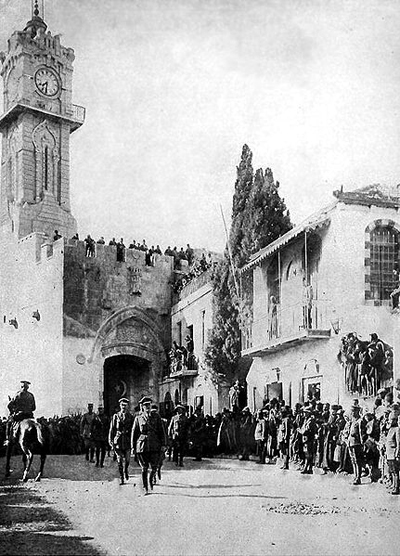
General Allenby enters the Old City of Jerusalem on foot in 1917

Secondly, if this tunnel is to be cut through solid rock “under all the layers of the city”, then it must go below the Turkish city walls as well, which would therefore not be breached. It is to be hoped that the planners know where the top of the rock layers are located, for the preserved remains of the entrance to the Byzantine Nea Church are buried some 3-4 m. below the present parking lot.

Source: Joe Lauer
New plans for expanding the Western Wall Plaza near the Temple Mount in Jerusalem

In a previous report we wrote about plans to construct an underground elevator to make the western access to the Western Wall Plaza easier for the disabled. Now a different and much larger tunnel is planned to access the Western Wall Plaza from the south. See this report in Haaretz. The new plan also provides for a larger prayer area for women:

The Jerusalem Planning and Building Committee will meet today (October 4th, 2010) to discuss a master plan for expanding the Western Wall Plaza.
The program, still in its initial phase of planning, has already provoked an outcry among opponents, including Islamic groups, women’s rights groups and denizens of the Old City’s Jewish Quarter.
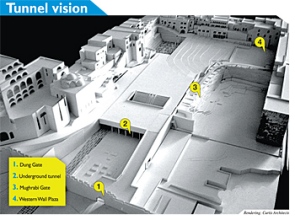
The plan – prepared by the Western Wall Foundation in conjunction with the Jerusalem municipality and Jerusalem Development Authority – includes the construction of a new underground passageway that would become the main entryway to the plaza.

Planned access to the Western Wall Plaza.
1. Dung Gate. 2. Proposed underground tunnel. 3. Present access path to the Temple Mount. 4. Western Wall Plaza.

The Western Wall receives 8 million visitors a year, and by 2025, that number is expected to nearly double.
Excavating the area is complicated by the fact that the plaza was never initially planned. Its appearance today is the result of the hasty demolition of the Moroccan Quarter, the neighborhood that once existed adjacent to the wall, in the immediate aftermath of the 1967 Six-Day War.
The cornerstone of the plan, which has been prepared by the architect Gavriel Kertesz, is to replace the current entryway to the plaza, via the Dung Gate, in favor of a wide underground corridor.
The tunnel will feature a large entry terminal where security personnel will examine visitors. Once inside, visitors will climb stairs or a ramp, or take an elevator, to the plaza itself.
Archaeological finds will line the corridor’s walls, giving visitors a sense of the area’s thousands of years of history.

As usual, a Muslim outcry is expected, but for archaeologists it would be a golden opportunity to learn more about the history of this fascinating area.

HT: Joe Lauer

Queen Helena of Adiabene and the Temple Mount

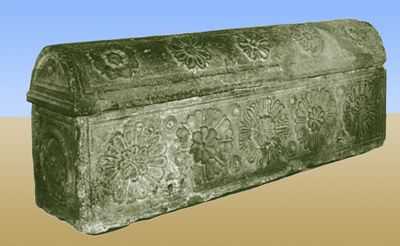
The sarcophagus of Queen Helena of Adiabene is now on display at the Israel Museum.

The Sarcophagus of Queen Helena of Adiabene

This sarcophagus and others had been removed in the 15th century AD from the so-called Tombs of the Kings in Jerusalem. In fact, this tomb complex should have been called the Tomb of the Queen, as it has been identified by her name on the above-mentioned sarcophagus. After removal, these sarcophagi were used as watering troughs on and near the Temple Mount.

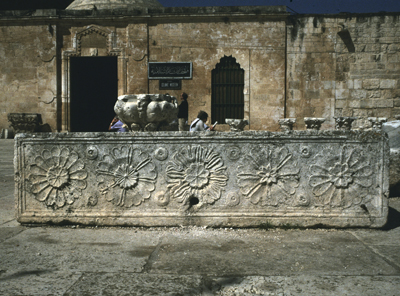
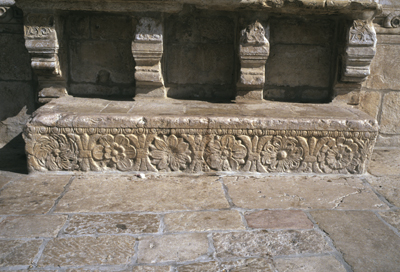
In 1866, the sarcophagus of Queen Helena was taken away and given to the French explorer Louis Felicien de Saulcy, who shipped it to France. Two of these sarcophagi remain on the Temple Mount, one in front of the Islamic Museum and the other at the foot of the Qayit Bay Fountain.

Herodian Sarcophagus at the Islamic Museum on the Temple Mount - Photo: Leen Ritmeyer
Herodian Sarcophagus at the foot of the Qayit Bay Fountain on the Temple Mount - Photo: Leen Ritmeyer

What interests me in these sarcophagi is their decorations. They all display rosettes, resembling flowers. These motifs are well known from the Temple Mount Excavations, where many such fragments were found. None of these fragments were large enough to inform us reliably as to the style of Temple Mount decoration. In order to make reconstruction drawings, we had to turn to the funerary monuments and sarcophagi of the Second Temple period which reflected the architecture on the mount itself.
The variation in motifs was amazing. For instance none of the rosettes on the sarcophagi and tomb friezes was the same as the next. The sarcophagus of this Mesopotamian queen with its arrangements of rosettes resembling a frieze is invaluable as an indication of the splendour and beautiful architecture of Herod’s Temple and the buildings of the Temple Mount.

Recommended: Historic Views of the Holy Land – The American Colony and Eric Matson Collection

I felt like a kid in a candy store when I viewed the “American Colony and Eric Matson Collection” of more than 4,000 photographs of sites and scenes from Palestine (as Israel was called then), Lebanon, Syria, Jordan and Egypt.

This collection is part of the “Historic Views of the Holy Land” series produced by Todd Bolen of BiblePlaces.com.

Founded in 1881 by Horatio Spafford (author of the famous hymn, It is Well With My Soul), the American Colony in Jerusalem operated a thriving photographic enterprise for almost four decades. Their images document the land and its people, with a special emphasis on biblical and archaeological sites, inspirational scenes, and historic events. One of the photographers, G. Eric Matson, inherited the archive, adding to it his own later work through the “Matson Photo Service.” He eventually donated all the negatives to the U.S. Library of Congress, which has made them available to the public.

My attention was immediately drawn to Volume 2: The Temple Mount and it was exciting to see pictures of views that cannot be seen anymore or of places that are now inaccessible. I have been in most of the underground places on the Temple Mount, such as the Golden Gate, the Double and Triple Gate passages and Solomon’s Stables, but was never able to enter the interior of Barclay’s Gate. It was therefore fascinating to see pictures taken in the 1940’s of the interior and see the views which I only knew from the survey drawings of Charles Warren. Each photograph is described by Tom Powers and his comments are very helpful.

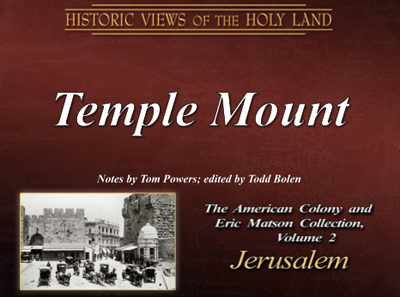
The Temple Mount - The American Colony and Eric Matson Collection

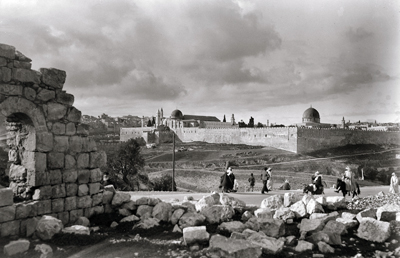
While working on the Temple Mount excavations in the 1970’s, we were excited to discover what was below ground, not giving much thought to what the site looked liked before the first pick was raised to break the ground. Seeing the “Southern Side of the Temple Mount” in a photograph taken sometime between 1989 and 1946, reminded me of how much has been discovered in the excavations, led by the late Prof. Benjamin Mazar between 1968 and 1978.

South Side of the Temple Mount - American Colony and Eric Matson Collection

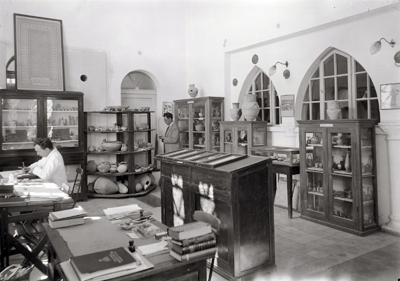
In the photographs of the Hebrew University, there are pictures of people whose names we are familiar with, but we do not always know their faces. Here you can meet Lord Balfour, Sir Herbert Samuel, Chancellor Judah Leon Magnes and Eliezer Sukenik, the father of the late Yigael Yadin. In another album you can meet General Edmund Allenby, who entered the city on foot through Jaffa Gate, ascended the steps of the Citadel and read a proclamation to the inhabitants of Jerusalem.

Prof. Eliezer Sukenik (center), the father of the late Yigael Yadin at the Hebrew University - The American Colony and Eric Matson Collection

Having lived many years in Jerusalem, I know the city very well, but it is amazing to see views of Jerusalem, taken 100 years ago. It is like a time machine, going back a century. Anybody interested in the history of Jerusalem would enjoy seeing these views. Although I would naturally focus on Jerusalem, the two CDs contain many interesting photographs of other parts of the Land and the surrounding countries. The album “Traditional Life and Customs” documents agriculture, home life and religious life of the different communities living in the Land.

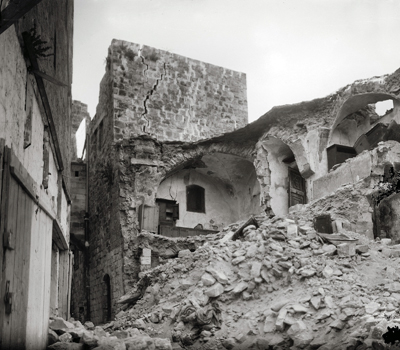
There are photographs of the devastating earthquake of 1927 that ruined many buildings from Jericho to Jerusalem, of World War I, the Arab riots of 1929 and British personalities who were involved in the Mandate. It is possible to study the turbulent history that led up to the establishment of the State of Israel in 1948 by viewing this fascinating collection.

Building in Jerusalem damaged by the earthquake of 1927 - The American Colony and Eric Matson Collection

Every photograph has been labeled and there is an extensive bibliography on the DVD, but most interesting is the file called “Jerusalem’s American Colony and its Photographic Legacy” by Tom Powers. It has profiles of people who lived in the American Colony, specially the Spafford and Vester families and the photographers that built up this irreplaceble collection.

Many of the photographs were taken by Eric Matson, who came to Jerusalem in 1896 and moved to America in 1946. As mentioned above, in his later years he donated the whole of the photo archive of the American Colony to the U.S. Library of Congress. The pictures can be downloaded from the website, but, having done it myself several times, I know that it is a laborious process. We can be thankful to Todd Bolen for having made the most interesting of these photographs available in an easily accessible format.

Bethesda in Jerusalem and 2,000-year-old pills

From the feedback we have received from users of our latest CD, Jerusalem in the time of Christ, one of the pics you have found most illuminating is the new reconstruction drawing of a votive offering depicting the serpent god of healing, Asclepius, discovered at the Pools of Bethesda. These pools  are now known to have been part of an Asclepium – a temple to the snake god. The drawing, made especially for this production, reminds us how fitting it was that Jesus should expose the claims of this false god by healing the paralytic man in his centre of pagan healing.

This fact came home to us very forcefully recently when we visited the Asclepium in Pergamon (now Bergama) in Turkey. Galen, the great physician of antiquity, began his studies of medicine at this Asclepium in his home town.

The Altar to Asclepius with relief of snakes at Pergamum

As an aside, a most interesting paper was presented yesterday on ancient pills formulated according to the writings of Galen and other ancient physicians and discovered in a ship which was wrecked in 130 B.C. off the coast of Tuscany, Italy. The findings were presented at the Fourth International Symposium on Biomolecular Archaeology in Copenhagen, Denmark.

Recommended: The Online Catalogue of the École Biblique in Jerusalem

Tom Powers, an American citizen living in Jerusalem, runs a lively blog, called View from Jerusalem. Whilst perusing our post Lost in Words – Recommendations from our library, he decided to pass on information about the On-line Catalogue of Jerusalem’s École Biblique, which went online about two years ago.

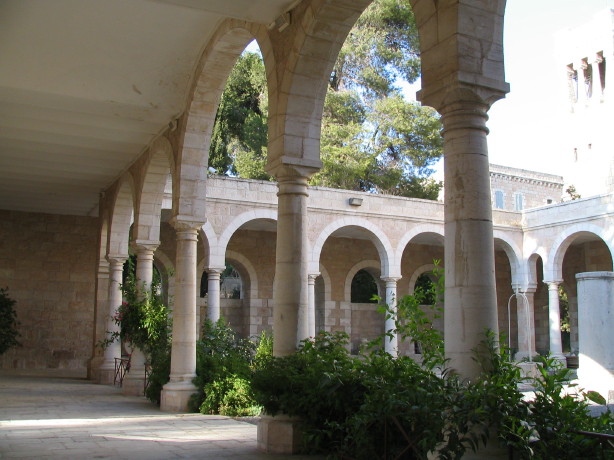
The Atrium of the École Biblique - photo Tom Powers

Here is an excerpt from Tom’s interesting post:

From the very beginning (ca. 1890), the Dominicans here made a point of indexing their collection on the level of the individual articles contained in journals, periodicals and books. Thanks to their foresight and diligence, that means that someone today can sit at their computer — wherever in the world – and do a search of the catalog by keyword, author, or any number of other parameters, and pull up the reference data on a whole host of relevant articles (and books), materials that they might then have access to in their own institutional library or via internet resources such as JSTOR.

About the École’s Library:

More than 140,000 volumes and 400 specialized periodicals are available for ready consultation. The great majority of this material concerns biblical exegesis, the archeology and literature of the Near East, ancient languages, etc.

Knowing the rich collection of this library, we agree that the online catalogue will be an extremely useful tool for anyone who wants to dig deeper into the Archaeology of the Holy Land and the Near East.

Fake Arab Tombs near the Temple Mount in Jerusalem

When archaeological investigations were frustrated by existing tombs, be they Jewish, Muslim or Christians, we used to say that the dead are more powerful than the living. Graves are usually respected by archaeologists. Fake tombs, however, should not be respected. See this report: Fake tombs near the Eastern Wall of the Temple Mount

MK Nisim Ze’ev (Shas) said the matter was a very serious one. “The Jerusalem Municipality is allowing complete abandonment of territory and assets,” he said. “The Arabs are trying to conquer the Land of Israel in every possible way. If we do not wake up to their conniving ways we will find ourselves before a gaping chasm. We need to plow the area and take down all of the fictitious tombs.”

Pictures of the fake tombs near the eastern Wall of the Temple Mount can be viewed in this article [Hebrew].

Hopefully, the un-dead in the fake tombs will not be so powerful when their un-existing remains and their rough stone enclosures will be removed.

11th Annual Archaeology Conference, The City of David, Jerusalem

Wished I could attend this exciting open-air archaeological conference in the City of David, but the notification came too late:

11th Annual Archaeology Conference
CITY of DAVID Jerusalem, Israel

Wednesday September 1, 2010
From 4:00 pm visit new excavation sites in the City of David
The City of David

18:30  Gather in the City of David, Area E

19:00  Opening Remarks

Ahron Horovitz, Director of the Megalim Institute
Representative of the Israel Antiquities Authority
Guy Alon, Israel Nature and National Parks Authority

19:15
First Session – Chair: Prof. Aaron Demsky
Prof. Jodi Magness
Archaeological Evidence of the Sassanid Persian Invasion of Jerusalem

Prof. Zohar Amar, Dr. David Illouz
The Persimmon in the Land of Israel

Ms. Sara Barnea
The History of the Mapping of the Jewish Cemetery on the Mount of Olives

20:40 Break

21:00
Second Session – Chair: Dr. Hillel Geva

Dr. Doron Ben-Ami, Ms. Yana Tchekhanovets
The Givati Parking Lot – Roman-Period Discoveries and Finds

Eli Shukron, Prof. Ronny Reich|
The excavation between the stepped Shiloah Pool and the interior face
of the damming wall at the southern end of the Tyropoeon Valley,
Jerusalem

Prof. Ronny Reich, Eli Shukron
The Large Fortification Near the Gihon Spring in Jerusalem, and its

Relationship to Wall NB Discovered by Kathleen Kenyon

22:00 Estimated end of conference

Entrance is free, but spaces are limited (there is no advance registration)
It may be cold at night so dress accordingly


Parking is available in the Mount Zion Parking Lot and the Givati
Parking Lot (for a fee)
Public Transportation: Buses 1, 2, 38.

HT: Joe Lauer

Temple Mount Repairs Leave Eyesores

Hershel Shanks comments on the unsightly appearance of the repair of bulges in the Temple Mount walls that was done several years ago and the scaffolding that was left behind. The Waqf (Muslim authority over the Temple Mount) and the Israelis accuse each other of having caused these bulges, on one of which we reported in a previous post.

One of the first lessons I was taught during the MA course in the Conservation of Ancient Buildings at the Institute of Advanced Architectural Studies of the University of York, UK, was that one NEVER uses ordinary Portland cement in the repair of ancient buildings. It prevents ancient walls from “breathing” and eventually causes the collapse of these walls. The Waqf’s continued use of modern building materials in the repair of these bulges and other walls is the equivalent of putting a time-bomb in the walls of the Temple Mount.

Hershel asks himself the question about the remaining scaffolds: “They’ve been there now for several years. How much longer?” I can’t aswer that question, but I am sure that the unsightly repairs won’t be there for ever, for the ancient Temple Mount walls keep absorbing, not only the normal amount of rain water, but also the added amount of water that runs off the new paving that was laid at the southern end of the Temple Mount and that was also sealed with Portland cement. When ancient walls can’t breathe, they eventually collapse.

The Way to Golgotha in Jerusalem

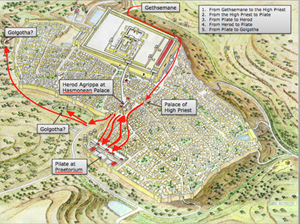
Feedback from customers who have purchased our new CD Volume 2: “Jerusalem in the time of Christ,” has been very positive, indicating that you have found it a really useful aid in understanding and teaching this topic. You can see a taster below of the final slide in the set. It shows the culmination of a series of five slides, each one building on the next and indicating a stage in The Way to Golgotha – Christ’s last journey in Jerusalem. Stages shown are:

From Gethsemane to the High Priest
From the High Priest to Pilate
From Pilate to Herod Antipas
From Herod Antipas back to Pilate
From Pilate to Golgotha

Five stages in the Way of the Cross

The traditional Via Dolorosa or Path of Sorrows was fixed by monks in Western Europe in the eighteenth century and a devotional procession along this route is still led by Franciscans every Friday. In fact, the streets upon which Jesus walked lie about 10 feet below the level of these thoroughfares. By contrast, The Way to Golgotha is firmly based on Scriptural and archaeological evidence, with the claims of the two alternative sites for the crucifixion clearly evaluated.