PA Declares ‘Western Wall Was not Jewish’ until 16th Century AD

The Israeli press is full of reports of a paper prepared by Al-Mutawakel Taha, a senior official with the PA Ministry of Information to “refute” Jewish claim to the Western Wall.

The Jerusalem Post quotes him as follows:

Many studies published by Jewish experts have affirmed that there is no archeological evidence that the Temple Mount was built during the period of King Solomon,” the paper added. “One can only conclude that the Al-Buraq Wall is a Muslim wall and an integral part of the Aqsa Mosque and Haram Al-Sharif. No one has the right to claim ownership over it or change its features or original character. Also, no one has the right to agree with the occupation state’s racist and oppressive measures against history and holy sites.”

He is correct in saying that the Western Wall was not built in the time of Solomon. However, he appears to be ignorant of or chooses to ignore the history of the Temple Mount between Solomon and the Early Muslim period.

The drawing below from our Image Library shows the five stages in the development of the Temple Mount in Jerusalem. From top to bottom:

1. The square Temple Mount built by King Hezekiah around the Temple built by King Solomon.
2. The Akra Fortress (red) was built by the Seleucid King Antiochus IV Epiphanes in 168 BC to control the local Jewish population. The fortress was destroyed by the Maccabees in 141 BC.
3. After the destruction of the Akra, the Hasmoneans extended the Temple Mount to the south (blue).
4. King Herod the Great renewed the Temple Mount by enlarging the square Temple Mount to double its size and building a new Temple.
5. During the Umayyad period, the Dome of the Rock was built on the site of the Temple and the El Aqsa mosque on that of the Royal Stoa. Large public buildings were erected to the south and west of the Temple Mount.

The Development of the Temple Mount from Hezekiah to the Early Muslim period

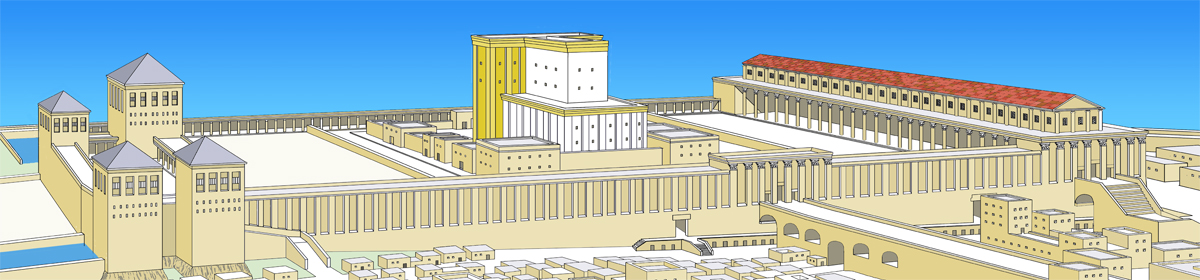
I made the reconstruction drawing of the Herodian Temple Mount below at the end of the 10-year long excavation project led by the late Prof. Benjamin Mazar (1968-’78). The Western Wall, where the Jews pray today, is shown in red. This approx. 60 m. long wall is part of the 485 m. long western retaining wall of the Herodian Temple Mount. Many finds from the Second Temple period, such as Hebrew inscriptions, coins and also the architectural style prove that the present-day walls of the Temple Mount are irrefutably Herodian. To deny this is ignorance in the extreme.

Herod's Temple Mount with the Western Wall shown in red

Roman Bathing Pool found in Jerusalem

The discovery of the remains of a bathing pool that may have belonged to a Roman bathhouse has been widely reported. I read about it first in the Jerusalem Post. The original announcement was made by the IAA (Israel Antiquities Authority). Here is a link to the pictures.

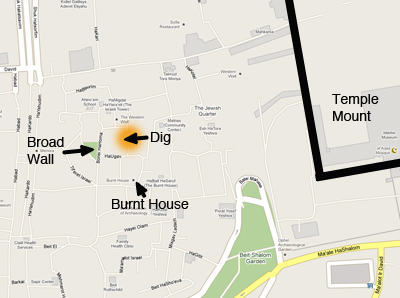
The dig is located in 10 Haomer Street in the Jewish Quarter of the Old City of Jerusalem, which is north of the Burnt House and east of the Broad Wall.

Location of the Roman Bathing Pool

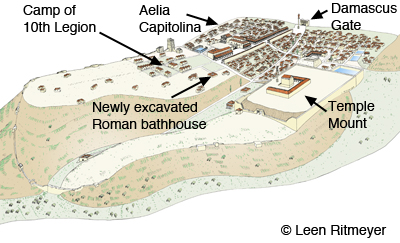
The announcement of the discovery came at a time when I was preparing to add a reconstruction drawing of Aelia Capitolina to our new Image Library. It gave me the opportunity to add the newly discovered bath house to this drawing:

Reconstruction drawing of Aelia Capitolina (the name of Jerusalem in the Roman period) showing the location of the newly discovered bathhouse

The drawing illustrates the comments of Yuval Baruch, who noted:

the importance of the discovery, which sheds light on the study of post-destruction Jerusalem.

“Despite the very extensive archaeological excavations that were carried out in the Jewish Quarter, so far not even one building has been discovered there that belonged to the Roman legion,” he said.

“The absence of such a find led to the conclusion that Aelia Capitolina, the Roman city which was established after the destruction of Jerusalem, was small and limited in area.”

“The new find, together with other discoveries of recent years, shows that the city was considerably larger than what we previously estimated. Information about Aelia Capitolina is extremely valuable and can contribute greatly to research on Jerusalem because it was that city that determined the character and general appearance of ancient Jerusalem and as we know it today. The shape of the city has determined the outline of its walls and the location of the gates to this very day.

The development of the Western Wall plaza near the Temple Mount

In a previous post, we reported on the new plans for the development of the Western Wall plaza. Israel’s cabinet has now decided to allot NIS 85 million ($23 million) for this project.

The project  will upgrade physical and transportation infrastructure at the site, provide access to new archeological findings, and run educational programs for soldiers and students.

The PA, of course, objects to the plan. Here is the report as it appears in today’s Jerusalem Post. A similar report appears in Haaretz.

Controversy about David and Solomon

National Geographic magazine’s feature article for the December 2010 edition is devoted to “David and Solomon — Kings of Controversy” and asks “Was the Kingdom of David and Solomon a glorious empire—or just a little cow town? It depends on which archaeologist you ask.”

It is difficult to determine if the archaeological remains do indeed belong to David’s Palace, but the location is a logical one. Long before Eilat Mazar’s controversial dig started, I already made a reconstruction drawing of David’s Palace, based on the results of Yigal Shiloh’s excavations in Area G. This drawing is one of the many images in our new Image Library.

Reconstruction of King David's Palace - © Leen Ritmeyer 1995

HT: Joe Lauer

Israel’s High Court ruled against stopping the destruction of the Temple Mount by the Islamic Waqf

Here is a report concerning the recent dismissal by Israel’s High Court of Shurat HaDin’s private prosecution of the Islamic Waqf for the Waqf’s depredations on the Temple Mount:

Israel’s High Court of Justice has handed down a decision which blocks a
first-of-its-kind private prosecution brought by Shurat HaDin against the
Islamic Waqf (“Trust”) in Jerusalem.

The Waqf is the radical anti-Israel authority which the government allows to oversee Muslim holy places including the mosques on Jerusalem’s Temple Mount. Following months of reports that the Waqf was utilizing bulldozers on the Temple Mount to carry out unauthorized construction that was obliterating ancient Jewish artifacts and the refusal of the Israeli police to act to safeguard these relics, we decided to go to Court against the Muslims.

Read the full report here.

Israel National News (Arutz 7) has a similar report:

Attorneys from the Israel Law Center accused the Wakf of deliberately destroying Jewish artifacts in order to eradicate evidence of the Jewish claim to the Temple Mount. By neglecting to take action to stop the demolition of ancient historical finds, the Israel government has been “abandoning the millenniums-long Jewish claim over the Temple Mount and allowing Islamic extremists to re-write Jerusalem’s history,” they said.

The attorney general’s office had tried to get the Israel Law Center suit dismissed, arguing that private citizens should not be allowed to prosecute in a case that affects the general public. The Law Center responded by accusing the attorney general of caving in to political pressure.

Read the full report here.

HT: Joe Lauer

Rachel’s Tomb, The Tomb of the Patriarchs and the Mugrabi Gate

The politicians are at it again. UNESCO has declared The Tomb of Rachel to be a mosque. Israel’s Prime Minister has slammed the report.

The claim is, of course, ludricous. This photograph, taken in 1890-1900, already describes the building as The Tomb of Rachel:

The Tomb of Rachel - photograph taken in 1890-1900

Joe Lauer reminded us of what Abba Eban once said about the United Nations General Assembly, “If Algeria introduced a resolution declaring that the earth was flat and that Israel had flattened it, it would pass by a vote of 164 to 13 with 26 abstentions.” 

When guiding round the Temple Mount excavations, we always pointed out that the headquarters of the United Nations are rightfully situated on the Mount of Evil Counsel.

In another report, the US demands from Israel to remove the Tomb of the Patriarchs from Israel’s list of national heritage sites. The very architecture of the Tomb of the Patriarchs of proves that it was built by Herod the Great.

The Tomb of the Patriarchs. The wall has been partly cut away to indicate the location of the double cave where Abraham, Isaac and Jacob and their wives were buried.- © Leen Ritmeyer

The Mugrabi Gate is also in the news, as it has been reported that falling stones from the ramp could endanger the women who pray below:

UNESCO appeared to support the PA demand for the Temple Mount as well, asking that Muslim officials be allowed to examine the Mughrabi Gate near the Western Wall (Kotel). Muslim leaders have accused Israel of attempting to damage the Al-Aksa Mosque on the Temple Mount under the guise of repairs to the Mugrabi Gate. Israeli officials have warned that if the gate is not repaired, it could collapse, putting worshipers at the Western Wall at risk.

Rabbi Shmuel Rabinovich, Rabbi of the Western Wall, termed the decision “outrageous.” “They have never said in the past that this was a Muslim holy site. The [UN] organization responsible for heritage has turned heritage into politics.” Israel should think carefully about whether or not to cooperate with UNESCO in the future, he said.

In an earlier post, The UNESCO leopard has not changed its spots, we discussed the problems of the ramp. It is clear that nothing has changed in the attitude of UNESCO. See also Todd Bolen’s post: Falling Stones Endanger Women at Western Wall.

HT: Joe Lauer

Mamre and the Temple Mount in Jerusalem

Israel National News, Arutz Sheva, reported today that the site of Mamre near Hebron has been visited recently and may be opened soon.

The site is mentioned three times in Genesis, in chapters 13,14, and 18. This is where Abraham settled after separating from his nephew Lot, where he built an altar to G-d, and where G-d sent him three angels to inform him that his son Isaac would be born the following year.
It was also here that Abraham established the first Hebrew army, for the purpose of rescuing Lot, who had been kidnapped by the Four Kings during their war against the Five Kings as described in Genesis.

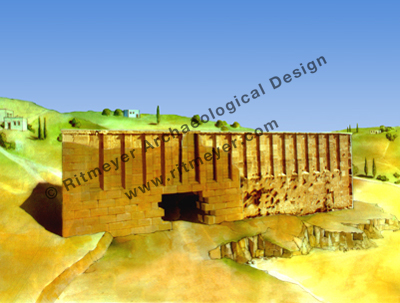
The Herodian wall with pilasters in Mamre - © Leen Ritmeyer

Today, Elonei Mamre is also one of Israel’s most important archaeological sites. A two-meter-high, 70-by-30-meter wall has been found there, apparently built by King Herod 2,000 years ago. The wall’s construction has similar characteristics to that in the Machpelah Cave [the Cave of the Patriarchs, ed.] and the Western Wall in Jerusalem. Remains of two towers from an earlier period have also been found in Elonei Mamre.

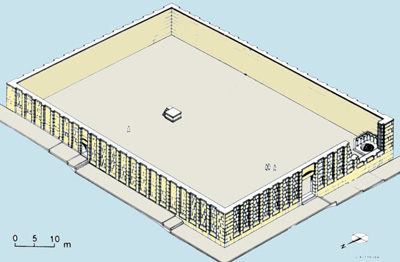
In the 1980’s I visited the site and made this reconstruction drawing of the Herodian enclosure. It was amazing to see how closely the architectural style of the outer walls resembled those of the Tomb of the Patriarchs in Hebron and the Temple Mount in Jerusalem.

Reconstruction drawing of the Herodian enclosure at Mamre - © Leen Ritmeyer

Lecture on New finds in Jerusalem’s Jaffa Gate

In a previous post, we reported on the new archaeological finds in the Jaffa Gate area. If you are in Jerusalem this week (and understand Hebrew!), you may enjoy attending this lecture, which will take place in the Yad Ben Zvi Institute, 12 Abarbanel Street, Rehavia, Jerusalem.

Yad Ben Zvi will host a program Tuesday evening, October 12, 2010, from 6-8 pm, devoted to lectures and responses on “New Finds in Jaffa Gate”. The talks are by the lead excavators Ofer Sion and Architect Shahar Poni.

The MC is Hillel Geva, director of the Israel Exploration Society, intimately familiar with Old City excavations over decades, who is currently publishing the final excavation reports of Nachman Avigad’s work in the Old City.

Source: Joe Lauer and Barnea Levi Selavan

Jaffa Gate Moat in Jerusalem

A reader of a previous post asked a question about the breaching of the city wall near the Jaffa Gate:

Are you sure about the Jaffa Gate? Every other source I’ve read says that the the wall was breached between Jaffa Gate and David’s Citadel to allow the Kaiser’s entourage to enter the city — ie, it was not just a question of filling in the moat.

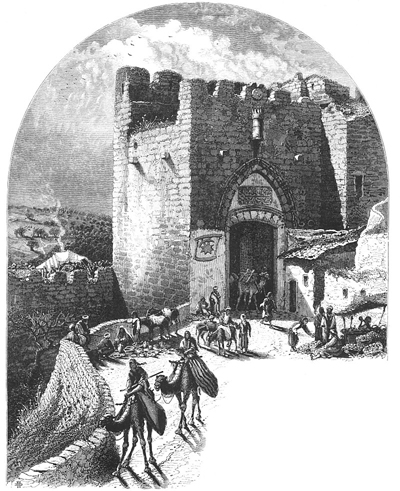
The Jaffa Gate and Moat in 1880 - Charles Wilson: Picturesque Palestine

The accompanying picture from Charles Wilson’s book Picturesque Palestine (1880), shows that the moat between the Jaffa Gate and the Citadel was the only defence in this area. On both sides of the moat, there were low walls to prevent people from falling into this moat. This low wall on the outside, or curtain wall as it is called in this report, was not a city wall and its removal can hardly be called “breaching”.

To let the Kaiser ride in on horseback, the moat was filled in and, of course, the low curtain walls were dismantled as well.

More on renovations planned for Jerusalem’s Old City

In connection to my previous post, I was interested to see that The Jerusalem Post also reported on the planned underground tunnel and parking lot in the Old City. I’m sure that Jerusalem archaeologists will be pleased with the prospect of excavating this area of the Jewish Quarter.

The architect Sherki admitted that it:

would be impossible not to lose some archeology in the course of construction, and said it took many years for the Israel Antiquities Authority to agree with the plan because of the potential archeological losses. But he believes that because they have a good idea of what exists underneath, the construction will minimize the destruction of archeological ruins.


At its deepest point, if no significant archeological discoveries are made, the parking garage will reach a depth of about nine meters, allowing for four levels of parking. But with as little as five meters, a depth Sherki is certain they can reach without disturbing any ruins, they can have a double-tiered parking garage.

Sherki may be disappointed, as from my experience of working on the Jewish Quarter excavations, I know that the Byzantine remains are only 3-4 m deep. They have been excavated by the team of the late Prof. Nahman Avigad and the results have been documented and published.

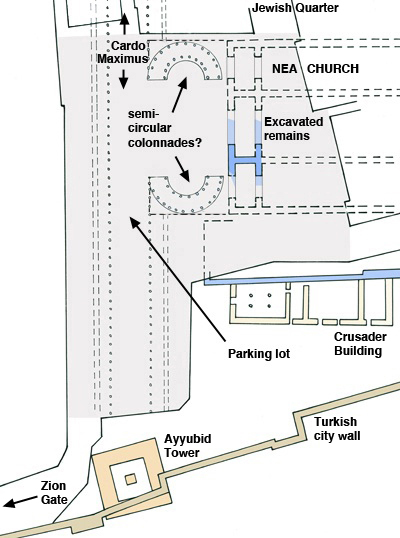
I could not help but be intrigued at the thought of what could be found, should the excavations go ahead. Depending how large an area will be opened, more of the entrance and narthex of the Byzantine Nea Church may be found and perhaps some of the internal architecture.

Remains of the Cardo Maximus may also be found. A large stretch of this street was already excavated during the 1980’s and I was privileged to supervise its reconstruction. The southern continuation, however, runs through the western part of the parking lot area.

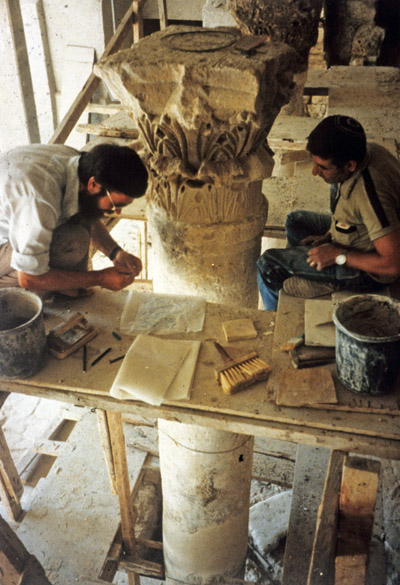
Reconstructing the Byzantine Cardo. © Leen Ritmeyer

Procopius (500 – 565 AD), a prominent scholar who lived in Caesarea, wrote a detailed description of the Nea Church. According to his description, “as one advances there are two semi-circles (hemikykla) which stand facing each other on one side of the road that leads to the church”.
The street must be the Cardo Maximus and the two semi-circular colonnades stood between the Cardo and the Nea. Procopius does not supply us with any further information but I have suggested a possible arrangement on the accompanying plan. This differs from the plan of other Byzantine churches, which usually have a rectangular or square atrium in front of them. St. Peter’s Church in Rome (although dating from a much later period) also has two semi-circular colonnades in front of it.
In Jerusalem there is no space for anything as grand as in Rome, but nevertheless I hope that some light may be shed on Procopius’ description of the Nea Church, in particular on these semi-circular structures. The Byzantine historian did write that Justinian’s Nea Church was “a shrine with which no other can be compared.”

HT: Joe Lauer