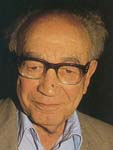
Ha’aretz reports that today, September 25th, is the birthday of the late Prof. Nahman Avigad:
September 25, 1905, is the birthdate of Nahman Avigad, one of the leading members of the first generation of biblical archaeologists in modern Israel. Avigad’s excavations in Jerusalem following the Six-Day War revealed much of the history of the Jewish Quarter of the Second Temple and Byzantine periods; he also interpreted one of the Dead Sea Scrolls and dug at Masada and Beit She’arim, among other places.
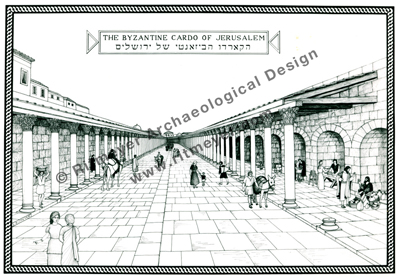
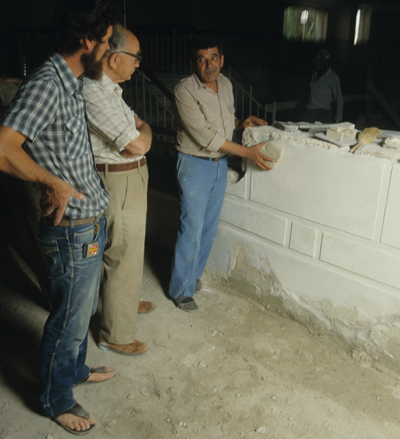
It has been a privilege to have worked with Avigad for over ten years in the Jewish Quarter Excavations of the Old City of Jerusalem, from 1987-1987. He was a very fine scholar having the distinct advantage of being trained in both architecture and archaeology. He let me help him supervise the reconstruction of the Cardo:
It is for his work in the Old City of Jerusalem, where he excavated between 1969 and 1983, that Avigad is best remembered. When the task of finding the Herodian “Upper City” was offered to him, two years after East Jerusalem came under Israeli sovereignty, Avigad was already contemplating retirement. He dug up the Cardo, the Byzantine-era road that linked the Church of the Holy Sepulchre with the Nea Church, and that was previously known by its depiction in the Madaba Map mosaic; the “Broad Wall,” constructed after the return from the Babylonian Exile; and the Iron Age (prior to the 6th century B.C.E.) Israelite Tower. Avigad also found and dug up the so-called Burnt House.
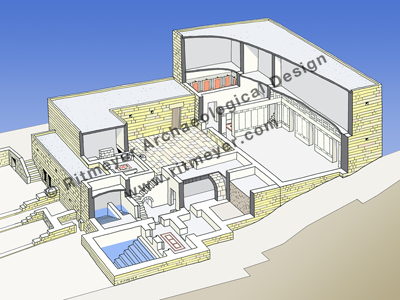
Later on, he put me in charge of the restoration of six magnificent Herodian villas, now located below the Yeshivat Hakotel, the largest of which may have been the palace of Annas the High priest:
Archaeological work proceeded at the same time that the commercial and residential development of the Jewish Quarter was under way, and dictated the pace of that development. As a consequence, however, today there is an archaeological museum underneath Yeshivat Hakotel, which serves as an excellent introduction to life in Second Temple-era Jewish Jerusalem, and a number of other historical sites that can be visited, and that are integrated into the Quarter, among its shops and homes.
Our Image Library has been updated with many new drawings. There are two new series on Jerusalem, new reconstruction drawings in portrait orientation of the Tabernacle, the Temples of Solomon and Herod, also of Herodium and other sites.
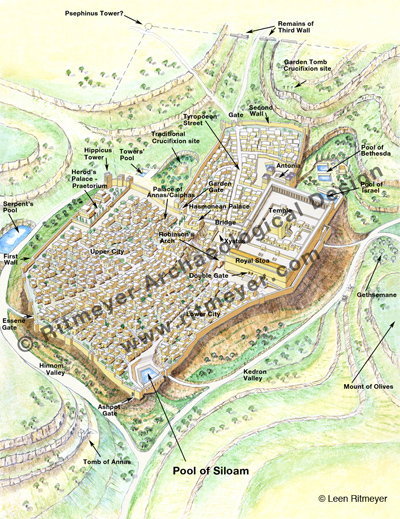
Throughout its history, the size of Jerusalem expanded, but also diminished at times, as shown here:
The city began its history on the Eastern Hill, located between the Kedron and Central Valleys. That is where Salem, the city of Melchizedek was located. The Jebusites took over the city and built a strong fortification around the Gihon Spring to the east. King David captured the Jebusite city and since then it was called the City of David:
His son Solomon built a new Temple and Royal Palace on Mount Moriah, to the north of the City of David and joined the new Temple/Palace complex to the previous city with city walls, as shown on this drawing:
Jerusalem was greatly enlarged by King Hezekiah who had to cope with a large influx of refugees from the Assyrian invasion. For the first time in its history, the Western Hill was enclosed with city walls and joined to the City of Solomon:
After the Babylonian Exile, Jerusalem was restored, but the Western Hill was left out, the destroyed houses and city wall a lasting memorial to the terrible Babylonian destruction:
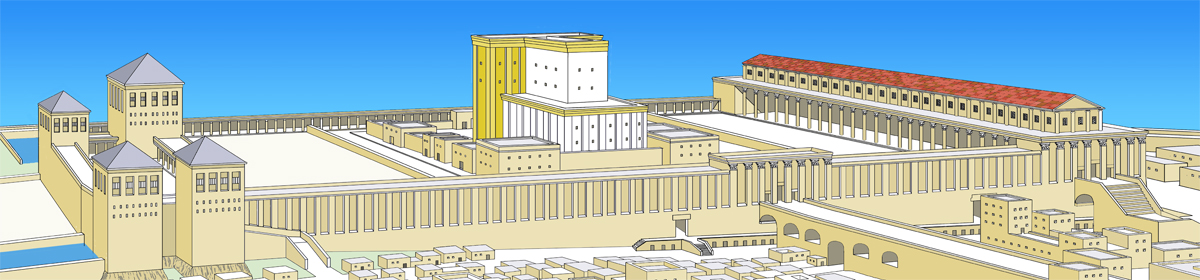
It was in the Hellenistic period that this hill became part of Jerusalem again. King Herod the Great enlarged the city to the north, as far as the present-day Damascus Gate, and built a magnificent new Temple Mount, as can be seen here:
Just before the revolt against the Romans, an attempt was made to build another wall further to the north, the Third Wall:
All of these drawings and many more are available from our Image Library
About two years ago, we mentioned in a post that an epic movie about Jerusalem was being made in iMax format. As of August 16, this year, the movie has been released and will be distributed by National Graphic. It shows stunning helicopter photography of the Land of Israel and tells the story of Jerusalem through the eyes of three young women, Christian, Jewish and Arab. Here you can watch the trailer:
We are pleased to have been able to contribute to this movie with reconstructions of Jerusalem in the Second Temple and Byzantine periods.
For further information see Facebook:
JERUSALEM releases worldwide in 2013, please click on ‘Welcome’ to sign up for our email list or visit www.jerusalemthemovie.com to learn more.
Description
Through the unrivaled beauty and visceral nature of the IMAX® experience, JERUSALEM seeks to increase public understanding and appreciation for Jerusalem’s historical, spiritual, cultural and artistic uniqueness, as well as highlighting some of the intersections between Judaism, Christianity and Islam.
Plot outline
Through the unrivaled beauty and visceral nature of the IMAX® experience, JERUSALEM seeks to increase public understanding and appreciation for Jerusalem’s historical, spiritual, cultural and artistic uniqueness, as well as highlighting some of the intersections between Judaism, Christianity and Islam.
Initially, the movie will be shown in these locations:
Boston, Massachusetts – Museum of Science
Special Event: Thursday, September 12, 2013
Public Start Date: Friday, September 20, 2013
Charlotte, North Carolina – Discovery Place
Public Start Date: Wednesday, September 18, 2013
West Nyack, New York – IMAX Theater at the Palisades
Public Start Date: Monday, September 23, 2013
Ottawa, Ontario – Canadian Museum of Civilization
Special Event: Monday, September 23, 2013
Public Start Date: Friday, September 27, 2013
McMinnville, Oregon – Evergreen Aviation Museum
Public Start Date: Friday, September 27, 2013
Seattle, Washington – Pacific Science Center
Special Event: Friday, September 20, 2013
Public Start Date: Saturday, September 28, 2013
Garden City, New York – Cradle of Aviation
Special Event: Wednesday, September 25, 2013
Public Start Date: Saturday, September 28, 2013
St. Louis, Missouri – St. Louis Science Center
Public Start Date: Tuesday, October 1, 2013
Lubbock, Texas – Science Spectrum
Public Start Date: Tuesday, October 1, 2013
Houston, Texas – Houston Museum of Natural Science
The Roman destruction of Jerusalem in 70AD, was a tragedy that is still mourned today by many. Josephus Flavius, also known as Yosef Ben Matityahu, was an eye-witness to the siege of Jerusalem. He somehow survived the siege of Yotvat in Galilee and with one of his soldiers surrendered to the Roman forces in July 67. The Roman forces were led by Flavius Vespasian and his son Titus, both subsequently Roman emperors. In 69, Josephus was released (War 4.622-629) and according to Josephus’s own account, he appears to have played a role as a negotiator with the defenders during the Siege of Jerusalem in 70. After a desperate struggle, the Temple was destroyed, followed by the rest of Jerusalem. Despite the entreaties of Josephus to spare the city, the rebels, as he called them, refused to give up the city and rather fought to the end. Many people died of famine and others, who wanted to save their lives by surrendering to the Romans, were killed by their fellow fighters. There were corpses everywhere. Some of the rebels tried to save their lives by hiding in underground structures:
“A last and cherished hope of the tyrants and their brigand comrades lay in the underground passages, as a place of refuge where they expected no search should be made for them, intending after the complete capture of the city and the departure of the Romans to come forth and make their escape. But this proved to be but a dream: for they were not destined to elude either God or the Romans” (War 6.370, Loeb edition).
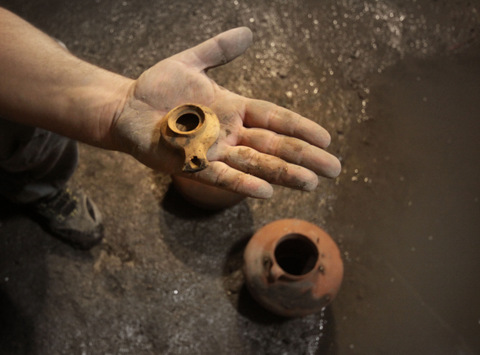
Interestingly, as we are leading up to the 9th of Ab (starts in the evening of Monday, July 15th and ends in the evening of the 16th), the date on which the Jews mourn the loss of both their Temples, two discoveries have been announced this week that may cast light on this tragic episode. First, the Israel Antiquities Authority announced the finding of some cooking pots and an oil lamp in an underground cistern near the Western Wall that indicate, according to Eli Shukron, the excavation director, that some people went into the cistern and secretly eat the food that was inside the pots.
Three complete cooking pots and a small ceramic oil lamp were uncovered inside a small cistern in a drainage channel that runs from the Shiloah Pool in the City of David to Robinson’s Arch. Photograph of the finds in the cistern: Vladimir Naykhin.
And today it was announced that in the Ophel Excavations, directed by Eilat Mazar, a cave, connected to a system of tunnels, was also used as a last hiding place.
“The project archaeologists suggest that the tunnels and shafts may possibly have been made and used by inhabitants of the city hiding or protecting themselves from the Roman siege of Jerusalem during the height of the First Jewish Revolt.”
The area supervisor, Brent Nagtegaal, observes:
“It’s amazing when you look at some of these tunnels … A lot of them are incomplete.”
At a certain location, he speculates:
“This is probably the point at which the Romans broke through or the point at which the Jews realized they could do no more digging, there was no more time and they had to hide themselves.”
In this video, Brent explains the findings:
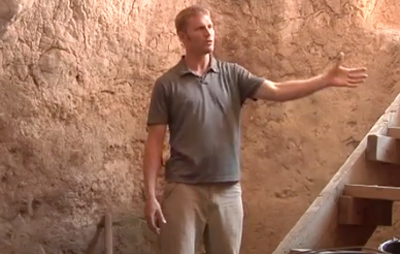
Brent Nagtegaal
The historical record by Josephus and these recent finds, however sad, have nevertheless given us a deeper and more realistic insight into this tragic event.
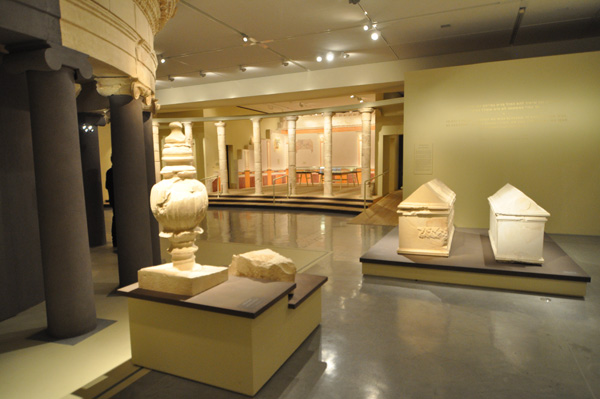
Last March I was able to visit this exhibition and it took my breath away. We were fortunate to have special permission to film before the exhibition was opened to visitors as I was part of a team making a documentary for the National Geographic.
Circular tholos of Herod’s Funerary Monument on the left, with his theatre box in the background. On the right are two sarcophagi found at the site of Herodium.
As has been widely reported e.g. Todd Bolen’s Bible Places, the Israel Museum has now put on their website a “Virtual Tour” for those who cannot see the exhibition for themselves. The front page of the website has many interesting links. German speakers can also follow a tour of the exhibition by David Mevorah, the curator of the exhibition. (HT Alexander Schick)
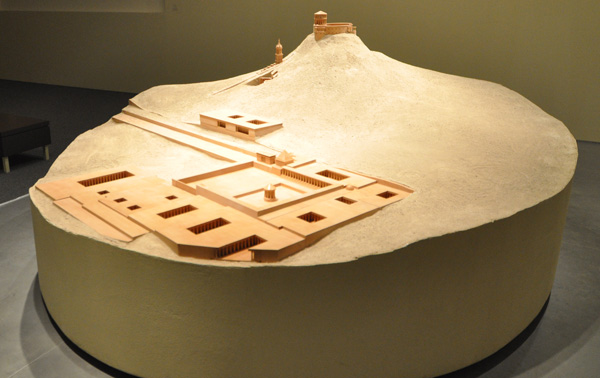
Model of Herodium, Herod the Great Exhibition, Israel Museum.
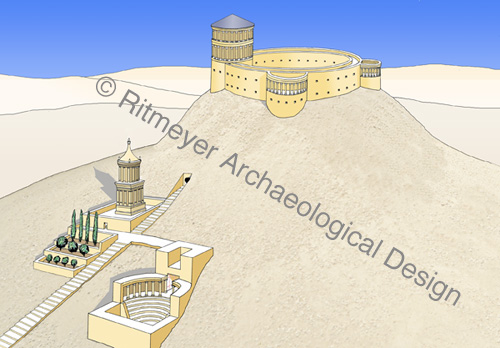
I was naturally drawn to the beautiful model of Herodium that accompanies the exhibition of the remains of Herod’s Funerary Monument and the Theatre. As I found that the theatre was built too deep into the surface of the model, I created my own reconstruction drawing:
The drawing shows the Upper Palace on top of a man-made hill, with the monument and theatre built on opposite sides of the stairway leading to the palace. The steps of the theatre are cut out of the natural bedrock side of the mountain.
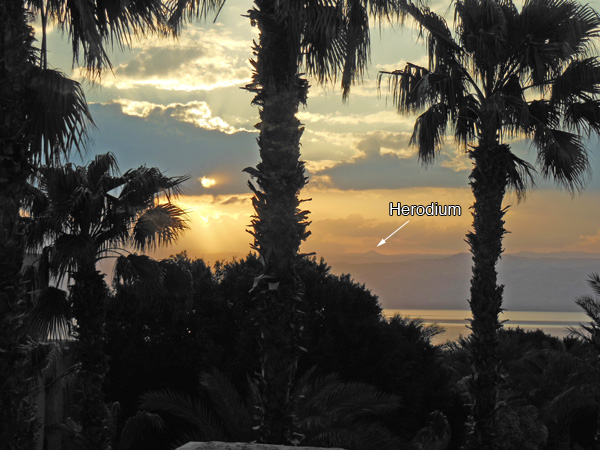
It is remarkable that this creation of Herod can be seen in silhouette from across the Dead Sea. We could easily pick it out at sunset, when sitting on the terrace of our hotel on the Dead Sea shore, where we stayed during this year’s season of the Tall el-Hammam excavations in Jordan:
Herodium viewed from Jordan, on the east side of the Dead Sea. The silhouette of Herodium can be seen between the two palm trees (see arrow).
Last year we attended the First annual conference of Hekhal: the Irish Society for the Ancient Near East that was held in Dublin, Ireland.
This year, the second conference, entitled “Pilgrimage, Travel, and Cult” will be held on 24-26 May 2013 at CITI, Braemor Park, Dublin 14.
Many scholars from different parts of the world, including Israel, will attend. On the Hekhal website there are links that let you download the sessions and abstracts of the different papers.
The sessions that I would find particularly interesting are: “Pools of Jerusalem: Pilgrimage, Purity and the Holy City” by David Gurevich, University of Haifa, Israel, and “The role of the Temple Mount after 70AD” by Shlomit Weksler-Bdolah, Israel Antiquities Authority.
HEKHAL is currently preparing the proceedings of its first annual conference for publication, which will contain our article on “Relating the Temple Scroll from Qumran to the Architecture of the Temple Mount in Jerusalem”.
David Willner and Barnea Levi Selavan met up with archaeologist Yuval Gadot (Tel Aviv University), who generously gave of his time and knowledge to help them understand the City of David in First and Second Temple times.
Dr. Yuval Gadot of Tel Aviv University has initiated a long term excavation to explore several research issues in the Late Bronze Age and Iron Age periods. After two months in the field he welcomed David Willner and Barnea Levi Selavan of Foundation Stone’s LandMinds program to see the excavation taking shape.
On the Foundation Stone’s website you can watch a video of this interview and also listen to three audio segments.
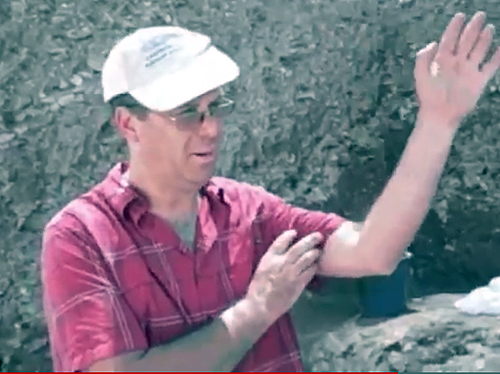
Yuval Gadot explains the latest findings in his trench in the City of David
At this point in time, only pottery remains of the First Century have been found. It will become more interesting when they go down the next layer.
I am often approached by people that are under the impression that the Eastern Gate of the Temple Mount had to be directly opposite the entrance leading into the Holy Temple. According to Middot 1.3, there was only one gate in the Eastern Wall of the Temple Mount: “the Eastern Gate on which was portrayed the Palace of Shushan”.
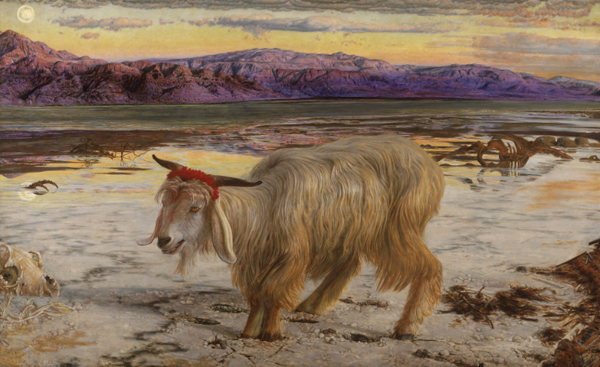
The Eastern Gate is an important gate of the Temple Mount, as on Yom Kippur the scapegoat that was chosen by the High Priest in front of the Temple, would have been led through the Court of the Women, down a stairway to and through the Shushan Gate and into the Kedron Valley. From there it was led over the Mount of Olives into the Wilderness of Judea.
Painting of the Scapegoat by William Holman Hunt
Another biblical scene takes us to the top of the Mount of Olives, where a priest would sacrifice a Red Heifer. Numbers 19 stipulated that in order for the people to be purified, a Red Heifer should be sacrificed, its ashes collected and put in a container with water. This was used to sprinkle those in need of purification. The Mishnah said that the priest that was consecrated to burn the Red Heifer would leave the Temple Mount with the Heifer and go through the eastern gate to the Mount of Olives. The problem of the identification of the eastern gate lies in two passages, in Mishnah Parah 3.9 and 4.2. The first states that the priest that offered the Red Heifer on the Mount of Olives, sprinkled its blood seven times toward the Holy of Holies. According to the second passage, “if the blood was sprinkled not in the direction of the entrance [of the Holy of Holies] it is invalid.” There must therefore have been a direct line of vision between the Mount of Olives and the entrance to the Temple. From the place of this activity, he could look straight through the Nicanor Gate and see the entrance to the Temple.
The idea that the Shushan Gate had to be directly opposite the entrance to the Temple comes from a misunderstanding of the passage in Middot 2.4: “All the walls there were high, save only the eastern wall, because the [High] priest that burns the [Red] heifer and stands on top of the Mount of Olives should be able to look directly into the entrance of the Sanctuary when the blood is sprinkled.” Does that mean that the Eastern Gate of the Temple Mount should be on the same line of vision, drawn between the Temple and the top of the Mount of Olives?
Looking from the top of the Mount of Olives through the Golden Gate one could never see the Temple, wherever one places it on the Temple Mount, as that gate is located far too low down. One cannot expect to look through a lower gate and see something that is higher than that gate. Only the drawing of a section would make that clear. In order to solve architectural problems, one needs to think in three dimensions.
The level of the top of the Mount of Olives (810 m. above sea level) is 75 m. (246 feet) higher than the Temple platform (735 m.). The sill of the Golden Gate is located some 21 m. (70 feet) lower than the Temple platform. How then could one look from the top of the Mount of Olives through the Golden Gate, or any other gate in the Eastern Wall of the Temple Mount, and hope to see the entrance to the Temple? It is totally impossible!
We must conclude that the passage in Middot 2.4 needs to be read differently or that the writer didn’t remember the actual line of vision. Which walls are referred to by “All the walls …”? Those of the Temple Mount or those of the Temple Courts? The previous passage (Middot 2.3) describes structures “inside the Temple Mount” and it ends with a reference to the Nicanor Gate. This was an extraordinarily beautiful gate with bronze doors made in Alexandria, that stood between the Temple Court and the Court of the Women, right in front of the Herodian Temple .
The Nicanor Gate stood in front of Herod’s Temple. It gave access from the Court of the Women to the Temple Courts. In front of this gate were fifteen semi-circular steps on which Levites sang the fifteen “Psalms of the Steps” (Psalms 120-134 of Degrees or Ascents). The gold-covered Temple towered above all other buildings.
There is a direct line of vision from the top of the Mount of Olives to the entrance to the Temple through the Nicanor Gate, while the walls of the Court of the Women were kept low (see illustration above). If one stands today to the east of the Dome of the Rock one can see the Mount of Olives clearly. The Nicanor Gate therefore is the only gate that the writer of Middot could have had in mind. The High Priest that offered the Red Heifer on the Mount of Olives would have had to look through this gate in order to see the entrance to the Temple. I believe therefore that the gate mentioned in Middot 2.4 is the Nicanor Gate and not the Shushan Gate.
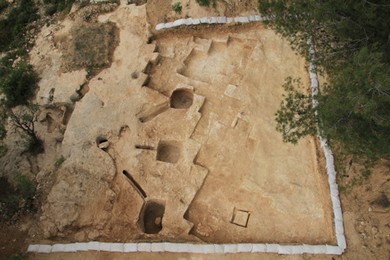
An archaeological excavation conducted by the Israel Antiquities Authority near a highway construction site in the Kiryat Menachem neighborhood of Jerusalem, unearthed a rare ritual bath (mikve), dating back to the late Second Temple period.
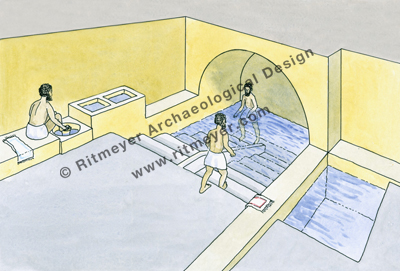
Many mikva’ot – Hebrew for ritual baths, mikveh in the singular, – have been excavated in Jerusalem and elsewhere. These baths were used for purifying oneself by total immersion.
A mikveh is usually a stepped pool carved out of the rock with a small dividing wall built on the upper steps. The purpose for this was to descend on one side and, after immersion, ascend on the other side, thus preventing contact with those who were not yet purified.
In this drawing, a pool has been drawn to the right of the mikveh that in Hebrew is called an otzar. It is a special basin that contains pure rainwater. After the water in the main mikveh is changed, a plug in the small channel that connects the two bodies of water is briefly taken out, thereby purifying the water in the mikveh.
Benyamin Storchan, director of the excavation on behalf of the Israel Antiquities Authority, explains that the water supply to this mikve is “unique and unusual”.
“The ritual baths known until now usually consist of a closed cavity that was supplied with rainwater conveyed from a small rock-cut pool, located nearby,” he said. “The complex that was exposed at this time is a more sophisticated and intricate system. The bath was apparently associated with a settlement that was situated there in the Second Temple period.”
Storchan said the ritual bath consists of an underground chamber accessible by stairs, which received rainwater from three collecting basins situated on the roof of the bath. The pure water was then carried inside the chamber through channels.
A digital illustration shows the ancient Plutonium, celebrated as the portal to the underworld in Greco-Roman mythology.
Italian archaeologist Francesco D’Andria said:
A “gate to hell” has emerged from ruins in southwestern Turkey, Italian archaeologists have announced.
Known as Pluto’s Gate — Ploutonion in Greek, Plutonium in Latin — the cave was celebrated as the portal to the underworld in Greco-Roman mythology and tradition.
Historic sources located the site in the ancient Phrygian city of Hierapolis, now called Pamukkale, and described the opening as filled with lethal mephitic vapors.
Here is a photo of the archaeological remains:
It looks very different from when we visited there a few years ago:
We could see the cave’s lethal properties during the excavation. Several birds died as they tried to get close to the warm opening, instantly killed by the carbon dioxide fumes.
It appears that the stone with the arched opening in the above picture was not in its original location, for when I stuck my head in the opening, I didn’t smell anything and nothing happened:
You can read the full account of the excavations here.