Rachel’s Tomb, The Tomb of the Patriarchs and the Mugrabi Gate

The politicians are at it again. UNESCO has declared The Tomb of Rachel to be a mosque. Israel’s Prime Minister has slammed the report.

The claim is, of course, ludricous. This photograph, taken in 1890-1900, already describes the building as The Tomb of Rachel:

The Tomb of Rachel - photograph taken in 1890-1900

Joe Lauer reminded us of what Abba Eban once said about the United Nations General Assembly, “If Algeria introduced a resolution declaring that the earth was flat and that Israel had flattened it, it would pass by a vote of 164 to 13 with 26 abstentions.” 

When guiding round the Temple Mount excavations, we always pointed out that the headquarters of the United Nations are rightfully situated on the Mount of Evil Counsel.

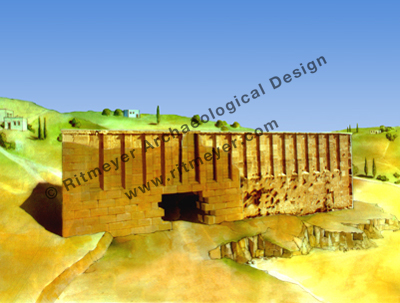
In another report, the US demands from Israel to remove the Tomb of the Patriarchs from Israel’s list of national heritage sites. The very architecture of the Tomb of the Patriarchs of proves that it was built by Herod the Great.

The Tomb of the Patriarchs. The wall has been partly cut away to indicate the location of the double cave where Abraham, Isaac and Jacob and their wives were buried.- © Leen Ritmeyer

The Mugrabi Gate is also in the news, as it has been reported that falling stones from the ramp could endanger the women who pray below:

UNESCO appeared to support the PA demand for the Temple Mount as well, asking that Muslim officials be allowed to examine the Mughrabi Gate near the Western Wall (Kotel). Muslim leaders have accused Israel of attempting to damage the Al-Aksa Mosque on the Temple Mount under the guise of repairs to the Mugrabi Gate. Israeli officials have warned that if the gate is not repaired, it could collapse, putting worshipers at the Western Wall at risk.

Rabbi Shmuel Rabinovich, Rabbi of the Western Wall, termed the decision “outrageous.” “They have never said in the past that this was a Muslim holy site. The [UN] organization responsible for heritage has turned heritage into politics.” Israel should think carefully about whether or not to cooperate with UNESCO in the future, he said.

In an earlier post, The UNESCO leopard has not changed its spots, we discussed the problems of the ramp. It is clear that nothing has changed in the attitude of UNESCO. See also Todd Bolen’s post: Falling Stones Endanger Women at Western Wall.

HT: Joe Lauer

Report on the Destruction of the Temple Mount

Government ‘tried to bury’ report on Temple Mount excavations

This funny pun introduces an article about the suppression by the Government of Israel of a report on the illegal Temple Mount excavations.

We had earlier reported here, here, here, here, here and here on these illegal excavations and registered our protest.

The newspaper article goes on to say:

The report has not yet been published but Knesset sources who have seen it say it contents are so sensitive that they could spark riots once revealed.

It doesn’t take much to spark a riot in Jerusalem, but we are interested to hear more about this report than seeing people injured.

First Temple period wall found in Jerusalem – revisited

One of my blog readers, Arthur Chrysler, made the following comments on a previous post, which I would like to share with other blog readers:

The Large Tower, explored by Warren and one hundred years later by Dame Kenyon, is constructed of stones of the character identified as Phoenician at Samaria. The header-and-stretcher construction is also identified as Phoenician at Samaria. Kenyon stated, “The date of these earliest walls, on the basis of the deposits against them, is, on the field estimate of the pottery, eighth century B.C. OR EARLIER (Digging up Jerusalem p.115). She also states in the caption under pl. 38, “Wall in Site S II on eastern crest of eastern ridge, which can be STRATIGRAPHICALLY dated to 8th century B.C….”. This area of Jerusalem is not a Tel! You cannot stratigraphically date anything here. This unique topography, consisting of a steep slope with exposed bedrock demands unique methodology. Kenyon states that, “Close at hand, there was a wall of the time of Solomon, from which the builders of the eighth century B.C. derived their stones”. King Hezekiah had a unique style of construction as seen in the Broad Wall, the Outer Wall, and his section of wall cutting across the Jebusite angle above the Gihon Spring. None of these examples give a hint of header-and-stretcher characteristics. Why would Hezekiah go through the trouble of re-stacking Solomon’s massive stones to move the tower only a few meters? Kenyon used the dating method that she was familiar with but it led her to the wrong conclusion regarding the tower here. The tower is certainly Solomonic and the connected wall and the Golden Gate, all of which display Identical characteristics.

If it is true that nothing can be dated stratigraphically in this part of Jerusalem, how can you then insist on a Solomonic date for the wall in Kenyon’s site SII and Benjamin Mazar’s Field 23? Kathleen Kenyon excavated down to the bedrock in this area and indeed concluded that:

“Beneath … the Byzantine wall … is a wall which probably belonged to a projecting tower. The date of these earliest walls, on the basis of the deposits against them, is … eighth century B.C. or earlier.” “… these walls were constructed of re-used stones … with irregular projecting bosses having margins on one, two or three sides.”

If these stones are indeed in secondary use, which I am not convinced of, it is possible that these are rejects or surplus masonry from Hezekiah’s square Temple Mount construction.

If you would examine the elevation, section and Isometric drawing of the Ophel Wall on Warren’s Plans, Elevations, Sections, etc., (1884), Plate 40, then it is clear that this L-shaped wall is built against an earlier wall and one can still see today that two different First Temple period building phases are represented in this area. That is why Warren called this wall section the “Extra Tower” or “Corner Turret”, i.e. it is a tower that was later added to strengthen an earlier fortification or part of the city wall. If the L-shaped wall, as you insist, is Solomonic, does that make the wall against which it is built Canaanite? If there are two construction phases in a building, that is called stratigraphy, showing that one wall is earlier than another. This stratigraphy is not different from that on a tell. This picture shows that the stratigraphically four building constructions can be identified:

1. The Byzantine Tower
2. Excavating inside and below the Byz. tower, a Herodian mikveh was found that was built against the inside wall of the “Extra Tower” (not visible in the picture)
3. The 8th century L-shaped “Extra Tower”
4. The pre-8th century wall against which the “Extra Tower” was built, which may be Solomonic if that can be proved conclusively.

Kenyon dated this L-shaped corner construction to the eighth century B.C. or earlier, but that does not necessarily mean that it is Solomonic. You compared it with the Phoenician masonry in Samaria, but that dates to the 9th century and is not Solomonic. A similar style masonry has been found in the sanctuary walls in Tel Dan, which is also post-Solomonic. I had suggested that there is an historical link between the “Extra Tower” and the masonry near the Golden Gate, but neither of these two constructions can be Solomonic.
The Destruction of the Temple Mount continues

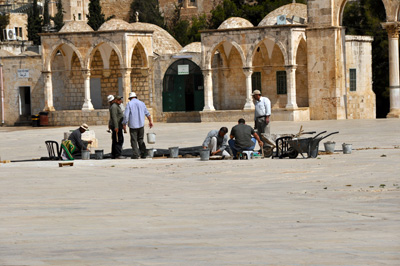
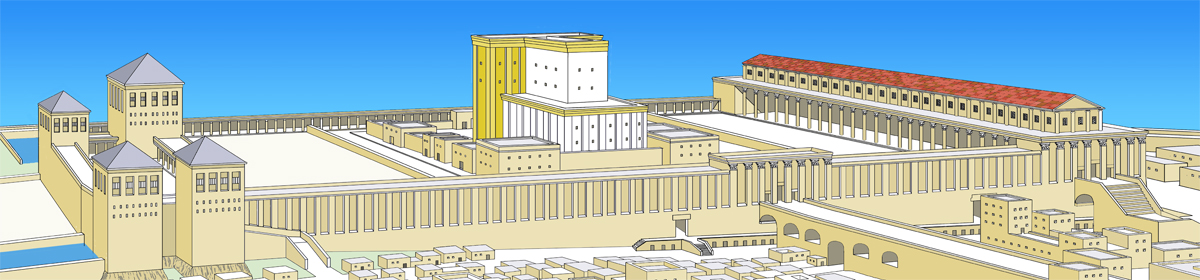
It is feared that the destruction of the Temple Mount by Muslims continues. It has been observed that work is taking place to the east of the Dome of the Rock, where the Court of the Priests and the Altar were located. According to this report:

“The Waqf works are constant, we see tractors going to and fro carrying earth. The work is taking place near the Dome of the Rock, exactly in the place between where our Holy Temple’s courtyard and the Altar used to stand. The Waqf claims they are doing pavement work there, or so they advertise in the news sites, but in practice they surrounded themselves in white burlap and we see there is scaffolding. I suppose that for paving works there should be no need for scaffolding.”

The bedrock is only a few feet below the pavement and the layers between it and the pavement could easily be destroyed. On a visit to the Temple Mount last year, we observed repairs to pavement north of the Dome of the Rock and it was clear that no digging with tractors was involved:

Hopefully some more information will become available soon.

Bible Lands Expedition (BLE) tour


Another BLE Bible Lands Expedition study tour is planned for October 2010, God willing. Dr. Steve Collins and myself will be leading the tour. This is an exciting adventure travelling through Jordan and Israel with the likely outcome that you’ll never read your Bible in the same way again! We do not take more than one bus full, so you really get to know each other well. There are a few places left, so have a look at the website and tour overview!

“Solomonic Wall” found in Jerusalem

The confusion in the reporting on this wall was summed up in one sentence by Neil Silberman: “Dr. Eilat Mazar is at it again– running to the press before properly submitting her finds to serious archaeological scrutiny.” This has been my personal experience going back to 1986.

I do believe that she is a good archaeologist, but this running to the press, without giving scientific reasons for her conclusions is totally unacceptable. People are no longer prepared to believe statements that are not backed up with facts. It gives Biblical Archaeology a bad name.

Barnea Levi Selavan of the Foundation Stone organisation, which, together with Ateret haCohanim, has the aim of purchasing and restoring “ancient homes in the Old City which are occupied by young and idealistic yeshiva families and students who have breathed new life into the heart of Yerushalayim”, wrote this to me:

“Eilat explained to the press that she reached bedrock, she dug under the floor and found 10th century pottery in the fill under the floors. most media reports did not quote this. she said no evidence of Canaanite structure earlier here. Typology of pottery distinctively Israelite. Original floor preserved in two places.”

So, all that was done, as I already presumed, was digging down deeper in previously excavated areas and finding 10th century material. How that fill relates to the wall segments is still unclear.

Solomon’s Temple

In November last year, I gave some lectures at the New Orleans Baptist Theological Seminary (NOBTS).

An abstract of my lecture on Solomon’s Temple has been put on their website. You can read it here.

Where Heaven and Earth Meet: Jerusalem’s Sacred Esplanade

A new book on the Temple Mount was published today in Jerusalem. It has been widely reported, for example here, here, here and elsewhere. Various Jewish, Muslim and Christian authors discuss the meaning of the Temple Mount, called in this book the “Sacred Esplanade”. The book is a collection of essays by renowned scholars on the history, archaeology, aesthetics and politics of the place that Jews revere as the location of their two ancient temples, and that now houses the Al Aksa Mosque, the third holiest site in Islam. The aim was to “to try to dispel insensitivity born of ignorance.”

Book

According to Miriam Feinberg Vamosh this aim was not achieved: “Despite their best efforts to produce an ecumenical book, the editors of this beautiful volume on the Temple Mount could not induce their Jewish, Christian and Muslim authors to agree on a single narrative, a fact that only confirms the complex and deeply held variety of traditions associated with the site.”

The wanton ignorance of archaeological evidence of the ancient temples, despite the many discoveries which prove that a Jewish Temple once graced the Temple Mount, has sadly led many Palestinians to deny any real Jewish attachment or claim to the plateau.

Nevertheless, I look forward to reading this book.

Source: Joe Lauer

Coins from ancient Jewish revolt found near Temple Mount on display

AP reported that an interesting collection of coins, which was found below the Herodian street along the Western Wall of the Temple Mount, is on display at the Davidson Centre. One coin, with a date palm portrayed on it, dates from one year before the Roman destruction of Jerusalem.

A peek into excavations near the Temple Mount

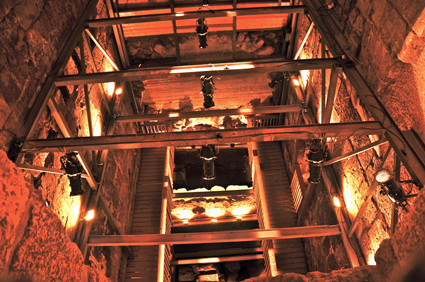
Just over a week ago I led a tour through the Western Wall tunnels and saw some very deep excavations between the foundations of buildings which date from the Mamluk period (14th-15th Century AD). Excavations are continuing until bedrock is reached. Several mikva’ot (Jewish ritual baths) from the Second Temple period were observed – an indication that Jerusalem was indeed Jewish at the time. Here is a picture I took of one of the deepest excavation pits:

WWHFdig

Joe Lauer sent me this report, showing that not everybody is happy with the excavations. The title of the article is misleading, as no excavations are conducted inside the Temple Mount. The Muslim claim that tunnels are dug within the Temple Mount are not true. The whole area lies to the west of the Temple Mount. An invitation to tour the area was turned down by Muslims. How can one reach understanding when dialogue is refused?