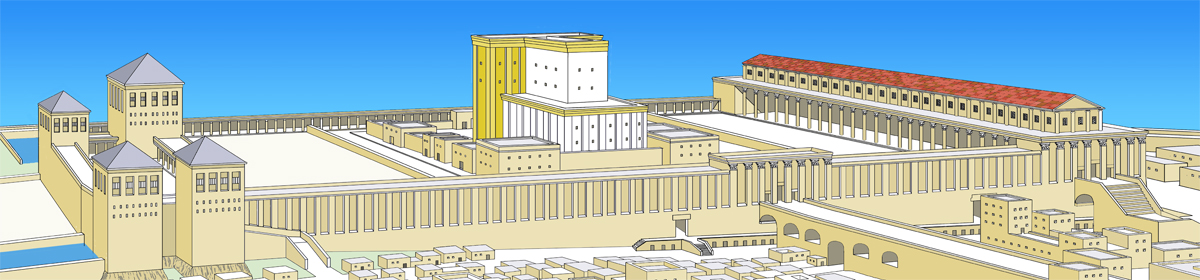
Rachel’s Tomb, The Tomb of the Patriarchs and the Mugrabi Gate

The politicians are at it again. UNESCO has declared The Tomb of Rachel to be a mosque. Israel’s Prime Minister has slammed the report.

The claim is, of course, ludricous. This photograph, taken in 1890-1900, already describes the building as The Tomb of Rachel:

The Tomb of Rachel - photograph taken in 1890-1900

Joe Lauer reminded us of what Abba Eban once said about the United Nations General Assembly, “If Algeria introduced a resolution declaring that the earth was flat and that Israel had flattened it, it would pass by a vote of 164 to 13 with 26 abstentions.” 

When guiding round the Temple Mount excavations, we always pointed out that the headquarters of the United Nations are rightfully situated on the Mount of Evil Counsel.

In another report, the US demands from Israel to remove the Tomb of the Patriarchs from Israel’s list of national heritage sites. The very architecture of the Tomb of the Patriarchs of proves that it was built by Herod the Great.
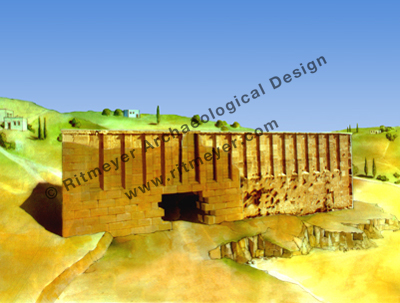
The Tomb of the Patriarchs. The wall has been partly cut away to indicate the location of the double cave where Abraham, Isaac and Jacob and their wives were buried.- © Leen Ritmeyer

The Mugrabi Gate is also in the news, as it has been reported that falling stones from the ramp could endanger the women who pray below:

UNESCO appeared to support the PA demand for the Temple Mount as well, asking that Muslim officials be allowed to examine the Mughrabi Gate near the Western Wall (Kotel). Muslim leaders have accused Israel of attempting to damage the Al-Aksa Mosque on the Temple Mount under the guise of repairs to the Mugrabi Gate. Israeli officials have warned that if the gate is not repaired, it could collapse, putting worshipers at the Western Wall at risk.

Rabbi Shmuel Rabinovich, Rabbi of the Western Wall, termed the decision “outrageous.” “They have never said in the past that this was a Muslim holy site. The [UN] organization responsible for heritage has turned heritage into politics.” Israel should think carefully about whether or not to cooperate with UNESCO in the future, he said.

In an earlier post, The UNESCO leopard has not changed its spots, we discussed the problems of the ramp. It is clear that nothing has changed in the attitude of UNESCO. See also Todd Bolen’s post: Falling Stones Endanger Women at Western Wall.

HT: Joe Lauer

Mamre and the Temple Mount in Jerusalem

Israel National News, Arutz Sheva, reported today that the site of Mamre near Hebron has been visited recently and may be opened soon.

The site is mentioned three times in Genesis, in chapters 13,14, and 18. This is where Abraham settled after separating from his nephew Lot, where he built an altar to G-d, and where G-d sent him three angels to inform him that his son Isaac would be born the following year.
It was also here that Abraham established the first Hebrew army, for the purpose of rescuing Lot, who had been kidnapped by the Four Kings during their war against the Five Kings as described in Genesis.

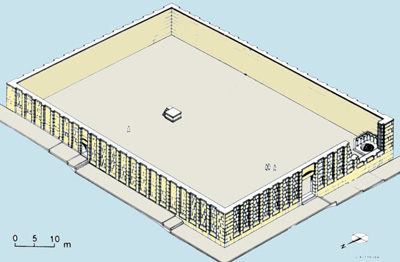
The Herodian wall with pilasters in Mamre - © Leen Ritmeyer

Today, Elonei Mamre is also one of Israel’s most important archaeological sites. A two-meter-high, 70-by-30-meter wall has been found there, apparently built by King Herod 2,000 years ago. The wall’s construction has similar characteristics to that in the Machpelah Cave [the Cave of the Patriarchs, ed.] and the Western Wall in Jerusalem. Remains of two towers from an earlier period have also been found in Elonei Mamre.

In the 1980’s I visited the site and made this reconstruction drawing of the Herodian enclosure. It was amazing to see how closely the architectural style of the outer walls resembled those of the Tomb of the Patriarchs in Hebron and the Temple Mount in Jerusalem.

Reconstruction drawing of the Herodian enclosure at Mamre - © Leen Ritmeyer

Queen Helena of Adiabene and the Temple Mount

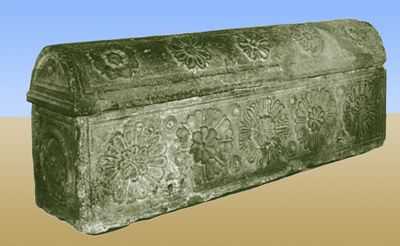
The sarcophagus of Queen Helena of Adiabene is now on display at the Israel Museum.

The Sarcophagus of Queen Helena of Adiabene

This sarcophagus and others had been removed in the 15th century AD from the so-called Tombs of the Kings in Jerusalem. In fact, this tomb complex should have been called the Tomb of the Queen, as it has been identified by her name on the above-mentioned sarcophagus. After removal, these sarcophagi were used as watering troughs on and near the Temple Mount.

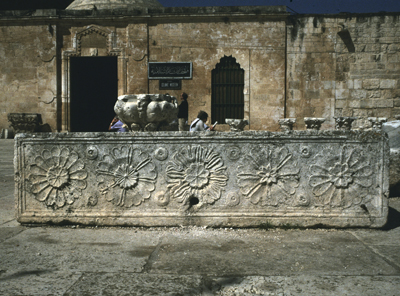
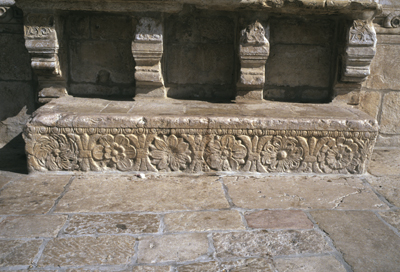
In 1866, the sarcophagus of Queen Helena was taken away and given to the French explorer Louis Felicien de Saulcy, who shipped it to France. Two of these sarcophagi remain on the Temple Mount, one in front of the Islamic Museum and the other at the foot of the Qayit Bay Fountain.

Herodian Sarcophagus at the Islamic Museum on the Temple Mount - Photo: Leen Ritmeyer
Herodian Sarcophagus at the foot of the Qayit Bay Fountain on the Temple Mount - Photo: Leen Ritmeyer

What interests me in these sarcophagi is their decorations. They all display rosettes, resembling flowers. These motifs are well known from the Temple Mount Excavations, where many such fragments were found. None of these fragments were large enough to inform us reliably as to the style of Temple Mount decoration. In order to make reconstruction drawings, we had to turn to the funerary monuments and sarcophagi of the Second Temple period which reflected the architecture on the mount itself.
The variation in motifs was amazing. For instance none of the rosettes on the sarcophagi and tomb friezes was the same as the next. The sarcophagus of this Mesopotamian queen with its arrangements of rosettes resembling a frieze is invaluable as an indication of the splendour and beautiful architecture of Herod’s Temple and the buildings of the Temple Mount.

Fake Arab Tombs near the Temple Mount in Jerusalem

When archaeological investigations were frustrated by existing tombs, be they Jewish, Muslim or Christians, we used to say that the dead are more powerful than the living. Graves are usually respected by archaeologists. Fake tombs, however, should not be respected. See this report: Fake tombs near the Eastern Wall of the Temple Mount

MK Nisim Ze’ev (Shas) said the matter was a very serious one. “The Jerusalem Municipality is allowing complete abandonment of territory and assets,” he said. “The Arabs are trying to conquer the Land of Israel in every possible way. If we do not wake up to their conniving ways we will find ourselves before a gaping chasm. We need to plow the area and take down all of the fictitious tombs.”

Pictures of the fake tombs near the eastern Wall of the Temple Mount can be viewed in this article [Hebrew].

Hopefully, the un-dead in the fake tombs will not be so powerful when their un-existing remains and their rough stone enclosures will be removed.

Temple Mount Repairs Leave Eyesores

Hershel Shanks comments on the unsightly appearance of the repair of bulges in the Temple Mount walls that was done several years ago and the scaffolding that was left behind. The Waqf (Muslim authority over the Temple Mount) and the Israelis accuse each other of having caused these bulges, on one of which we reported in a previous post.

One of the first lessons I was taught during the MA course in the Conservation of Ancient Buildings at the Institute of Advanced Architectural Studies of the University of York, UK, was that one NEVER uses ordinary Portland cement in the repair of ancient buildings. It prevents ancient walls from “breathing” and eventually causes the collapse of these walls. The Waqf’s continued use of modern building materials in the repair of these bulges and other walls is the equivalent of putting a time-bomb in the walls of the Temple Mount.

Hershel asks himself the question about the remaining scaffolds: “They’ve been there now for several years. How much longer?” I can’t aswer that question, but I am sure that the unsightly repairs won’t be there for ever, for the ancient Temple Mount walls keep absorbing, not only the normal amount of rain water, but also the added amount of water that runs off the new paving that was laid at the southern end of the Temple Mount and that was also sealed with Portland cement. When ancient walls can’t breathe, they eventually collapse.

The Destruction of Jerusalem’s Temple and Rome

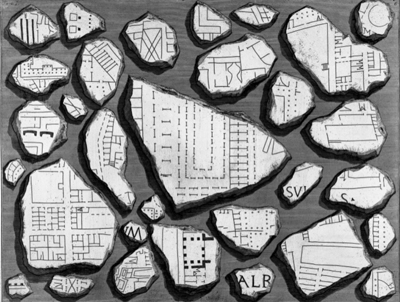
Archaeologists hope to find more pieces of the ancient Forma Urbis Severiana, a marble map that was attached to the wall of the Temple of Peace in Rome. A plan of the city during the time of the Roman Emperor Septimius Severus (193-211 AD) was incised on 150 marble slabs, arranged in eight rows and covering an area of 60 by 43 feet. It shows in astounding detail the layout of streets with housing insulae, temples, bath houses and commercial areas.

Several pieces of the world’s oldest and largest unsolved jigsaw puzzle, a 2,200-year-old map of Rome made of thousands of marble fragments, could be unearthed next year following construction work for a new metro line near Rome’s majestic forum area.
“This is a unique occasion to excavate the Forum of Peace, where the map once stood,” Rossella Rea, director of the Colosseum, told the Italian financial daily “Il Sole 24 Ore.”
Carved into marble slabs around  210 A.D., during the rule of the emperor Septimius Severus, the map was originally hung on a wall in the Templum Pacis (Temple of Peace), which stood in the middle of an enclosure called Forum of Peace.
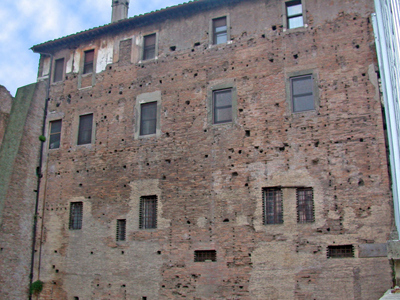
The wall still survives today in a building near the 6th-century Church of Santi Cosma e Damiano. Rows of holes where the map was attached using bronze clamps can still be seen.

Surviving wall of the Temple of Peace. Bronze clamps were fixed in the holes of the wall to keep the marble slabs in place

Reporter Rossella Lorenzi mentions the fascinating connection with the destruction of the Temple of Jerusalem in 70 AD:

The centerpiece of the Forum of Peace was indeed the temple. Built in 71-75 A.D by Vespasian, the Temple of Peace celebrated the brutal pacification of the Jews and the destruction of the Temple at Jerusalem in 70 A.D.
Tons of gold, silver trumpets and gold candelabra were plundered from the Jerusalem temple and paraded through Rome’ streets in triumph.
The moment was captured in a frieze carved into the Arch of Vespasian’s son, Titus, which clearly shows the menorah, the seven-branched temple candelabra that was the symbol of ancient Judaism, being exposed through the streets.
Between 75 A.D. and the early 5th century, the treasure, which helped finance the building of the Colosseum, was put on public display right in the Temple of Peace.
Although it is unlikely that fragments from the treasure are unearthed, the archaeologists hope to bring to light other precious remains from the Forum of Peace.

Marble pieces from the Forma Urbis Severiana - the Plan of Rome in about 210 AD

HT: Joe Lauer

Elevator for the disabled near the Temple Mount

According to this report, the Company for the Reconstruction and Development of the Jewish Quarter plans to build an elevator inside an underground tunnel leading from the Jewish Quarter to the Western Wall Plaza.

The report tries to draw a historical parallel with the Temple Mount that stood in Jerusalem 2,000 years ago:

Two thousand years ago, stone bridges connected the Jewish Quarter directly to the Temple Mount, saving the high priests the long trek down and back up.

There was actually only one bridge, namely the Bridge of the Priests that was constructed over Wilson’s Arch between the Temple Mount and the Upper City – now the Jewish Quarter. The other arch, Robinson’s Arch, carried a stairway down to the street along the Western wall:

Despite the fact that the exit of the tunnel will be located about 1,000 feet to the west of the Temple Mount, according to this report the Arabs are, predictably, against it.

The purpose of the underground elevator “would greatly improve access for visitors in wheelchairs or those with other disabilities, who now have to contend with several flights of stairs”, but the Arabs claim “that the area in front of the wall could be used as a base from which to attack the mosque compound.” Even helping disabled people in Jerusalem is looked upon as suspicious by the Arabs.

HT: Joe lauer

Islamic Destruction of the Temple Mount report

By Anshel Pfeffer, August 12, 2010


Tons of rubble was removed from under Temple Mount by the Muslim authority that oversees the site

An investigation into the failure of law enforcement agencies to prevent what is alleged to have been an attempt to wipe out Jewish history on Temple Mount 11 years ago looks set to cause widespread controversy.

The publication of the report into the removal, by night, of 6,000 cubic metres of mud from beneath the Al Aqsa Mosque by the Muslim Wakf authority that oversees the management of the mosque compound, has been suppressed for months by the government.

The dirt was dug out to make way for a new underground mosque, but Israeli archaeologists and politicians claim that another motive of the Wakf and the Islamic Movement – which financed the work – was to remove evidence of Jewish history from the site where the two temples of Jerusalem stood.

The excavation and building was carried out without any official permit from the planning authorities. Belated intervention by the Justice Ministry, spurred on by a rare petition signed by politicians, writers and archaeologists from the right and the left, brought the digging to an end, but it was too late.

Thousands of volunteers have been sifting ever since through the hundreds of tons of dirt, dumped in a valley east of Jerusalem, unearthing rare remnants of the Temple Mounts from all ancient periods of Jerusalem, going back to the Bronze Age. Among them were fragments and coins from the First and Second Temples, and relics of the Persian, Babylonia, Maccabean, Herodean, Roman, early Christian and Byzantine eras. The work is of questionable historic value as the rules of archaeology mandate that findings should be recorded in their original location, but is still ongoing.

Meanwhile, for the last three years, the Comptroller’s Office has been conducting an investigation into the way the Israeli government, the police and Jerusalem City Hall have relinquished control of the sacred site.

“The conclusions are clear,” says one source who has seen the report, “Israeli law ends at the gates to the Temple Mount.”

The reason for this is the same motive that has caused the government to try and suppress the report for the past few months, previous attempts to enforce Israeli sovereignty over the Temple Mount have provoked widespread Palestinian violence, as did the visit of the opposition leader, Ariel Sharon, in September 2000, which sparked the second intifada.

“On the one hand, no government wants to be seen as impotent,” said a security official in Jerusalem, “but they prefer keeping the status quo on the Temple Mount to another intifada with all that entails. Even when the report finally gets out, the government will do everything in its power to play it down.”

HT: Joe Lauer

Virtual Model of the Temple Mount in the Time of Jesus

From Justin Taylor’s blog:

For several years UCLA’s Urban Simulation Team has been working on a virtual reconstruction of Jerusalem and the Temple Mount prior to the destruction of A.D. 70. In collaboration with the Israel Antiquities Authority they have put together a display at the Ethan and Marla Davidson Exhibition and Virtual Reconstruction Center in Jerusalem.

Below is a video clip—the model was created by Dr. Lisa M. Synder—showing what the Temple Mount and Herod’s Temple would have looked like in the time of Jesus.

This video is not new, but always worth watching. The UCLA’s Urban Simulation Team are the ones who developed the Temple Mount animation at the Davidson’s Visitors Centre at the entrance to the Temple Mount Excavations in Jerusalem.

I got to know Justin Taylor when he was Project Director and Managing Editor of the ESV Study Bible.

This site allows you to download the trailer of another Temple video, which I worked on a few years ago. These videos are really useful if you want to imagine what the Temple looked like in the time of Jesus.

Here is the video itself:

New RAD Web Design

Thanks to our web designer we have been able to revamp our website and we hope you like the new design. A reconstruction drawing of the Eastern Wall of the Herodian Temple Mount with the Temple appears in the header, which we plan to eventually rotate with other designs.

The upgrade is not meant to be a pretty face only, but we hope to put more information on the site. We have started with our new Showcase, giving you an idea of the projects we have been involved in over the last few years. Please have a look …

We also plan to list reviews of books, movies and software which we have found particularly helpful for students of Biblical Archaeology.

We are even more excited about putting up an archive with photographs of archaeological sites and reconstruction models and also, of course, reconstruction drawings. Thumbnails of the illustrations will be available for all to see, with an option to buy low resolution pictures for Powerpoint presentations and high resolution ones for publishers.

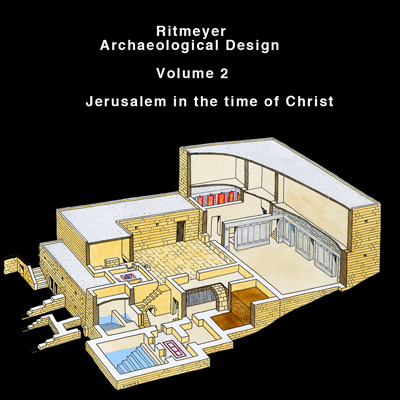
Many of you have asked why Vols. 2 and 3 are missing from the list of available CD-ROMs. Well, you won’t have to wonder much longer, as we are about to release these volumes. Volume 2 is called Jerusalem in the time of Christ:

Cover for Volume 2: Jerusalem in the time of Christ

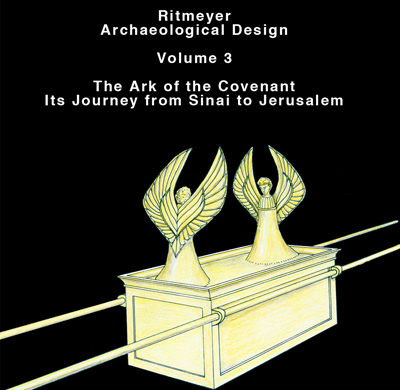
Volume 3 is called The Ark of the Covenant – Its Journey from Sinai to Jerusalem, and we will let you know as soon as they are available.

Cover for Volume 3: The Ark of the Covenant - Its Journey from Sinai to Jerusalem

Many years ago, we produced slide sets on these subjects and now the time has come to go digital. Whereas the two slide sets contained only 36 slides, the new CD-ROMs will have many more, with new digital or digitally enhanced pictures.

Another presentation on the Seven Churches of Revelation is also in the works.