Israel Government buries Temple Mount report

The Jerusalem Post has a follow-up on Sunday’s article on the Temple Mount report, as reported in our previous post:

Comptroller Temple Mount report stays behind closed doors

It reminded me of a volunteer who found a camel’s tooth on the Temple Mount dig. She was so excited that she buried it again for another volunteer to find and be excited as well. The Knesset is burying part of this highly sensitive document “for diplomatic and security reasons”.

Israel is a democracy, so this report will eventually be unearthed again and I wonder if the public will be so excited as the second volunteer, when they read it, for “It is not a secret that the Waqf is building on the Temple Mount, that works have been done, and that many archeological findings have been destroyed.”

Source: Joe Lauer

First Temple period wall found in Jerusalem – revisited

One of my blog readers, Arthur Chrysler, made the following comments on a previous post, which I would like to share with other blog readers:

The Large Tower, explored by Warren and one hundred years later by Dame Kenyon, is constructed of stones of the character identified as Phoenician at Samaria. The header-and-stretcher construction is also identified as Phoenician at Samaria. Kenyon stated, “The date of these earliest walls, on the basis of the deposits against them, is, on the field estimate of the pottery, eighth century B.C. OR EARLIER (Digging up Jerusalem p.115). She also states in the caption under pl. 38, “Wall in Site S II on eastern crest of eastern ridge, which can be STRATIGRAPHICALLY dated to 8th century B.C….”. This area of Jerusalem is not a Tel! You cannot stratigraphically date anything here. This unique topography, consisting of a steep slope with exposed bedrock demands unique methodology. Kenyon states that, “Close at hand, there was a wall of the time of Solomon, from which the builders of the eighth century B.C. derived their stones”. King Hezekiah had a unique style of construction as seen in the Broad Wall, the Outer Wall, and his section of wall cutting across the Jebusite angle above the Gihon Spring. None of these examples give a hint of header-and-stretcher characteristics. Why would Hezekiah go through the trouble of re-stacking Solomon’s massive stones to move the tower only a few meters? Kenyon used the dating method that she was familiar with but it led her to the wrong conclusion regarding the tower here. The tower is certainly Solomonic and the connected wall and the Golden Gate, all of which display Identical characteristics.

If it is true that nothing can be dated stratigraphically in this part of Jerusalem, how can you then insist on a Solomonic date for the wall in Kenyon’s site SII and Benjamin Mazar’s Field 23? Kathleen Kenyon excavated down to the bedrock in this area and indeed concluded that:

“Beneath … the Byzantine wall … is a wall which probably belonged to a projecting tower. The date of these earliest walls, on the basis of the deposits against them, is … eighth century B.C. or earlier.” “… these walls were constructed of re-used stones … with irregular projecting bosses having margins on one, two or three sides.”

If these stones are indeed in secondary use, which I am not convinced of, it is possible that these are rejects or surplus masonry from Hezekiah’s square Temple Mount construction.

If you would examine the elevation, section and Isometric drawing of the Ophel Wall on Warren’s Plans, Elevations, Sections, etc., (1884), Plate 40, then it is clear that this L-shaped wall is built against an earlier wall and one can still see today that two different First Temple period building phases are represented in this area. That is why Warren called this wall section the “Extra Tower” or “Corner Turret”, i.e. it is a tower that was later added to strengthen an earlier fortification or part of the city wall. If the L-shaped wall, as you insist, is Solomonic, does that make the wall against which it is built Canaanite? If there are two construction phases in a building, that is called stratigraphy, showing that one wall is earlier than another. This stratigraphy is not different from that on a tell. This picture shows that the stratigraphically four building constructions can be identified:

1. The Byzantine Tower
2. Excavating inside and below the Byz. tower, a Herodian mikveh was found that was built against the inside wall of the “Extra Tower” (not visible in the picture)
3. The 8th century L-shaped “Extra Tower”
4. The pre-8th century wall against which the “Extra Tower” was built, which may be Solomonic if that can be proved conclusively.

Kenyon dated this L-shaped corner construction to the eighth century B.C. or earlier, but that does not necessarily mean that it is Solomonic. You compared it with the Phoenician masonry in Samaria, but that dates to the 9th century and is not Solomonic. A similar style masonry has been found in the sanctuary walls in Tel Dan, which is also post-Solomonic. I had suggested that there is an historical link between the “Extra Tower” and the masonry near the Golden Gate, but neither of these two constructions can be Solomonic.
The Messiah in the Temple

In a previous report we commented on a new project called The Messiah in the Temple. A lot of progress has been made, especially in developing this new poster:

Martin Severin, the project manager wrote:

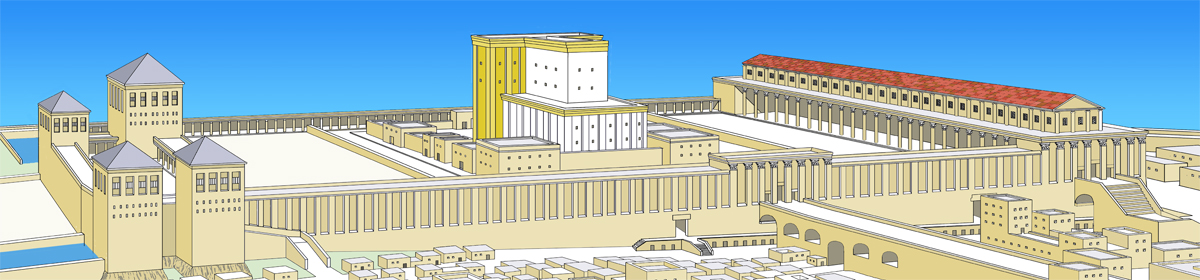
After months of detailed work we have succeeded in producing a photographic rendition of the Herodian Temple in the time of Jesus with 20.000 x 6000 pixels (that is 120 mega pixels). This makes it possible to get pin sharp prints which are several meters long. There is an astonishing amount of detail to be seen. We have tried to present everything as authentically and true to the original as possible. We even photographed the unique light quality and some single stones on-site at the remains of the temple to make the result as authentic as possible. Everything was based on the excellent building plans by Dr. Leen Ritmeyer. More than 2000 digital people were painstakingly included in the picture so that the end result is very realistic.
It’s only the beginning, but this is the kind of quality we intend to stick to for the rest of the project. In the photograph above you can see the first small version of this picture. The idea is to reproduce the final photograph in poster size which can be sold to raise further funds for the project.

The Temple Mount on a bus

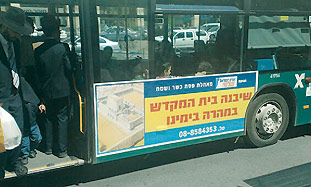
Who would have thought to see a reconstruction drawing of the Jerusalem Temple on a bus? Reconstruction drawings usually appear in books, magazines and occasionally on stamps, but on a bus? I don’t normally comment on politics, but this is different, see this Jerusalem Post report:

While tensions continue to simmer around the Temple Mount after riots in and around the capital’s Old City earlier this month, a new campaign calling for the construction of the Third Temple atop the holy site has made its way to the sides of 200 Egged buses in the city, which now sport posters featuring a picture of a rebuilt temple on the Mount, and nothing else.

The posters, which contain the phrase, “May the Bais Hamikdosh be rebuilt speedily and within our days,” were sponsored by the Our Land of Israel group, which is led by Rabbi Shalom Dov Volpo and activist Baruch Marzel, leave out the site’s current structures – namely the the Aksa Mosque and the Dome of the Rock.

The campaign’s organizers chose to plaster the posters on buses whose routes take them through predominately Arab neighborhoods of east Jerusalem.

With regards to the campaign, Volpo said Israel is waiting breathlessly for the coming of the messiah and the rebuilding of the temple.

“The Arabs and President Obama know that the Temple will be built on the Temple Mount,” he said. “Instead of the temporary buildings that are there today.”

Speaking to The Jerusalem Post on Sunday, Marzel said it was no mistake that the Islamic shrines were left out of the picture.

“We’re representing the truth, in front of everyone, and saying out loud what every Jew believes,” Marzel said. “That the Third Temple needs to be built immediately on the Temple Mount and that the mosque should not be there.”

“When we reach the end of the Pessah Seder tomorrow night, he continued, “we’ll say, ‘Next year in a rebuilt Jerusalem.’ What does ‘rebuilt’ mean? It means with the Third temple intact.”

Marzel brushed off the furor the ads might elicit from the capital’s Muslims, saying, “It upsets them that we’re alive, and that we’re living here.”

360 degree view of the Double Gate Tunnel

I just found this on Todd Bolen’s blog… a 360 degrees, virtual reality view of the inside of the Al-Aksa Mosque, Dome of the Rock and the underground Double Gate tunnel.

When you look at the Double Gate tunnel view, be sure to look up and see the beautifully decorated domes which still exist in their original form!

New Studies on Jerusalem

On Thursday, December 24, 2009 a conference will be held dealing with new studies on Jerusalem at the Ingeborg Rennert Center, Martin (Szusz) Department of Land of Israel Studies and Archaeology, The Faculty of Jewish Studies at the Bar-Ilan University in Israel. The conference will be held in Hebrew, but the proceedings with English abstracts will be available at the conference. If you understand Hebrew and are lucky enough to be in Israel at that time, here is the programme:

8:20 gathering
8:45 opening remarks:
Prof. Joshua Schwartz, Director of the Ingeborg Rennert Center for Jerusalem Studies
Prof. Avraham Faust & Dr. Eyal Baruch, conference organizers

Session 1 – 9:00-10:55
Chair: Eyal Baruch
09:00 Ronny Reich & Eli Shukron- Channel II in the City of David, Jerusalem: Technical Details, Date and Function
09:20 Avraham Faust- King David’s Palace, a Hellenistic Structure or a Jebusite Fort: A Reexamination of the Large Stone Structure Unearthed by Eilat Mazar in the City of David
09:40 Moshe Garsiel- The Book of Samuel: Compilation Stages and Historical Value for Describing David’s Kingdom and His Capital in Jerusalem
10:05 Ehud Nezer- An opus reticulatum Structure, West of the Old City, Jerusalem
10:25 Ram Bouchnick, Omri Larnow, Guy Bar-Oz & Ronny Reich- Jerusalem Fish Menu from the Late Second Temple Period
10:45 Discussion
10:55 Break

Session 2 – 11:20-13:10
Chair: Joshua Schwartz
11:20 Michael Ben-Ari- Simchat Beit Sho’eva – The Origins of the Custom.
11:40 Varda Sussman- Shaving/paring of Herodian Oil Lamps
12:00 Ze’ev H. Erlich (Jabo) – What is the ‘Kotel ha-Katan?’
12:20 Amos Kloner- The Damascus Gate
12:40 Yoav Farhi & Oded Lifshitz- A Unique Bulla from the Ramat Rahel Excavations Bearing the Name of Hadrian
13:00 Discussion

13:10 Lunch Break

Session 3 – 14:20-16:30
Chair: Josef Drory
14:20 Yehoshua Peleg- Were the Temple Mount Gates Reconstructed in the Second Century CE?

14:40 Gabriel Barkay and Zachi Zweig- A Roman Period Centaur Relief from the Temple Mount
15:00 Perez Reuven- A Decorated Beam from the Roman Period in the Temple Mount
15:20 Bat-Sheva Garsiel- The Status of Jerusalem in Early Islamic Theological Writings
15:40 Michael Ehrlich- The Southern Quarters of Jerusalem during the Medieval Period: A Multi-Periodical Overview
16:00 Oded Shay- The Contribution Made by the Jerusalem-based Monk Father Antonin, to Jewish Studies and to the Research of the Material Culture of Palestine in the Final Years of the Ottoman period
16:20 Discussion
16:30 Break

Session 4 – 17:00-18:30
Chair: Boaz Zissu
17:00 Amos Frumkin & Boaz Lengford- The Research of a Karstic Cave Used for Refuge in the Jerusalem Hills
17:20 Boaz Zissu & Roi Porat- A Hoard of Coins and Other Finds from the Bar-Kokhba Period, Recently Discovered in a Refuge Cave in the Jerusalem Hills
17:40 Guy Stiebel- “On the Edge” – Military Equipment from a Refuge Cave in the Jerusalem Hills
18:00 Hanan Eshel- New Discoveries from a Refuge Cave in the Jerusalem Hills, and their Contribution to the Study of the Bar-Kokhba War
18:20 Discussion

Source: Joe Lauer

Leprosy in Jerusalem

In 1994 my archaeologist-wife Kathleen and I wrote an article in Biblical Archaeology Review (Nov/Dec 1994) called “Akeldama – Potter’s Field or Priestly Cemetery?” Akaldama is mentioned in the Bible as a burial place for strangers, bought with the money given to Judas to betray Jesus (Acts 1.19). Akeldama means Field of Blood, for Judas, while trying to hang himself, fell down and his body burst open.

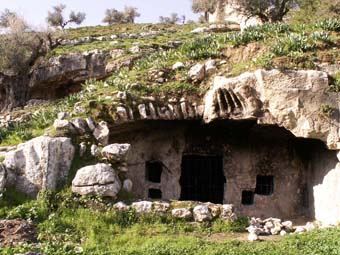
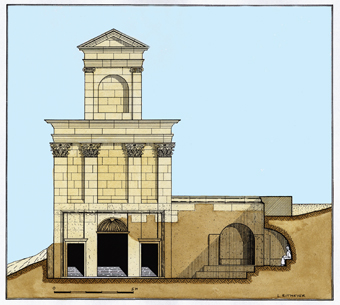
We then suggested that a small, but beautifully decorated tomb in the area below St. Onuphrius Monastery might have belonged to Annas the High Priest, who condemned Jesus to death, for the Temple Mount could be viewed from this tomb and the architectural decoration of the tomb has been copied from the Temple Mount. There are other decorated tombs in this area. Instead of a burial place for strangers, this area was most likely the cemetery of priestly families.

TombAnnasTn
Entrance to the Tomb of Annas the High Priest

AnnasTombTn
Reconstruction of the Tomb of Annas (© Ritmeyer Archaeological Design)

In June 2000, another tomb was accidentally found, which contained bones and remains of a linen shroud. The tomb is located next to the tomb which we had identified as Tomb of Annas. Carbon-14 dating showed that the shroud dated from the first half of the first century AD. It has been reported that a new analysis has now showed that the man to whom the shroud belonged suffered from leprosy. Leprosy is mentioned in the Bible, but this is the first time that archaeological evidence has proved that it actually existed. Joe Lauer pointed me to an article in the Daily Mail, which has several photographs of the tomb.

It is interesting to note that this shroud doesn’t look at all like the Turin Shroud. The shroud in Jerusalem was made up of several wrappings and there was a separate wrapping for the head. This would, of course, be in harmony with the burial of Jesus, whose body was buried with a separate head cloth (John 20.27).

National Geographic’s The Holy Land Special Issue

While we were in the US, we noticed a special November 2009 issue of the National Geographic on The Holy Land.

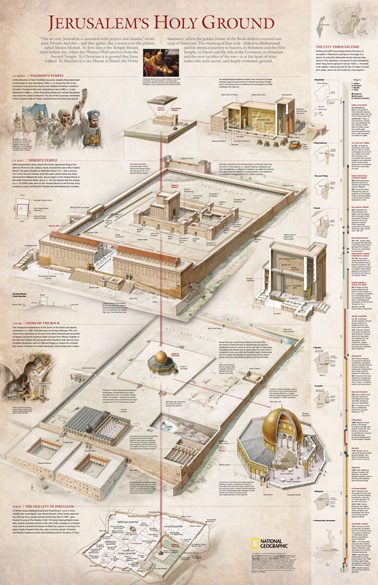
It has many interesting articles about the Holy Land, but it also has a previously published poster of the Temple Mount as an insert. We described this poster, of which we were one of the contributors, in this previous blog post. Many readers asked for copies of this map and we are delighted to announce that it is still available inside this special issue.

If you don’t have a subscription to the National Geographic, you can order this special issue here.

Here is a view of the poster, reproduced with permission of the National Geographic Society:

Conferences and Lectures in New Orleans

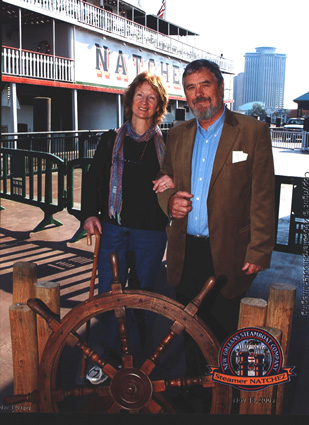
My wife Kathleen and I enjoyed our time last week in New Orleans and even had time to sail on the Mississippi on the Steamboat Natchez. It was also interesting to listen to the many stories about the Katrina disaster four years ago. People’s lives are still dominated by that event. Their recent history seems to be divided in pre- and post-Katrina periods. The New Orleans Baptist Theological Seminary, where I lectured for two days as the Manuel Lectureship Speaker, is only now getting back to normal, after having had to move to Atlanta, as most of the campus was flooded.

natchezweb

There were many lectures to choose from at the ASOR, ETS, SBL and NEAS conferences. We attended lectures, ranging from Satellite Remote Sensing, the Location of Sodom, through the latest updates of recent archaeological excavations, such as Kh. Qeiyafa and Tell Es-Safi/Gath, to a fascinating section on Teaching Archaeology.

The latter section was at times hilarious, listening to archaeologists who had to teach archaeology, without having had any prior teacher training, to students who didn’t know anything about the subject at all. Reading assignments sometimes produced gems like the title of Eric Cline’s lecture: “The Israelites Wondered in the Dessert for 40 years” and “Before the Printing Press, it took 300 Sheep to Write the Bible”.

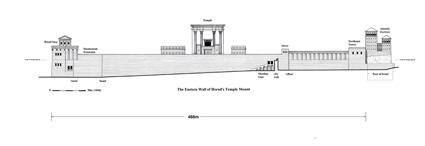
Here is a comment on my lecture on “The Eastern Wall of the Temple Mount in Jerusalem – Deciphering Its Story”.

Lectures by Dr. Leen Ritmeyer

On Nov. 15th and 16th, I have been invited by Dr. Dennis Cole to lecture at the New Orleans Baptist Theological Seminary on two topics:
• The History and Archaeology of the Temple Mount in Jerusalem.
• The History and Archaeology of Herodian Jerusalem.

On Nov. 18th, 9.00 am, I am scheduled to deliver a lecture for ASOR (American Schools of Oriental Research), also in New Orleans, on:
• The Eastern Wall of the Temple Mount – Deciphering its Story.

The Eastern Wall is the most interesting of all the Temple Mount walls, as three types of masonry can be discerned: Herodian, Hasmonean and Iron Age (8th Century B.C.). These masonry types are directly linked with the historical development of the Temple Mount.
EastWallBlog