Israel Independence day

Tomorrow is Independence day – Yom Ha’atzmaut in Israel. My suggestion for a great family picnic spot is Ramat haNadiv National Park.

Leen Ritmeyer (right) planning the reconstruction of the Herodian/Byzantine farm at Ramat haNadiv in 1988.

After the picnic you could visit the Herodian/Byzantine farm (Mansur el-Aqab) which I reconstructed many years ago.

Another interesting sit is Horvat-Eleq – an Herodian Fortress with adjacent water features, a columbarium and bathhouse.

Horvat Eleq, drawing by Adam Hook

Hag sameach – happy holidays!


Excavating the City of David – Where Jerusalem’s History Began

Recently we returned from a trip to Australia – hence the absence of blogs – and I was excited to receive this long-awaited book in the post.

Ronny Reich, Excavating the City of David – Where Jerusalem’s History Began
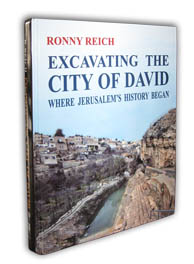
Ronny Reich has excavated in several locations in Jerusalem for over 40 years, starting in 1969 as surveyor on Prof. Nahman Avigad’s team in the Jewish Quarter (a position he held till 1978 when I took over this post, after he had left for the Israel Dept. of Antiquities and Museums) and in the City of David, together with his colleague Eli Shukron, since 1995.

This book is a fascinating account of the history of the City of David. The first part of the book recounts the activities of the many excavators who worked in this area and in the second part, Reich reconstructs the history of the City of David based on the results of all of the archaeological excavations.

The story of the early exploration begins with a description of the visit on April 17, 1838 by Edward Robinson to the Gihon Spring, the ever-flowing water source that determined the location of the City of David. This is followed by the account of Charles Warren’s daring walk through Hezekiah’s Tunnel, which Reich prefers to call the Siloam Tunnel. Reich then examines the explorations of many other excavators, such as Schick, Bliss and Dickie, Weill, Macalister and Duncan, Kenyon, Shiloh and others. Each investigator added a little to our understanding of the history of this site and Reich’s useful analysis of these findings makes it easier to fit them into an overall picture of the development of the City of David.

His own and Shukron’s explorations added much to our understanding of the waterworks in this location, especially how the different components, such as the Siloam Tunnel and the different channels worked together. His explanation of the construction of the Siloam Tunnel and how Channel I was used as a “spirit level” to make sure that the water of the Gihon Spring flowed smoothly to the Siloam Pool makes for exciting reading.

The excavations round the Gihon Spring revealed that the spring and its approach from the city were strongly fortified in the Jebusite period. Two massive walls created a safe approach to a Rock-cut Pool from which water could be drawn.

This book was written, according to Reich, “First and foremost … for lay readers who love the history of Jerusalem”. I found Reich’s discussion of the historical interpretations of the different finds honest and frank. He acknowledges, however, that he is a skeptic and minimalist where the Biblical text is concerned and has difficulty reconciling the text and the archaeological remains. He discusses these problems in a special boxed section called “Biblical traditions: David, Solomon and the United Monarchy”, which is well worth reading and may help in an accurate examination of the Biblical text.

The book is illustrated with many beautiful photographs, but I would like to have seen more interpretative drawings showing how certain features fit together. The text is easy to read, but a final edit should have weeded out mistakes in spelling and syntax.

The book was published by the Israel Exploration Society in Jerusalem, it has 384 pages and 207 illustration (most of them in color), Hard Cover, and measures 10 x 7.5 inches. 
   ISBN: 9789652210821

Price: $49.95


City of David: The Story of Ancient Jerusalem

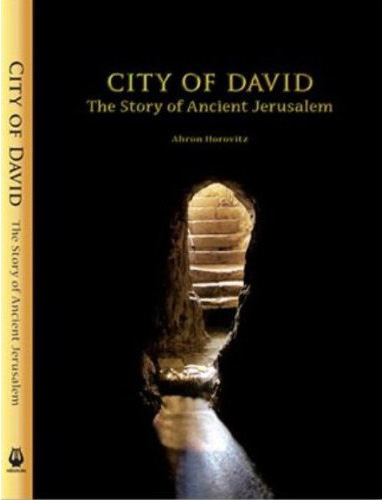
For my birthday last month, I received a magnificent tome called: City of David: The Story of Ancient Jerusalem by Ahron Horovitz (edited by Dr. Eyal Meiron), Jerusalem: Megalim-City of David Institute for Jerusalem Studies, 2009, 325 pp. Amazon price $56.07.

If you are considering requesting the book to be brought from Jerusalem, give a thought to your friend’s baggage allowance! The book is lavishly produced, quite large and very heavy. So heavy indeed  (about 6 pounds) that it was cheaper to bring it 160 miles by car from London to Cardiff, where we live, than to send it by Royal Mail!

The book recounts the Biblical story of Jerusalem and uses the results of archaeological excavations to illustrate it.

Jane Cahill West, a senior staff archaeologist for the Hebrew University’s City of David project (1978-’85) directed by the late Yigal Shiloh, writes in her book review here:

One of the best features of the book is Horovitz’s ability to provide clear, concise descriptions of the debates that surround interpretation of Jerusalem’s most controversial archaeological remains, such as Warren’s Shaft, the Stepped Stone Structure, and the city’s fortifications. Reconstruction drawings depicting how the city may have looked at various stages of Biblical history are based primarily on the interpretation of fellow tour guide Eyal Meiron, while explanations for some of the most controversial features of Jerusalem’s water supply systems are those offered by Zvi Abells, a retired electrical engineer who devotes all his spare time to studying Jerusalem’s water systems. These reconstructions and interpretations offer perspectives on issues of contentious debate rarely seen in print.


The 37 Israel Archaeological Congress (Bar Ilan University)

From Jack Sasson:

37th Annual Archaeological Congress in Israel

This Thursday (14th of April, 2011) the 37th Annual Archaeological
Congress in Israel will be held at Bar-Ilan University. The
conference, as always, will be a combination of short lectures
presenting new finds and excavations, as well as topical studies (note that the afternoon sessions will be running in parallel halls).

This year, there were be sessions on the following topics:
1) Prehistory (9 to 11 am)
2) Archaeological Science (11:30 to 13:30)
3) New Directions in the Study of the Persian Period (14:30-16:30)
4) Feasting in the archaeological record (14:30-16:30)
5) New excavations and studies – early periods (17:00-19:00)
6) New excavations and studies – later periods (17:00-19:00).

Program (in Hebrew) at
<http://arenmaeir.files.wordpress.com/2011/04/the-37-israel-archaeological-congress.pdf>.

Should be a very interesting day. Hope to see you there!

The Western Wall of the Temple Mount Gets Cleaned for Passover, All Notes Taken Out

Did you ever wonder what happened to all those prayer notes that people stick in between the stones of the Western Wall of the Temple Mount? Once a year, in preparation for Pesach (Jewish Passover), they are taken out and buried. According to Jewish Law they cannot be trashed, as the name of God appears on most of the notes. This Israel National News report and video tells you how they do it:

The holiday of Passover is quickly approaching and as we are all busy cleaning our homes, the Kotel (Western Wall) is also being cleaned and the many notes which visitors place between the stones throughout the year are being removed. After the notes are removed, they are taken to genizah (storage for sacred documents).

You can watch the video here: 

Cleaning the Western Wall

“We do this so that there’s room for people who come in the future to place their notes,” explained the caretaker of the Kotel, Yehoshua Rachamim. “We also do it so the wall is Kosher for Passover and there are no traces of chametz between the stones.”

Rachamim added that the cleaning staff does not look at the contents of the notes under any circumstances.

“We don’t look at the notes,” he emphasized. “We only clean, gather the notes, place them in a bag, and take them for genizah.”

In addition to removing the notes, professional engineers are also working at the site, using a crane to ensure that the stones remain stable and that there is no fear that they could break and fall on the worshipers.

The work is being carried out by the Western Wall Heritage Foundation, and is being supervised by the Kotel’s rabbi, Rabbi Shmuel Rabinovich.


Lecture on “Re-excavating Jerusalem” in Oxford

A great reason to visit the “city of dreaming spires”

This drawing shows the excavation results of the fortified area in the City of David. The earliest remains are stone filled terraces from the Jebusite period, which were excavated by Kathleen Kenyon. Yigal Shiloh excavated the rest of the area, which he called Area G.

The Department of Antiquities at the Ashmolean Museum (University of Oxford) is pleased to invite friends and colleagues to:
The Seventh Annual Roger Moorey Memorial Lecture:
Dr Kay Prag, University of Manchester, “Re-excavating Jerusalem: A Review, Fifty Years On”

Saturday 28 May 2011, 2.30pm, at Wolfson College, Linton Road, Oxford, OX2 6UD

Summary: May 2011 marks the 50th anniversary of the start of the large-scale excavations undertaken by Dame Kathleen Kenyon in Jerusalem. The huge archive contains a remarkable record of finds from the earliest occupation through to the Islamic centuries – but did Kenyon achieve her aim – to put the archaeology of Jerusalem on a sound scientific footing for the first time?

***Entry to this lecture is free but seat reservation is essential***
Please contact: Ilaria Perzia, Department of Antiquities, Ashmolean MuseumE-mail: antiquities@ashmus.ox.ac.uk     Tel: 01865 278020 www.ashmolean.org

HT: Jack Sasson

2nd International Temple Mount Awareness Day

In the Book of Exodus we read about the construction of the Tabernacle. On the first day of the first month (called ‘Rosh Chodesh Nisan’ in Hebrew) of the second year after coming out from Egypt, the Tabernacle was put up (Exodus 40.1) and on the same day God’s glory filled the Tabernacle (Exodus 40.34).

The entrance to the open Court of the Tabernacle was via a curtain of fine linen interwoven with blue, purple and scarlet and supported by four pillars (Exodus 27.16). © Leen Ritmeyer

Tomorrow, on the 5th of April, the Jews celebrate Rosh Chodesh Nisan (which is also the beginning of the Sacred New Year) and the Temple Institute of Jerusalem is organising the 2nd International Temple Mount Awareness Day with a program that will be live broadcast from 2.00 – 8.00 pm Israel time. Click on the picture below to see a video that gives a brief description of what they are planning:

2nd International Temple Mount Awareness Day. © Temple Institute

Participating are:

  • Yitchak Zweig – archaeologist, founder and director of Temple Mount Sifting Project
  • Dovid Louis – researcher into the original music of the Holy Temple
  • Reuven Prager – expert on the restoration of Levitical garments
  • Baruch Ben-Yosef – legal scholar on Temple Mount issues
  • Yisrael Medad – Temple Mount activist


The 70 books

If there was an award for Most Timely Blog, it should be awarded to Todd Bolen for his post yesterday called Early Christian Lead Books Discovery: Some Problems.

With claims such as have been made for this discovery, ones’s in-box gets flooded with enquiries and it takes time to set out the facts. Time is in short short supply here at the moment, so I can do no better than refer you to his incisive post.

Todd concludes:

There may be something to this discovery, but first the artifacts must be confiscated by the officials and assigned to reputable scholars.

It may be April Fool’s Day, but let us take the advice of wise Solomon:

“He who answers a matter before he hears it, it is folly and shame to him” (Proverbs 18.13, NKJV).

Discovering the Water Systems of the City of David in Jerusalem

The Jerusalem Post has an article called “Mythical Water Pipe Discovered”. In the accompanying video, tour guide Danny Herman explains the various components of the water system in the City of David and how it developed over the ages. If you haven’t been in the City of David for a while, you may find this video interesting.

Over the last 150 years or so, researchers have attempted to understand the water systems in Jerusalem and the City of David in particular. During the 19th Century, illustrious researchers, such as Wilson, Warren, Conder, Schick, Weill and others have discovered and recorded parts of underground water channels and tunnels, which were all connected with the Gihon Spring in one way or another. The discovery of a vertical shaft from inside the so-called Hezekiah’s Tunnel by Charles Warren, has since 1878 been identified with the ‘tsinnor’ by which Joab presumably climbed into the City of the Jebusites, so that David could capture it, according to the account in 2 Sam. 5. This has now been discounted by the latest excavators.

The Siloam Pool and Reservoir at the southern end of the City of David. © Leen Ritmeyer

The first scientific recording of this water system in the 20th Century was done by Vincent, who accompanied the Parker Mission in 1911. He published very valuable plans and sections in ‘Jerusalem Sous Terre’ (1912). Later researchers, such as Kathleen Kenyon and Yigal Shiloh did further exploration of these tunnels and channels, but the most extensive research was done from the end of the 20th Century up till now by Ronnie Reich and Eli Shukron. Despite all their investigations, it is not altogether clear how all the different channels, pools and reservoirs work together, but we are a lot closer to understanding the water systems now than ever before.


GLO for Mac, iPad and iPhone

As a dedicated Mac user, I am pleased to announce that GLO is now available for Mac owners.

Glo is an interactive Bible with a world of media, resources and tools – HD video and documentaries, high resolution images, zoomable maps, 360-degree virtual tours and much more – to help you get closer to the Word of God. The Bible comes to life through Glo, allowing you to experience and explore the biblical world in ways never before possible. And it’s easy to use with Glo’s unique browsing lenses.

The main website gives information about GLO for various platforms, such as PC, Mac, iPad and iPhone. FAQs are answered on this site.