Restoration of the ‘crown’ of the Damascus Gate

The Damascus Gate is located in the centre of the northern wall of the Old City of Jerusalem. The Kikar haShabbat News reports that the top of this gate has been restored as part of the Jerusalem City Wall Conservation Project.
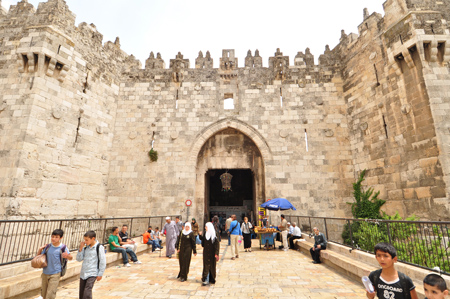
The Damascus Gate. Photo: © Nathaniel Ritmeyer

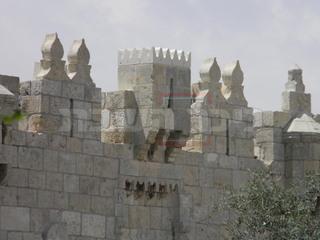
The article puts special emphasis on the central decoration at the top of the gate, nicknamed ‘the crown’, that was destroyed in the Six Day War.
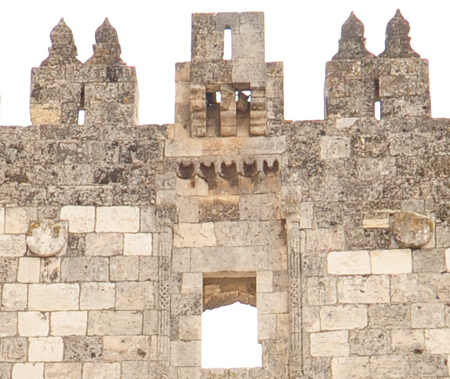
This detail shows the 'crown' before restoration.
The 'crown' after restoration. Photo: Kikar haShabbat

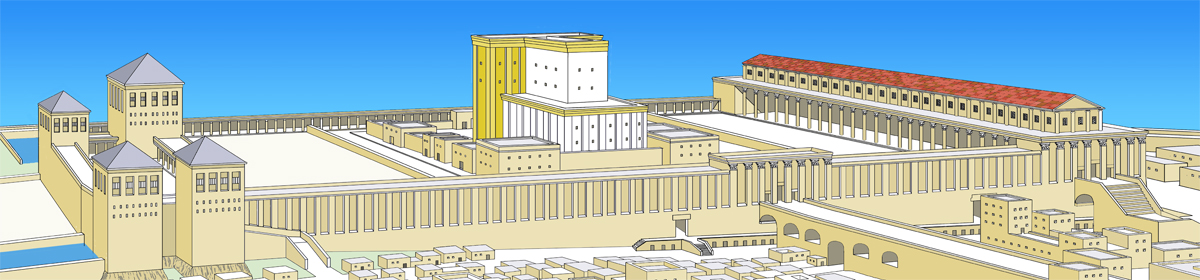
The Damascus Gate was built by the Turkish sultan Suleiman the Magnificent  in 1538 AD  over the remains of a Roman gate. That gate was built in the 2nd century AD during the reign of the Roman Emperor Hadrian as a monumental entrance to the city of Jerusalem, which he had renamed Aelia Capitolina. This gate features on the Madaba Map, which shows an open square with a column inside the gate. In the Byzantine period, the gate was incorporated into the city wall.

Reconstruction drawing of the Roman gate. © Leen Ritmeyer

Jack Sasson reports the article in full:

After extensive conservation work on the largest and most impressive of Jerusalem’s gates, which took nearly a year to complete, visitors there can now enjoy the gate in all its splendor just as the public experienced it for hundreds of years, until  the ‘crown’ was damaged in the battles of 1967.
The conservation of the gate was carried out as part of the Jerusalem City Wall Conservation Project, in cooperation with the Jerusalem Development Authority, the Israel Antiquities Authority and the Prime Minister’s Office

For hundreds of years, when visitors arrived in Jerusalem and entered the city by way of Damascus Gate – the largest and most magnificent of Jerusalem’s gates – they glanced up and saw the large ‘crown’ that the sultan Suleiman the Magnificent built atop the gate in 1538 CE.

But in 1967 the gate sustained serious damage and the crown was destroyed during the fighting in the Six Day War. Now, the Jerusalem Development Authority, in cooperation with the Israel Antiquities Authority and with funding provided by the Prime Minister’s Office, is concluding a comprehensive project of rehabilitating Damascus Gate, during which the gate was cleaned of the effects from the ravages of time and its ornamentation was restored, including the magnificent ‘crown’ at the top of the gate.

When workers of the Conservation Department of the Israel Antiquities Authority went about restoring the decorations on Damascus Gate they were aided by pictures of the gate that were taken at the beginning of the twentieth century when the British governed Jerusalem.  The pictures show the gate in all its glory, with the crown at the top of the center embrasure, and based on this the conservators proceeded with their work. As part of the engineering and stabilizing measures performed, the ‘crown’ was secured to the core of the wall by means of eleven anchors. At the same time the decoration’s four stones were
completely restored, and its ceiling was covered again with stone slabs as it was in the past, based on the historical photographs.

“The Old City of Jerusalem is a focus of interest for people the world over and the number one tourist attraction in Israel”, says the Elʽad Kendel, director of the Old City Basin in the Jerusalem Development Authority, “the city walls and the gates are the first thing that everyone sees when they arrive at the Old City, and it is therefore important to us that tourists, both domestic and foreign, see the city in all its glory”.

According to Avi Mashiah, the project’s architect on behalf of the Conservation Department of the Israel Antiquities Authority, “The work at Damascus Gate was particularly challenging since it is located at the entrance to a noisy and bustling marketplace. All of the work that was carried out there was done so in agreement with the local merchants. In order to avoid disturbing business in the marketplace, work was begun after the last stall closed at 10:00 PM, and continued until the early hours of the morning, prior to the start of the following business day.  Because of its beauty, Damascus Gate is also
the most documented of Jerusalem’s city gates and its historical
material and numerous photographs facilitated an accurate restoration of its appearance. Every single decoration, including all of its features, was studied and restored by us down to the smallest detail, in order to provide visitors to the gate as full and complete an experience as possible”.

Four years ago the Jerusalem Development Authority commenced work on the rehabilitation and conservation of the Old City walls in Jerusalem, in cooperation with the Conservation Department of the Israel Antiquities Authority, which is actually carrying out the work on the walls, and with funding provided by the Prime Minister’s Office. As part of the project, work was conducted along the entire length of the Old City walls and on the gates from the Dung Gate, clockwise in the direction of Zion Gate, Jaffa Gate, the New Gate and
Damascus Gate. Work on the wall is currently being done at the
northeastern corner of the Old City and is scheduled to be completed by year’s end.

The work on the wall included conservation, the removal of hazards and the rehabilitation of elements in the wall. In addition a laser scan was used for the purpose of precisely measuring the wall, particularly the gates, which were surveyed and studied at the level of individual stones. The Jerusalem Development Authority and the Israel Antiquities
Authority are pleased that visitors to the Damascus Gate can now enjoy the full splendor of the structure, and experience it exactly as the public has for 460 years, until the gate was damaged in 1967.

Menorah and Roman sword found in Jerusalem

Two amazing finds testify to the last days of Jerusalem’s destruction in 70 AD, In a drainage channel that led from the Temple Mount to the Siloam Pool a stone with an inscribed menorah was found, together with a Roman sword. These finds vividly reminds us of the terrible destruction and how some people tried to save their lives by fleeing through the underground drainage channels.

A stone with an inscribed menorah. Photo: Sebastian Scheiner / AP

The full stories are here and here.

Both the menorah and the sword reminded me of similar finds made by Prof. Nahman Avigad in the Jewish Quarter. A sword was found in the Burnt House and a menorah was found inscribed in the wall of one of the priestly houses.

This depiction of the Lampstand (menorah) was found incised on one of the walls of a priestly family home in Jerusalem. Apart from the Lampstand, it shows the Table of Shewbread (bottom right), the Altar of Incense (top right) and the three-stepped stone (bottom left) which the priest would stand on to light the lamps of the Lampstand in the Temple.

HT: Joe Lauer

City of David Conference – Sept 8th, 2011

Barnea Levi Selavan sends this program of the upcoming conference in the City of David.

September 8th, 2011

6.30 – Entry
7pm Aharon Horowitz, Yuval Baruch, Evyatar Cohen (two varying options concerning dating of tunnel)

7.15
Y Garfinkel – thoughts about the Kingdom of Judah
R Reich and E Shukron – new look at Shiloach tunnel dating
I Finkelstein- the large stone structure, facts vs yearnings

8.20 – Break

8.40

G Barkay – Bat Paro grave, a new look
Asher Grosberg – south section of Channel II, Shiloach, both of Hezekiah
Shukron and Reich – main Second Temple drainage channel, with completion of the southern section in 2011

HT: Jack Sasson

Have Archaeologists Discovered High Priest’s Bell?

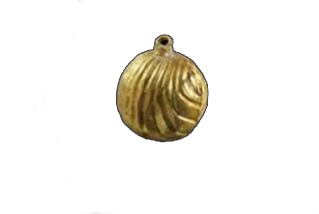
Archaeologists have discovered a rare gold bell during an excavation in the City of David National Park in Jerusalem.
by Elad Benari

Archaeologists have discovered a rare gold bell with a small loop at its end. The finding was made during an archaeological excavation in the City of David National Park (near the walls of the Old City of Jerusalem) by the Israel Antiquities Authority in cooperation with the Israel Nature and Parks Authority and the Ir David Foundation.

Rare ancient bell. © IsraelNationalNews

The directors of the excavation on behalf of the Antiquities Authority, archaeologists Eli Shukron and Professor Ronny Reich of Haifa University, said after the finding, “The bell looked as if it was sewn on the garment worn by a man of high authority in Jerusalem at the end of the Second Temple period.

“The bell was exposed in the city’s main drainage channel of that period, between the layers of dirt that had been piled on the floor of the channel,” they continued. “This drainage channel was built and hewn west to the Western Wall of the Temple Mount and drained the rainfall in the different parts of the city, through the City of David and the Shiloah Pool to the Kidron valley.”

The excavation area, above the drain, is located in the main street of Jerusalem which rose from the Shiloah Pool in the City of David. In this street an interchange was built through which people entered the Temple Mount. The remains of this interchange are what is known today as Robinson’s Arch. Archaeologists believe that the eminent man walked the streets of Jerusalem in the area of Robinson’s Arch and lost the golden bell which fell off his outfit into the drain beneath the street.

Jewish sources say that the high priests who served in the Holy Temple in Jerusalem used to hang golden bells on the edges of their coats. The book of Exodus (Shemot), for example, contains a description of the coat of Aaron the high priest in which it is said that coat contains, “bells of gold.”

While it is unknown if the bell belonged to one of the high priests, archaeologists have not ruled out the possibility.

The holy garments of the High Priest are described in Exodus 28 and 39. A golden plate with an inscription "Holy to Yahweh" was fixed to a white head covering. A colourful vest, called the ephod, had the breastplate of judgment with 12 precious stones attached to it. On the shoulders were two onyx stones with the names of the 12 tribes of Israel engraved on them. Under the ephod was a robe of blue and a long white undergarment. Attached to the hem of the blue robe were bells and pomegranates. © Leen Ritmeyer


Israeli history photo of the week: Holy Land Quake, 1927

In previous posts (here and here) we reported on the fact that Israel expects a major earthquake to happen in the near future.

The Jerusalem Post reports today on a special Library of Congress collection of photographs that document the earthquake that struck Israel and particularly Jerusalem and the Temple Mount in 1927.

Four pictures, one of which we used in a previous post, are shown in this article. Many more photographs of this period, taken by photographers of the American Colony, have been collected by Todd Bolen on a CD called Life in the Holy Land, Jerusalem.


The mound on the mount: a possible solution to the “problem with Jerusalem”?

A downloadable pdf of an article by this name written by Israel Finkelstein, Ido Koch and Oded Lipschits is available at http://www.arts.ualberta.ca/JHS/Articles/article_159.pdf
Published in The Journal of Hebrew Scriptures, Volume 11, Article 12, it attempts to provide an answer to the problem that intensive archaeological research on the City of David ridge, conventionally regarded as the original mound of Jerusalem, has proven that:

“between the Middle Bronze Age and Roman times, this site was fully occupied only in two relatively short periods: in the Iron Age IIB-C (between ca. the mid-eighth century and 586 B.C.E.) and in the late Hellenistic period (starting in the second half of the second century B.C.E.). Occupation in other periods was partial and sparse—and concentrated mainly in the central sector of the ridge, near and above the Gihon spring. This presented scholars with a problem regarding periods for which there is either textual documentation or circumstantial evidence for significant occupation in Jerusalem; we refer mainly to the Late Bronze Age, the Iron IIA and the Persian and early Hellenistic periods.”

The solution they put forward is as follows:

“… we raise the possibility that similar to other hilly sites, the mound of Jerusalem was located on the summit of the ridge, in the center of the area that was boxed-in under the Herodian platform in the late first century B.C.E. Accordingly, in most periods until the second century B.C.E. the City of David ridge was outside the city. Remains representing the Late Bronze, Iron I, Iron IIA, and the Persian and early Hellenistic periods were found mainly in the central part of this ridge. They include scatters of sherds but seldom the remains of buildings, and hence seem to represent no more than (usually ephemeral) activity near the spring. In two periods—in the second half of the eighth century and in the second half of the second century B.C.E.—the settlement rapidly (and simultaneously) expanded from the mound on the Temple Mount to both the southeastern ridge (the City of David) and the southwestern hill (today’s Jewish and Armenian quarters).”

They acknowledge that their theory cannot be proven without archaeological excavations taking place on the mount, something we all know to be impossible and quote N. Naaman, who wrote that: “the area of Jerusalem’s public buildings is under the Temple Mount and cannot be examined, the most important area for investigation, and the one to which the biblical histories of David and Solomon mainly refer, remains terra incognita”, (1996. The Contribution of the Amarna Letters to the Debate on Jerusalem’s Political Position in the Tenth Century B.C.E. BASOR 304: 18-19).
Whilst we cannot deny this, I feel that it is overstates the case. I believe that there are enough clues on the surface and in the walls and underground structures of the Temple Mount to deduce much of the history of Jerusalem. And, with the publication of The Quest – Revealing the Temple Mount in Jerusalem, the mount is certainly less “incognita”!
It is true that the area between the Square Temple Mount and the Herodian Southern Wall is quite large and it is possible that some houses were built there in the “missing” periods. The problem, however, is that in 186 B.C. Antiochus IV Epiphanus built the Akra in this location. Some 25 years later, in 141 B.C., this fortress was totally destroyed by Simon Maccabee and the mountain leveled. So, even if one could excavate this area, nothing much would be found.

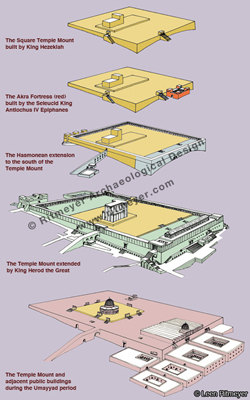
These five drawings show the five stages in the development of the Temple Mount in Jerusalem. From top to bottom: 1. The square Temple Mount built by King Hezekiah. 2. The Akra Fortress (red) was built by the Seleucid King Antiochus IV Epiphanes in 168 BC to control the local Jewish population. The fortress was destroyed by the Maccabees in 141 BC. 3. After the destruction of the Akra, the Hasmoneans extended the Temple Mount to the south (blue). 4. Herod the Great renewed the Temple Mount by enlarging the square Temple Mount to double its size and building a new Temple. 5. During the Umayyad period, the Dome of the Rock was built on the site of the Temple and the El Aqsa mosque on that of the Royal Stoa. Large public buildings were erected to the south and west of the Temple Mount

Additionally, as Todd Bolen also pointed out, the access from the proposed “mound” to the water supply would have been unprotected, which is both unsatisfactory and contradicts the Biblical account that the City of David was located near the Gihon Spring.

Mughrabi Gate bridge renovation plan stopped

In a previous post, we reported that is was decided to demolish the Mughrabi Gate bridge and replace it with a new one. That was supposed to have happened two weeks ago.

We have written previously about this bridge and its problems.

The Kingdom of Jordan had earlier agreed to the renovation plans, but they have suddenly changed their minds. The Jerusalem Post reports that Israel is furious with this U-turn in Jordan’s policy regarding the bridge:

Amman files complaint with UNESCO over renovation plans on Mughrabi Gate bridge linking the Western Wall Plaza with the Temple Mount.

You can read the Jerusalem Post’s article here. Joe Lauer comments:

“Based upon earlier reports, the sentence reading “Jordan later said it agreed to the renovations under US pressure.” should more accurately state, “Under US pressure Jordan later admitted that it had agreed to the renovations.”
That Jordan can lie but the UNESCO delegates voted against Israel anyway is just another in a long line of travesties.”

2,000 year old ossuary of Caiaphas’ granddaughter found

In 1990, a tomb with several ossuaries (bone boxes) was discovered in Jerusalem’s Peace Forest. One of them carried the inscription “Yehoseph son of Qafa” (Joseph son of Caiaphas). That was the name of the High Priest that condemned Jesus to death. Cafa (Caiaphas) was his nickname.

Now, the ossuary of Caiaphas’ granddaughter has been found. Three years ago it was turned over to the Israel Antiquities Authority’s Theft Prevention Unit and the result of their research has now been published. The inscription on the ossuary reads: ‘Miriam Daughter of Yeshua Son of Caiaphas, Priests [of] Ma’aziah from Beth ’Imri’.

The ossuary of Caiaphas' granddaughter Miriam. Photo: Boaz Sizzu.

You can read the IAA report here. Todd Bolen also reported on this find.

HT: Joe Lauer

Ophel excavations not yet open for visitors

In a previous post we reported on the inauguration of a complex dating from the First and Second Temple periods on the Ophel.

Jerusalem in the time of Solomon. © Leen Ritmeyer

Barnea Levi Selavah, co-director of the Foundation Stone organisation, reports that the site is not yet open to visitors. He also purchased a book called “Discovering the Solomonic Wall in Jerusalem” by Eilat Mazar. Here are some of his thoughts:

I attended the opening, and purchased the book “Discovering the Solomonic Wall in Jerusalem” by Eilat Mazar.

I am 3/4 of the way through.

It is a fast read, just understanding locations of walls and consequences is a bit of a challenge.

At several points she suggests insights to understandings of verses which have not made it into the news (besides Solomon-Kings and Nehemiah Water Gate).

The book unfolds the stages of discovery, and conclusions. Only this will empower you to discuss it intelligently.

You may want to add reading the reports from the 1986 excavations and related books, and Warren’s sketches and writings.

Do not rely on the news reports or press releases by themselves.

I submit it is must reading. Full of pictures.

Now –

1. The 3500 year old writing- not 3000 as reported in some media- is now in display in the Davidson Center.

It is the room to the right of the bathrooms which has other majestic finds and a second theater.

It has a slide show with enlarged pictures of the piece, an explanatory sign, and the piece itself.

Al Jazeera filmed Curator?IAA archivist Chana Katz as did others, there should be stuff on the web.

2. The area excavated has a wonderful system of stairways and explanatory signs installed.

3. In the park the access requires walking through the area where they are refurbishing the buildings and the ritual baths.

This is not yet finished.

According to the EJDC rep with whom I spoke last week, they hope to finish it by the end of August, no guarantees.

So there is no access now.

Once there is access, this area is done and ready.

4. For the event a gate was opened in a fence from the street; it is not opened now.

5. From the street you can see a lot, and they made a huge wall poster in color easily visible from the street.

6. Continue around the corner leading to the eastern wall, and you are looking at some of the most important walls.

7. If you read the book which is laden with pictures you will be able to give a highly effective tour of the area.

8. See Warren’s sketches from 1867-1870.

9. The question was raised that only one side at a certain point looks like a gate. Eilat deals with this on p. 85-89 or so in her book.

Her grandfather and Leen Ritmeyer came to that conclusion in their 1986 dig. Nachman Avigad disagreed. She raises the different points.

10. Another issue is dating the pottery which was found under the street, thereby dating the structures. She quotes Ami Mazar as reading the pottery to be 10th century; in her talks she allows for those who say it may be 9th.

On our LandMinds program last year Israel Finkelstein said they were 8th century. While since then he has offered revisions of his dating in general based on Megiddo, and other studies (ASOR 2010 and at Ami Mazar’ s retirement conference) I do not know about here.

See the discussion in the book about the black juglet and other pottery.

At any rate, there is no question it is First Temple period construction.

11. Note also the important point that the petrography shows the 3500 year old piece was manufactured locally, which shows some kind of educated society was functioning here at that time. The suggestions of who wrote and what it is saying is under discussion. Remember, this was found in the fill, and does not date the building. It wa only found thanks to wet sifting.

12. I was struck by the extent to which later periods used these structures to support their own.

13. I am wondering perhaps that is the case on Shonei Halachot Street, which is at least 700-900 years old based on some buildings, being built on First Temple period walls between the Israelite Tower and the Temple Mount.

This would be similar to Shekh Rechani Street being built on the water system running from Damascus Gate area to the Temple Mount, which Conrad Schick mapped in 1871, and that Gabai Barkai says is First Temple period; a te’alah, maybe the one mentioned twice in Tanach from the upper pools (1 of 4 current opinions), but not Hasmonean.

Maybe, maybe the buildings Shlomi Wexler Bdolach excavated under the steps down at the Kotel is in this line.

That’s me thinking out loud.

Eilat Mazar hopes more funds will be raised so she can connect this area with areas under and past the road, including under the UNRWA building, which Charles Warren identified, and other structures which she surmises must still be there, since structures were found on either side, and by matching this building to other layouts.

If you know someone who would undertake that, be in touch with her, or with me!


Summer days and nights in Jerusalem

A reconstruction of David's Palace in Jerusalem.© Leen Ritmeyer 1995

A press release from TravelVideo.tv lists the evocative tours taking place in and around the City of David this summer. These include:

The Archeological Experience at the Emek Tzurim National Park: Discovering the Past Hidden in the Dust: A unique exploration of the Temple Mount’s glorious past, travelers will be able to sift through rubble that originated in ancient buildings atop the Temple Mount while learning about the artifacts from on-site archeologists and guides.

Tour of the biblical City of David: A tour bringing travelers through Jerusalem’s biblical sites and places where the city’s the most stirring, remarkable artifacts were unearthed. Tour guides will lead travelers through an impressive underground world in Warren’s Shaft, the city’s ancient water system, as well as an illuminated walk in the waters of the Gihon Spring that flows through Hezekiah’s Tunnel.

In the footsteps of the Pilgrims – New Discoveries and Revelations from the Second Temple Period: A tour leading travelers in the footsteps of the architects of the city and incorporating recent archeological discoveries as well as the Shiloah Pool and the Herodian Road.

Enchanted Jerusalem-the New Nighttime Experience at the City of David: The new evening tour of the City of David begins at the Hatzofeh lookout point emphasizing the unique, low position of the biblical City of David in comparison with Jerusalem’s Old City walls. The tour will conclude with an innovative light show projected onto various antiquities, telling the story of the City of David through movement and sound.

Twilight at the City of David: A magical three-hour tour in a special nighttime ambiance allowing travelers to view the city through a course of excavations including David’s Palace and Hezekiah’s Tunnel. The tour concludes with harp music under the ancient olive trees in the King’s Garden.

Following the Water to Jerusalem – Hasmonean Aqueduct Tour: A flashlight tour highlighting the two 2,000-year-old aqueducts constructed to bring water from the Pools of Solomon to the Temple Mount and Upper City. Travelers will also witness the incredible views of ancient Jerusalem and the sophisticated water system built by King Herod on 150 BCE.

Kidron Monuments Tour: A tour of the massive, elaborate monuments in the Kidron Valley around the Old City’s original municipal border between the City of David and the Mount of Olives.

The full story is at http://www.cityofdavid.org.il/