Cement on the Temple Mount

The Jan/Feb 2011 issue of Biblical Archaeology Review, published my letter, “Cement Creates Temple Mount Time Bomb”,  in which I explained how the improper use of cement in the repairs was causing some of the problems on the Temple Mount.
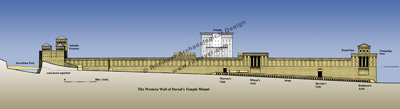
Reconstruction of the Herodian Western Wall of the Temple Mount. The Western Wall of the Temple Mount is 1590 feet (485 m) long. The Antonia Fortress is on the left. The four gates in the Western Wall are, from left to right, Warren's Gate, Wilson's Arch and bridge, Barclay's Gate and Robinson's Arch and stairway. © Leen Ritmeyer

Now BAR have posted on their website an article called “The Trouble with Cement”, commenting that my “view is now echoed by Edward D. Johnson, the chief conservator of the Archaeological Architectural Field School run by USAID in Luxor, Egypt, who condemns the use of cement in archaeological restorations and explains the dangerous and devastating problems it can cause.” Here is his comment in full:

Re: Leen Ritmeyer’s criticism of the use of cement in repairing the bulges in the Temple Mount wall. The problems with the use of cement for such repairs are even worse than he describes.
Being both an archaeologist and archaeological conservator whose practice emphasizes built heritage and having worked in many places around the world, principally in Egypt, for the last 22 years, I have repeatedly seen cement used on archaeological sites and structures with effects ranging from mildly damaging to completely disastrous. Simply put, cement has no place in the care and conservation of any archaeological site or structure. This is a basic principle of archaeological conservation that I have emphasized continually in my teaching of the subject, most recently in the Archaeological Architectural Field School run by USAID in Luxor, Egypt, where I was assistant director and chief conservator.
Cement damages ancient materials and structures in several ways, all of which work together to accelerate deterioration.
Cement in bulk has a different coefficient of expansion than ancient building materials, which are principally limestone and sandstone. Under warm, sunny conditions it will expand at about twice the rate of the original materials. When used on ancient structures, if put under ancient stone, or used to attach it to an underlying substrate, its expansion will tend to lift that stone off the surface to which it is attached, causing that surface to buckle, detach and slough off.
Cement is also loaded with soluble salts. These will leach out of the cement over time. They will migrate into the pores of the ancient building material, where they will be deposited by evaporation, forming salt crystals. Subsequent exposure to, or absorption of, moisture from the air will cause these crystals to dissolve and reform. This cycle of dissolution and recrystallization exerts immense pressure on the pores of the stone, causing their disruption and destruction. This leads to powdering, spalling off of decorated surfaces, and if not checked, complete disassociation of the stone into sand or powder which can cause larger structural failures in a monument.
Finally, cement is unsightly and always visually clashes with original stones and their patina of age as is dramatically revealed in the pictures in BAR.
Edward D. Johnson
Archaeologist/Archaeological Conservator
La Canada, California
 

The Water Gate of Jerusalem

The inauguration of a complex dating from the First and Second Temple periods on the Ophel has been widely reported, see for example here and here. In a previous post we mentioned that “The site was first excavated in the 1970′s under the direction of the late Prof. Benjamin Mazar and in the 1980′s and onward, Eilat Mazar has further excavated the site. The site has remains from the Israelite, Herodian (dismantled), Roman, Byzantine and Ummayad periods.”

The site is well known to me as I supervised the excavations of a large Herodian mansion in this area in 1975. My wife Kathleen also excavated in the same area. Moshe Feuer took over the supervision later on. Below the Herodian mansion, he discovered a substantial Iron Age structure that was tentatively identified by Prof. Benjamin Mazar as “The House of Millo”, mentioned in 2 Kings 12.20.

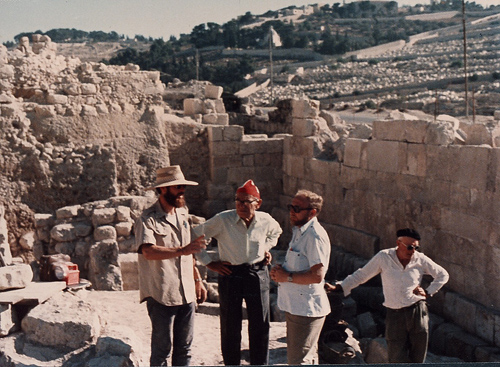
Leen (left) discussing the excavation results with Prof. Benjamin Mazar (with red hat) and Meir Ben-Dov, 1975.

Reporting on the inauguration, Todd Bolen asked the following question:

“I’d be curious to know if there are any other archaeologists who agree with Mazar’s identification of the structure she excavated as a gate. Some years ago it seemed that even those most sympathetic to her views did not follow her on this, but perhaps that has changed. I note that the press release does not state that this is a gate but that “Mazar suggests” that it is a gate.”

I will try to answer this question. While studying Warren’s plans of this area, it became clear to me that the excavated remains were connected with a large tower-like structure, dubbed by him “The Tower that lieth out” (Nehemiah 3.26). I tried to excavate this area which is located on the other side of the road, but was stopped by the religious authorities who claimed that a Medieval Jewish cemetery was located there, which subsequently proved to be correct.

Some 10 years later, under the direction of Prof. Benjamin Mazar and his granddaughter Eilat, the excavations were expanded to the east where a large structure of the First Temple period was found. When Eilat investigated the previously excavated area, she asked me to make the plans.

While working on the plans, I imposed symmetry on the remains and at that moment I thought that the structure excavated by Moshe Feuer could have been a gateway.

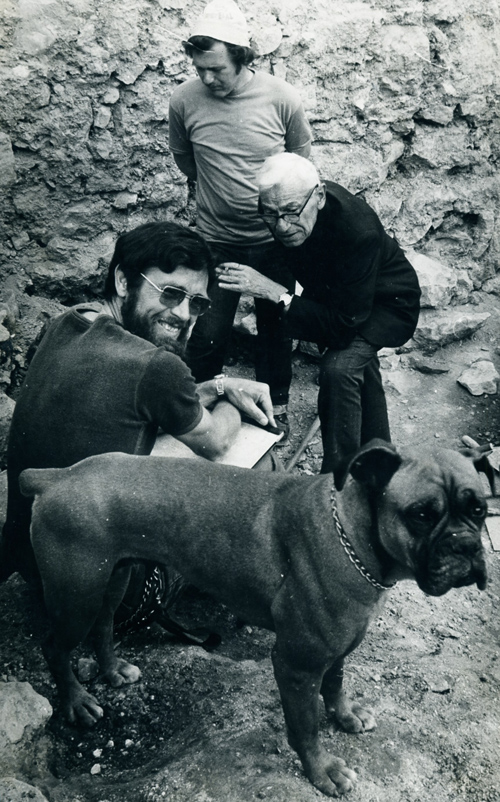
Moshe Feuer standing behind prof. Benjamin Mazar. Leen and his dog Simba in the foreground, 1975.

Working with Professor Benjamin Mazar was always a great pleasure as he often bounced off ideas during the many “brainstorming” sessions we had. I showed my preliminary ideas about the gate to Eilat, indicating the location where to excavate in order to prove that it was a gate. Instead of investigating the possibility, she invited the media the next day to announce that she had discovered the Water Gate! See Jerusalem Post report of April 22, 1986.

The Jerusalem Post reports that “Mazar believes the area is described in the Torah in the verse about King Solomon’s Temple: “… and the temple servants living on Ophel repaired to a point opposite the Water Gate on the east and the projecting tower” (Nehemiah 3:26). It may have been called the Water Gate because of the plethora of mikvaot in the area.”

This is a very uninformed statement, as Nehemiah 3 does not mention any temple, let alone Solomon’s Temple and the Book of Nehemiah is not part of the Torah (the five Books of Moses). The connection between the “Water Gate” and the mikvaot is untenable as the “gate” belongs to the First Temple period and the mikvaot to the Second Temple period. The earliest mikvaot date to the first century BC.

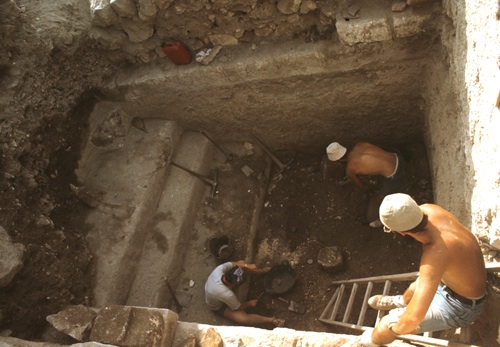
Excavating a Herodian (Second Temple period) mikveh in the Ophel area, 1975. Photo: Leen Ritmeyer

I no longer believe that the building in question is a gate, as the chambers do not resemble those of Iron Age gateways. The only complete chamber was stacked full with large storage jars which is also untypical of gateways. It would appear now that the building was a storage facility connected to a large domestic or public building.

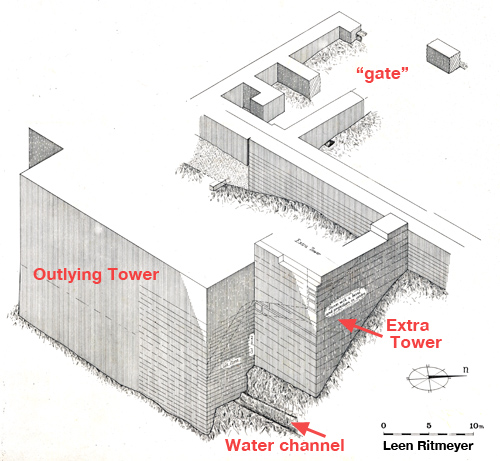
Reading Nehemiah 3.26, it is clear that the “Water Gate” and “the tower that lieth out” are separate points along the wall. The Water Gate must therefore be located south of the tower (somewhere near the Gihon Spring). According to Warren’s excavations, this outlying tower consists of two elements, a large tower and a smaller L-shaped wall (called by Warren the “Extra Tower”). The latter was built apparently to strengthen the larger tower.

The archaeological remains in the Ophel area, showing the "Outlying Tower", the "Extra Tower", the water channel and the "gate". Drawing: Leen Ritmeyer.

As there are some structures in this area, which, according to Eilat, belong to the 10th century BC. and if the outlying tower, which has not been excavated, belongs to this period, then the L-shaped “Extra Tower” structure must be later.

As a water channel from the First Temple period Bethesda Pool enters the “outlying tower” from the northeast, I would suggest that the “Water Gate” building served as a water distribution point, possibly during the time of King Hezekiah after he conducted the water of the Gihon Spring to the Siloam Pool. This would have left the Ophel area without a water supply and therefore a new water distribution point (where the storage jars could have been used) may have been created here to meet the needs  of the local population.

How should we approach Jerusalem?

“How should we approach Jerusalem?” This is the opening question posed at the beginning of this preview of a spectacular movie about Jerusalem. Filmed in Imax 3D, the footage takes you on an aerial journey around the Land of Israel with Jerusalem as its final destination. The movie is due to be released in two years’ time:

After a year of research and preparation, the giant screen film JERUSALEM advanced into production with an unprecedented aerial shoot throughout Israel and the West Bank. Scheduled for worldwide release in 2013, the film will take audiences on a spectacular tour of the Holy Land and the city once believed to lie at the centre of the world.

Jerusalem | An Arcane/Cosmic Picture Film

Follow this link for a high quality preview of the video.

HT: Pete Boon

Hezekiah’s Pool in Jerusalem

A large water reservoir in the Christian Quarter of the Old City of Jerusalem, known variously as Hezekiah’s Pool, the Towers’ Pool and the Pool of the Patriarch, is finally being cleaned up. Haaretz reports:

After years of neglect, Hezekiah’s Pool in the Old City of Jerusalem is finally being cleaned up. The work is being done by the Jerusalem Municipality, the Environmental Protection Ministry and Jerusalem Development Authority. As with anything in Jerusalem, the cleanup may cause a diplomatic crisis with Egypt and Jordan – and a conflict with the Waqf Muslim religious trust and the Coptic Church.

Hezekiah’s Pool, also known as the Pool of the Pillar, is located in the Christian Quarter, not far from Jaffa Gate. It is ancient and covers over three dunams (three-quarters of an acre ). But it is completely hidden from the public, with stores and homes surrounding it. Thousands of tourists coming through the gate and the Arab market pass right by it without having a clue that the historic site is nearby.

The pool was used at least from Second Temple times and was an important part of Jerusalem’s ancient water system until the 19th century.

Viewed from the Hippicus Tower, Hezekiah's Pool can be seen in the centre of the picture. Photo: © Leen Ritmeyer

Read the rest of the report here.

HT: Joe Lauer

The Mysteries of the Temple Mount

In a previous post, we wrote that Accordance Bible Software had added some of our books to their collections. My book, The Quest – Revealing the Temple Mount in Jerusalem, has now been reviewed by David Lang in an Accordance blog post called Embark on the Quest:

Look at most artistic reconstructions of the Temple Mount and you’re likely to see Leen Ritmeyer’s name attached to them. The architect of the Temple Mount Excavations following the Six-Day War, Ritmeyer has spent much of his life researching the mysteries of the Temple Mount and helping people visualize the ancient structures behind the present remains. The Quest is his personal chronicle of the research he has done, the challenges he has faced, and the answers he believes he has discovered.

You can read the full review here.

New online resource of Rabbinic Texts

David Instone-Brewer of Tyndale House has created an enormously useful website for the study of Rabbinic Texts.

It is now easy to look up most of the early rabbinic legal texts. The rabbinic texts were among the first to be digitised and there are some wonderful tools, but the good ones cost a lot of money and aren’t very friendly.

So I made the RabbinicTraditions.com site for myself. It is quick to use and more powerful than most, and has proved so valuable that I’m making it available to everyone.

You can freely read the texts of the Hebrew Bible, the Mishnah, Tosephta and the Babylonian and Jerusalem Talmuds. For a small fee per year or for life, you can fully search these texts.

The study of the Mishnah, in particular the tractate Middot, has helped enormously in my study of the Temple Mount and has made it possible to locate the pre-Herodian Square Temple Mount, shown in yellow in the illustration below:

King Solomon built the First Temple on the top of Mount Moriah which is visible in the centre of this cut-away drawing. This mountain top can be seen today, inside the Islamic Dome of the Rock. King Hezekiah built a square Temple Mount (yellow walls) around the site of the Temple, which he also renewed. © Leen Ritmeyer


Is the Second Temple waiting to be unearthed?

In an interview with Aaron Klein’s Investigative Radio programme on New York’s WABC Radio, Eilat Mazar claims that the 2nd Jewish temple is just ‘waiting to be unearthed’. You can read the interview here.

Although I would agree that many remains of the First and Second temple period are still existing below the surface of the present-day Temple Mount, I doubt if any remains of the Temple building itself are still extant.

According to Josephus, the Temple looked like a snow-clad mountain, for all that was not overlaid with gold was of the purest white. © Leen Ritmeyer

The reason for this is that the floor of the Dome of the Rock and  its surrounding area is actually 5 feet (1.5 m) lower than the top of the foundation of the Second Temple, which, according to Josephus was 10 feet 4 inches (3.15 m) high.

In this east-west section through the Temple Mount, the remains of Hezekiah's square Temple Mount are shown in yellow, while the Herodian constructions are coloured brown. The present configuration of the Temple Mount with its buildings are shown in dark blue. © Leen Ritmeyer

There is, however, the possibility that the foundation trenches which were usually cut into the bedrock are still existing.

This section through the Temple shows that the foundation of the Temple was level with the top of The Rock, which nowadays stands some 12.75 m above the floor of the Dome of the Rock. © Leen Ritmeyer

The bedrock falls to the east of the Dome of the Rock and I believe that remains of the steps leading up to the Temple, the Altar, and the Nicanor Gate could still be found.

The Temple was built on the top of Mount Moriah and therefore the further away from the top, the better the chances are that remains could be found.


HT: Joe Lauer

Priestly Blessing for the First Time on the Temple Mount during Jerusalem Day

On the second of the common days of Pesach (Passover), which this year fell on the 21st of April, there is usually a large gathering at the Western Wall to watch the priestly blessing.

Yesterday a much smaller, but perhaps more important priestly blessing was allowed for the first time in recent history on the Temple Mount itself. See this Israel National News report:

Hundreds of religious Jews from all streams were able to happily commemorate the 44th anniversary of the first-ever entry of Israeli soldiers onto the TempleMount.

For the first time in the history of Israeli restrictions on Jewish entry to the Temple Mount, the recitation of the Priestly Blessing was permitted there.  It happened on Wednesday, Jerusalem Reunification Day, when hundreds of visitors – all of whom immersed in a mikveh (ritual bath) prior to coming and took other precautions required by Jewish Law – were allowed to enter the Temple Mount in groups of 30-40.

Among them were several Cohanim (descendants of Aharon the Priest).  They spread their hands in the customary manner and recited, “May G-d bless and watch  over your… May G-d shine His countenance upon and show you grace… May G-d raise His countenance towards you and grant you peace” (Numbers 6, from the portion to be read aloud this week in synagogues throughout the Jewish world).

Rabbi Yisrael Ariel, head of the Temple Institute and one of the paratroopers who helped liberate the Temple Mount in 1967, and who was miraculously saved from death at the tim, recited aloud the blessing, “Barukh – Thou art the source of blessing, G-d, Who performed a miracle for me in this place.” Many visitors and listeners, including policemen, recited “Amen!”

The visitors specifically noted the fair and pleasant attitude displayed by the police, as well as the preparations and security precautions they implemented for all those wishing to ascend to the Temple Mount on this date.

In addition to the above, Rabbi Yoel Elitzur delivered a Torah lesson on Temple-related issues, after which the participants – again, including policemen – stood for the recitation of the Kaddish.

Despite the close proximity of the Moslem Waqf policemen and their obvious anger, the visit went off nearly without a hitch. One Israeli policemen yelled angrily and threatened the Jewish visitors, but that incident ended relatively quickly.


A moving scene at the Western Wall

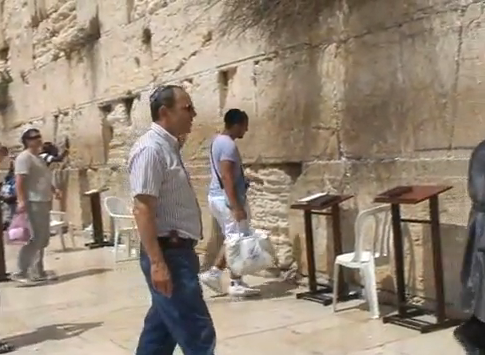
Jehuda Hartman was 22 on June 7, 1967 when he stood as an IDF paratrooper at the liberated Western Wall or Kotel. 44 Years later, on Jerusalem Day, he recreates the shot. Click on the picture to see the video:

Jehuda Hartman returns to the Western Wall

Two months later, I visited the Western Wall myself and vividly remember the excitement that was still in the air.

Read the full Jerusalem Post report here.

Jerusalem Underground Stream Discovered

Some 2000 years ago, Strabo wrote that Jerusalem was a “city well watered within, but desert outside” (Geography 16:2:40). The Gihon Spring and the many water reservoirs inside the Old City of Jerusalem attest to the truth of that statement.

I don’t think, however, that he knew anything about Israel’s largest underground stream that was recently discovered inside a man-made cave.

Zafrir Rinat of Haaretz reports:

A cave discovered during excavation work by Israel Railways in Jerusalem contains the largest and most impressive underground water sources ever discovered in Israel, scholars say.

The cave was discovered near the International Convention Center in the capital during construction work on a station for the future high speed Jerusalem-Tel Aviv train line. Builders came across it while digging a service shaft at a depth of 75 meters – five meters from the planned bottom of the shaft.

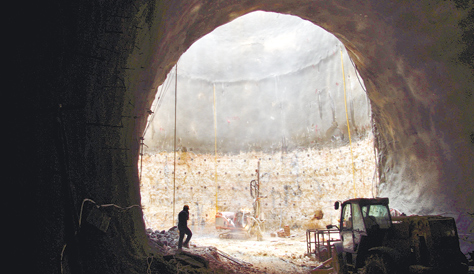
The Jerusalem cave opening into a shaft dug during railway construction. Photo: A. Frumkin

Over the past few days, scholars from the Cave Research Unit of the Hebrew University’s Department of Geography, who were called to the scene by engineering companies working with Israel Railways, have been crawling through the underground nooks and crannies. “It’s hard work, crawling through mud into a cave the end of which we haven’t reached yet,” Prof. Amos Frumkin, head of the unit, said. Frumkin said the cave is between a half a meter to a few meters wide, and is a few dozen meters high.

According to an initial survey by Frumkin’s team, the cave developed as water seeped in from the surface and dissolved the limestone. The resulting cavern is known as a karstic cave, named after the region in Slovenia where the phenomenon was first documented. The surveyors said that during their initial exploration, they found water flowing through the cave from northwest to southeast.

Frumkin estimates the cave to be about 200 meters long but that it could be longer. A small canyon at the end of the segment that has so far been checked plunges through cracks down into a series of waterfalls.

Frumkin says the cave “puts Israel on the map of tropical and temperate karstic regions where underground streams are common.”

The cave also has hydrological significance because it is part of the mountain aquifer, an underground reservoir into which rainwater flows from the surface, and that extends all along Israel’s central mountain range, Frumkin says. “The study of the cave can help us understand the precise mechanism by which water flows through the aquifer in the Jerusalem area,” he adds.

It will also help researchers understand how pollution leaches into the ground from the surface. Researchers usually have to drill wells to study this problem, but the newly discovered cave allows a direct look into the aquifer.

As opposed to the cave discovered in the Ramle area a few years ago, which contained crustaceans previously unknown to science, Frumkin says only microscopic life-forms were found in his explorations. Nevertheless, he says the cave must be protected as a valuable natural phenomenon, and that this can be accomplished without impeding construction of the railway station.

HT: Joe Lauer