Jerusalem Day

Read the Israel National News report on the countrywide celebrations that start tonight:

Jerusalem Reunification Day – the day marking Israel’s return to the Temple Mount, the Old City , Mt. of Olives, and the areas that became Ramat Eshkol, Gilo and more during the Six Day War in 1967 – is increasingly being celebrated not only in Jerusalem. In fact, over 80 cities around the country will mark the occasion with marches and otherwise, this Tuesday night and Wednesday.

These nationwide commemorations – the first time, in most cities – are being organized and coordinated by theMerimim et HaDegel(Raising the Flag) movement, in a campaign named, “We are All Jerusalem: Celebrating Jerusalem Throughout the Country.”

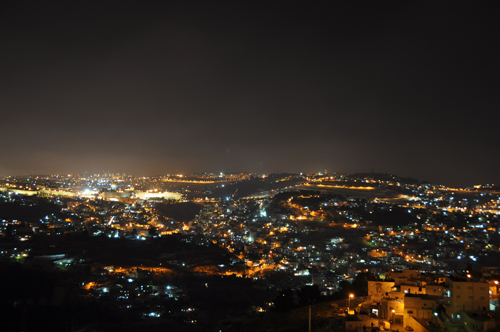
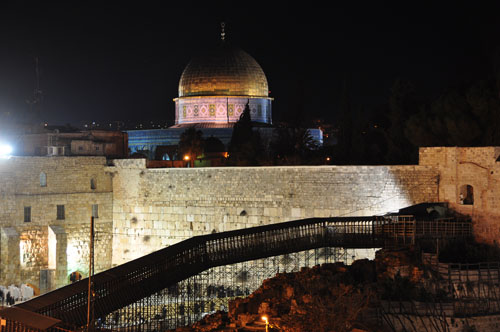
Jerusalem by night viewed from Abraham's Viewpoint in the south. Photo: © Joel Ritmeyer

Underground Jerusalem

This report by Matti Friedman of the Associated Press, has been widely published today:

JERUSALEM – Underneath the crowded alleys and holy sites of old Jerusalem, hundreds of people are snaking at any given moment through tunnels, vaulted medieval chambers and Roman sewers in a rapidly expanding subterranean city invisible from the streets above.

At street level, the walled Old City is an energetic and fractious enclave with a physical landscape that is predominantly Islamic and a population that is mainly Arab.

Underground Jerusalem is different: Here the noise recedes, the fierce Middle Eastern sun disappears, and light comes from fluorescent bulbs. There is a smell of earth and mildew, and the geography recalls a Jewish city that existed 2,000 years ago.

Archaeological digs under the disputed Old City are a matter of immense sensitivity. For Israel, the tunnels are proof of the depth of Jewish roots here, and this has made the tunnels one of Jerusalem’s main tourist draws: The number of visitors, mostly Jews and Christians, has risen dramatically in recent years to more than a million visitors in 2010.

But many Palestinians, who reject Israel’s sovereignty in the city, see them as a threat to their own claims to Jerusalem. And some critics say they put an exaggerated focus on Jewish history.

A new underground link is opening within two months, and when it does, there will be more than a mile (two kilometers) of pathways beneath the city. Officials say at least one other major project is in the works. Soon, anyone so inclined will be able to spend much of their time in Jerusalem without seeing the sky.

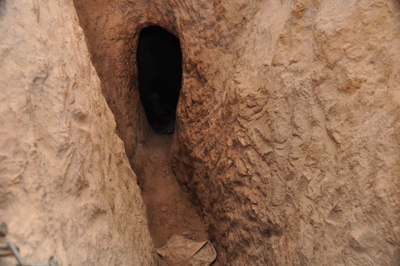
The full length of the underground Herodian drainage channel that led below the Tyropoeon Street will be opened this summer. Photo: © Nathaniel Ritmeyer

The article reports on the Western Wall Tunnel:

The Western Wall tunnel that runs along the Western Wall of the Temple Mount has been open for several years. Photo: © Leen Ritmeyer

Other tunnels are mentioned also, such as Hezekiah’s Tunnel, the Canaanite Tunnel and Zedekiah’s Cave, also known as Solomon’s Quarries near the Damascus Gate.

The Canaanite Tunnel, also known as Channel II, near the Gihon Spring. Photo: © Nathaniel Ritmeyer

The next major project, according to the Israel Antiquities Authority, will follow the course of one of the city’s main Roman-era streets underneath the prayer plaza at the Western Wall. This route, scheduled for completion in three years, will link up with the Western Wall tunnel.

Although most of these tunnels and underground areas have been known for a long time, it is interesting to see that they have become a new underground tourist attraction.

The report then continues to describe the political impact that these underground excavations and tunnels have on the local population. You can read the whole report here.

HT: Joe Lauer


Temple Mount Faithful petitions for State Comptroller’s excavation report

In a previous post, we reported on State Comptroller’s report on the illegal activities by the Waqf on the Temple Mount. According to the website of the Temple Mount Faithful:

“The goal of the Temple Mount and Land of Israel Faithful Movement is the building of the Third Temple on the Temple Mount in Jerusalem in our lifetime in accordance with the Word of G-d and all the Hebrew prophets and the liberation of the Temple Mount from Arab (Islamic) occupation so that it may be consecrated to the Name of G-d.”

The Jerusalem Post reports that this group, led by Gershon Salomon, has petitioned the High Court to have the full report published:

Fearing mass-scale destruction of holy artifacts under the Temple Mount, the Temple Mount Faithful, a group that calls for the Jewish takeover of the site, petitioned the High Court on Thursday to order the full publication of the secret State Comptroller’s Report on excavation works being conducted at one of the holiest places in the world.

Citing “harm to Israel’s national security and possible harm to its foreign relations”, the High Court has so far refused to publish the complete report.


HT: Joe Lauer

The Kenyon Institute of Jerusalem

A few years ago, the British School of Archaeology in Jerusalem was renamed the Kenyon Institute, after the late Dame Kathleen Kenyon who is best known for her excavations in Jericho and Jerusalem. The school’s website states its purpose:

The Kenyon Institute is proud to present cutting-edge research in the humanities and social sciences in the form of lectures and seminars throughout the year. The Lecture Series is an opportunity for Visiting Research Fellows and other researchers, both on CBRL-funded and non-affiliated projects, to present preliminary results on their work in Israel and the Palestinian Territories.

A look at their lecture series, however, shows that their involvement with politics has taken over from their stated objective:

Tuesday 3 May 2011, 5pm (World Press Freedom Day)
Journalism in the time of Revolution:  How do journalists deal with the challenges of covering conflict and rapid political and social change?
Dr Ehab Bessaiso, Media Expert and Lecturer, Cardiff University (via Skype); Nick Pelham, Correspondent, The Economist; Nasser Atta, Journalist, ABC; Khalil Assali, Chairman, Jerusalem Press Club; Sa’id Ghazali, Blogger, hankashtika.blogspot.com

Tuesday 24 May 2011, 5pm
Democracy from below: Lessons from the revolutions
Dr Samir Awad, Professor of International Studies, Birzeit University; Omar Shweiki, Acting Director and Research Scholar, Kenyon Institute, Council for British Research in the Levant

Tuesday 31 May 2011
Rock-cut Tombs in Petra and Jerusalem: some similarities and differences
Dr Lucy Wadeson (CBRL Fellow and University of Oxford)

Stephen Rosenberg, who posted the Bible and Interpretation‘s “Archaeology in Israel Update – April 2011”, advises the following:

The lectures now current both fail to serve British scholarship or to serve the original purpose of the School, the promotion of archaeology in the region. We trust that the CBRL and the Amman School will take the appropriate action to correct the position.

The lecture on the rock-cut tombs in Petra, however, appears to deal with archaeological similarities and differences with tombs found in Jerusalem, but I fail to see what journalism and revolutions have to do with archaeology, as it appears to serve a particular political agenda.

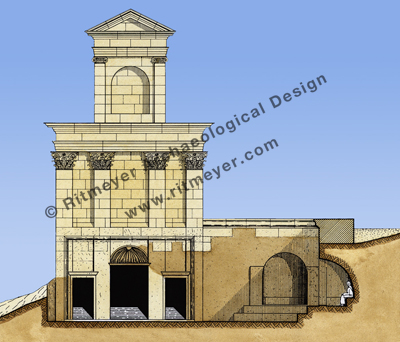
There are some beautifully decorated rock-cut tombs in Jerusalem, which certainly have some similarities with those in Petra. We believe to have identified the Tomb of Annas the High Priest, an elaborately decorated tomb in the Hinnom Valley. Gustav Dalman, who, together with his son Olaf, investigated this tomb in 1925, called this tomb the most beautifully decorated rock-cut tomb between the Mediterranean and Petra:

This drawing shows the reconstructed facade of the Tomb of Annas. The drawing shows the triple-gated entrance to the tomb's anteroom. There are indications that the tomb once carried a superstructure and so could be identified as a monument. © Leen Ritmeyer
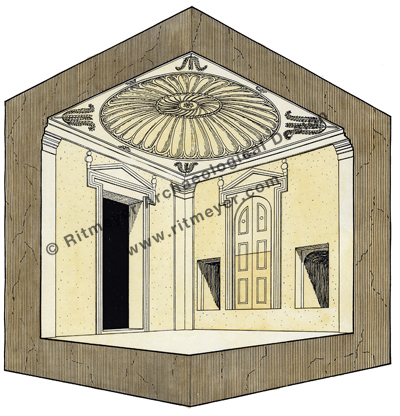
The inner burial chamber of the Tomb of Annas was highly decorated and had kokhim burial niches in the walls. The body of Annas was probably placed in the kokh (burial niche) disguised by the fake door in the wall on the right.© Leen Ritmeyer

Jerusalem City calls for the Mughrabi Gate to be destroyed within two weeks

The Mughrabi Gate, located just above the Western Wall in Jerusalem, is the only entrance to the Temple Mount for non-Muslim tourists. After the collapse of the earthern ramp in 2004, a wooden bridge was erected as a temporary solution until a new and safer bridge could be built to replace the old dirt ramp. We reported on this problem in previous posts here, here, here and here.

The Jerusalem Post reported today that:

The Jerusalem City Engineer sent a strongly worded letter to the Western Wall Heritage Fund on Sunday, stating that the temporary bridge to the Mughrabi Gate must be destroyed within two weeks, or the city will tear it down.

His  reasons were that the structure had become “hazardous due to deteriorating physical conditions”. The fragility of the temporary bridge is evident from this picture:

The Mughrabi Bridge at night. Photo: © Nathaniel Ritmeyer

“The municipality said that since the [Western wall] heritage fund received the necessary permits in March to build a replacement bridge, there is no reason to continue using the old bridge.”

The political ramifications, however, are such that nothing will probably done for a long time to come, which is good news for the many tourists that visit the Temple Mount every day.

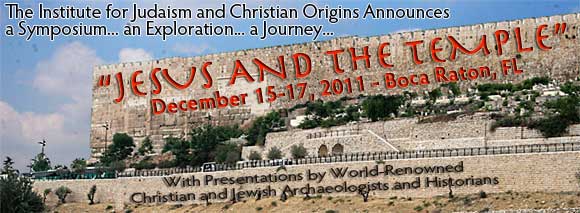
“Jesus and the Temple” Symposium in Boca Raton, FL

From December 15 – 17, 2011, a symposium on “Jesus and the Temple” is planned to take place in Boca Raton, Florida.

Focal Question: How significantly and in what ways did the Temple and its cult help define the social and spiritual life of early Jews, including Jesus and his earliest followers?

Purpose: To correct the popular impression that Jesus despised the Temple and its cult because he attacked the money changers and was apparently condemned by the leading high priests [the historicity of each event must be discussed]. To raise questions which are focused on pre-70 Jews, Jesus, his followers and the Temple and to seek a new consensus on the grid questions.

My topic will be “Imagining the Temple Early Jews Knew”.

Here are the details of the symposium.

Jerusalem – The Biography, Simon Sebag Montefiore

Good to see this book on Jerusalem (see previous post) in the list of Sunday Times (UK) bestsellers – for 15 weeks already! And it’s due for more exposure on Sunday, May 5th, when Montefiore speaks at the Hay Festival near us here, in the Brecon Beacons, Wales, UK.

Excavating the City of David – Where Jerusalem’s History Began

Recently we returned from a trip to Australia – hence the absence of blogs – and I was excited to receive this long-awaited book in the post.

Ronny Reich, Excavating the City of David – Where Jerusalem’s History Began
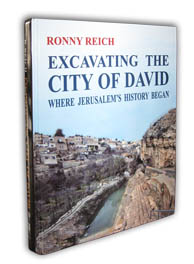
Ronny Reich has excavated in several locations in Jerusalem for over 40 years, starting in 1969 as surveyor on Prof. Nahman Avigad’s team in the Jewish Quarter (a position he held till 1978 when I took over this post, after he had left for the Israel Dept. of Antiquities and Museums) and in the City of David, together with his colleague Eli Shukron, since 1995.

This book is a fascinating account of the history of the City of David. The first part of the book recounts the activities of the many excavators who worked in this area and in the second part, Reich reconstructs the history of the City of David based on the results of all of the archaeological excavations.

The story of the early exploration begins with a description of the visit on April 17, 1838 by Edward Robinson to the Gihon Spring, the ever-flowing water source that determined the location of the City of David. This is followed by the account of Charles Warren’s daring walk through Hezekiah’s Tunnel, which Reich prefers to call the Siloam Tunnel. Reich then examines the explorations of many other excavators, such as Schick, Bliss and Dickie, Weill, Macalister and Duncan, Kenyon, Shiloh and others. Each investigator added a little to our understanding of the history of this site and Reich’s useful analysis of these findings makes it easier to fit them into an overall picture of the development of the City of David.

His own and Shukron’s explorations added much to our understanding of the waterworks in this location, especially how the different components, such as the Siloam Tunnel and the different channels worked together. His explanation of the construction of the Siloam Tunnel and how Channel I was used as a “spirit level” to make sure that the water of the Gihon Spring flowed smoothly to the Siloam Pool makes for exciting reading.

The excavations round the Gihon Spring revealed that the spring and its approach from the city were strongly fortified in the Jebusite period. Two massive walls created a safe approach to a Rock-cut Pool from which water could be drawn.

This book was written, according to Reich, “First and foremost … for lay readers who love the history of Jerusalem”. I found Reich’s discussion of the historical interpretations of the different finds honest and frank. He acknowledges, however, that he is a skeptic and minimalist where the Biblical text is concerned and has difficulty reconciling the text and the archaeological remains. He discusses these problems in a special boxed section called “Biblical traditions: David, Solomon and the United Monarchy”, which is well worth reading and may help in an accurate examination of the Biblical text.

The book is illustrated with many beautiful photographs, but I would like to have seen more interpretative drawings showing how certain features fit together. The text is easy to read, but a final edit should have weeded out mistakes in spelling and syntax.

The book was published by the Israel Exploration Society in Jerusalem, it has 384 pages and 207 illustration (most of them in color), Hard Cover, and measures 10 x 7.5 inches. 
   ISBN: 9789652210821

Price: $49.95


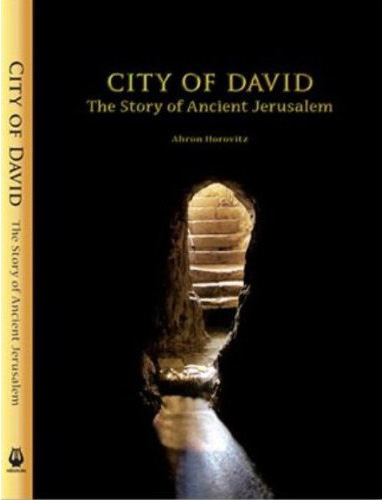
City of David: The Story of Ancient Jerusalem

For my birthday last month, I received a magnificent tome called: City of David: The Story of Ancient Jerusalem by Ahron Horovitz (edited by Dr. Eyal Meiron), Jerusalem: Megalim-City of David Institute for Jerusalem Studies, 2009, 325 pp. Amazon price $56.07.

If you are considering requesting the book to be brought from Jerusalem, give a thought to your friend’s baggage allowance! The book is lavishly produced, quite large and very heavy. So heavy indeed  (about 6 pounds) that it was cheaper to bring it 160 miles by car from London to Cardiff, where we live, than to send it by Royal Mail!

The book recounts the Biblical story of Jerusalem and uses the results of archaeological excavations to illustrate it.

Jane Cahill West, a senior staff archaeologist for the Hebrew University’s City of David project (1978-’85) directed by the late Yigal Shiloh, writes in her book review here:

One of the best features of the book is Horovitz’s ability to provide clear, concise descriptions of the debates that surround interpretation of Jerusalem’s most controversial archaeological remains, such as Warren’s Shaft, the Stepped Stone Structure, and the city’s fortifications. Reconstruction drawings depicting how the city may have looked at various stages of Biblical history are based primarily on the interpretation of fellow tour guide Eyal Meiron, while explanations for some of the most controversial features of Jerusalem’s water supply systems are those offered by Zvi Abells, a retired electrical engineer who devotes all his spare time to studying Jerusalem’s water systems. These reconstructions and interpretations offer perspectives on issues of contentious debate rarely seen in print.


The Western Wall of the Temple Mount Gets Cleaned for Passover, All Notes Taken Out

Did you ever wonder what happened to all those prayer notes that people stick in between the stones of the Western Wall of the Temple Mount? Once a year, in preparation for Pesach (Jewish Passover), they are taken out and buried. According to Jewish Law they cannot be trashed, as the name of God appears on most of the notes. This Israel National News report and video tells you how they do it:

The holiday of Passover is quickly approaching and as we are all busy cleaning our homes, the Kotel (Western Wall) is also being cleaned and the many notes which visitors place between the stones throughout the year are being removed. After the notes are removed, they are taken to genizah (storage for sacred documents).

You can watch the video here: 

Cleaning the Western Wall

“We do this so that there’s room for people who come in the future to place their notes,” explained the caretaker of the Kotel, Yehoshua Rachamim. “We also do it so the wall is Kosher for Passover and there are no traces of chametz between the stones.”

Rachamim added that the cleaning staff does not look at the contents of the notes under any circumstances.

“We don’t look at the notes,” he emphasized. “We only clean, gather the notes, place them in a bag, and take them for genizah.”

In addition to removing the notes, professional engineers are also working at the site, using a crane to ensure that the stones remain stable and that there is no fear that they could break and fall on the worshipers.

The work is being carried out by the Western Wall Heritage Foundation, and is being supervised by the Kotel’s rabbi, Rabbi Shmuel Rabinovich.