Cement on the Temple Mount

The Jan/Feb 2011 issue of Biblical Archaeology Review, published my letter, “Cement Creates Temple Mount Time Bomb”,  in which I explained how the improper use of cement in the repairs was causing some of the problems on the Temple Mount.
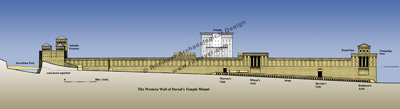
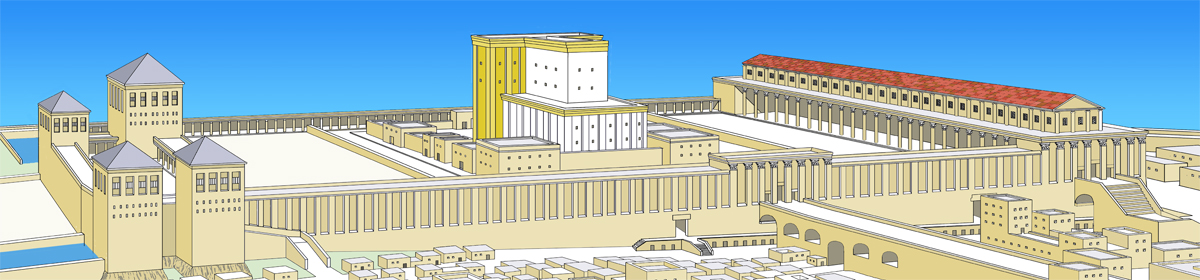
Reconstruction of the Herodian Western Wall of the Temple Mount. The Western Wall of the Temple Mount is 1590 feet (485 m) long. The Antonia Fortress is on the left. The four gates in the Western Wall are, from left to right, Warren's Gate, Wilson's Arch and bridge, Barclay's Gate and Robinson's Arch and stairway. © Leen Ritmeyer

Now BAR have posted on their website an article called “The Trouble with Cement”, commenting that my “view is now echoed by Edward D. Johnson, the chief conservator of the Archaeological Architectural Field School run by USAID in Luxor, Egypt, who condemns the use of cement in archaeological restorations and explains the dangerous and devastating problems it can cause.” Here is his comment in full:

Re: Leen Ritmeyer’s criticism of the use of cement in repairing the bulges in the Temple Mount wall. The problems with the use of cement for such repairs are even worse than he describes.
Being both an archaeologist and archaeological conservator whose practice emphasizes built heritage and having worked in many places around the world, principally in Egypt, for the last 22 years, I have repeatedly seen cement used on archaeological sites and structures with effects ranging from mildly damaging to completely disastrous. Simply put, cement has no place in the care and conservation of any archaeological site or structure. This is a basic principle of archaeological conservation that I have emphasized continually in my teaching of the subject, most recently in the Archaeological Architectural Field School run by USAID in Luxor, Egypt, where I was assistant director and chief conservator.
Cement damages ancient materials and structures in several ways, all of which work together to accelerate deterioration.
Cement in bulk has a different coefficient of expansion than ancient building materials, which are principally limestone and sandstone. Under warm, sunny conditions it will expand at about twice the rate of the original materials. When used on ancient structures, if put under ancient stone, or used to attach it to an underlying substrate, its expansion will tend to lift that stone off the surface to which it is attached, causing that surface to buckle, detach and slough off.
Cement is also loaded with soluble salts. These will leach out of the cement over time. They will migrate into the pores of the ancient building material, where they will be deposited by evaporation, forming salt crystals. Subsequent exposure to, or absorption of, moisture from the air will cause these crystals to dissolve and reform. This cycle of dissolution and recrystallization exerts immense pressure on the pores of the stone, causing their disruption and destruction. This leads to powdering, spalling off of decorated surfaces, and if not checked, complete disassociation of the stone into sand or powder which can cause larger structural failures in a monument.
Finally, cement is unsightly and always visually clashes with original stones and their patina of age as is dramatically revealed in the pictures in BAR.
Edward D. Johnson
Archaeologist/Archaeological Conservator
La Canada, California


The Mysteries of the Temple Mount

In a previous post, we wrote that Accordance Bible Software had added some of our books to their collections. My book, The Quest – Revealing the Temple Mount in Jerusalem, has now been reviewed by David Lang in an Accordance blog post called Embark on the Quest:

Look at most artistic reconstructions of the Temple Mount and you’re likely to see Leen Ritmeyer’s name attached to them. The architect of the Temple Mount Excavations following the Six-Day War, Ritmeyer has spent much of his life researching the mysteries of the Temple Mount and helping people visualize the ancient structures behind the present remains. The Quest is his personal chronicle of the research he has done, the challenges he has faced, and the answers he believes he has discovered.

You can read the full review here.

Is the Second Temple waiting to be unearthed?

In an interview with Aaron Klein’s Investigative Radio programme on New York’s WABC Radio, Eilat Mazar claims that the 2nd Jewish temple is just ‘waiting to be unearthed’. You can read the interview here.

Although I would agree that many remains of the First and Second temple period are still existing below the surface of the present-day Temple Mount, I doubt if any remains of the Temple building itself are still extant.

According to Josephus, the Temple looked like a snow-clad mountain, for all that was not overlaid with gold was of the purest white. © Leen Ritmeyer

The reason for this is that the floor of the Dome of the Rock and  its surrounding area is actually 5 feet (1.5 m) lower than the top of the foundation of the Second Temple, which, according to Josephus was 10 feet 4 inches (3.15 m) high.

In this east-west section through the Temple Mount, the remains of Hezekiah's square Temple Mount are shown in yellow, while the Herodian constructions are coloured brown. The present configuration of the Temple Mount with its buildings are shown in dark blue. © Leen Ritmeyer

There is, however, the possibility that the foundation trenches which were usually cut into the bedrock are still existing.

This section through the Temple shows that the foundation of the Temple was level with the top of The Rock, which nowadays stands some 12.75 m above the floor of the Dome of the Rock. © Leen Ritmeyer

The bedrock falls to the east of the Dome of the Rock and I believe that remains of the steps leading up to the Temple, the Altar, and the Nicanor Gate could still be found.

The Temple was built on the top of Mount Moriah and therefore the further away from the top, the better the chances are that remains could be found.


HT: Joe Lauer

Priestly Blessing for the First Time on the Temple Mount during Jerusalem Day

On the second of the common days of Pesach (Passover), which this year fell on the 21st of April, there is usually a large gathering at the Western Wall to watch the priestly blessing.

Yesterday a much smaller, but perhaps more important priestly blessing was allowed for the first time in recent history on the Temple Mount itself. See this Israel National News report:

Hundreds of religious Jews from all streams were able to happily commemorate the 44th anniversary of the first-ever entry of Israeli soldiers onto the TempleMount.

For the first time in the history of Israeli restrictions on Jewish entry to the Temple Mount, the recitation of the Priestly Blessing was permitted there.  It happened on Wednesday, Jerusalem Reunification Day, when hundreds of visitors – all of whom immersed in a mikveh (ritual bath) prior to coming and took other precautions required by Jewish Law – were allowed to enter the Temple Mount in groups of 30-40.

Among them were several Cohanim (descendants of Aharon the Priest).  They spread their hands in the customary manner and recited, “May G-d bless and watch  over your… May G-d shine His countenance upon and show you grace… May G-d raise His countenance towards you and grant you peace” (Numbers 6, from the portion to be read aloud this week in synagogues throughout the Jewish world).

Rabbi Yisrael Ariel, head of the Temple Institute and one of the paratroopers who helped liberate the Temple Mount in 1967, and who was miraculously saved from death at the tim, recited aloud the blessing, “Barukh – Thou art the source of blessing, G-d, Who performed a miracle for me in this place.” Many visitors and listeners, including policemen, recited “Amen!”

The visitors specifically noted the fair and pleasant attitude displayed by the police, as well as the preparations and security precautions they implemented for all those wishing to ascend to the Temple Mount on this date.

In addition to the above, Rabbi Yoel Elitzur delivered a Torah lesson on Temple-related issues, after which the participants – again, including policemen – stood for the recitation of the Kaddish.

Despite the close proximity of the Moslem Waqf policemen and their obvious anger, the visit went off nearly without a hitch. One Israeli policemen yelled angrily and threatened the Jewish visitors, but that incident ended relatively quickly.


A moving scene at the Western Wall

Jehuda Hartman was 22 on June 7, 1967 when he stood as an IDF paratrooper at the liberated Western Wall or Kotel. 44 Years later, on Jerusalem Day, he recreates the shot. Click on the picture to see the video:

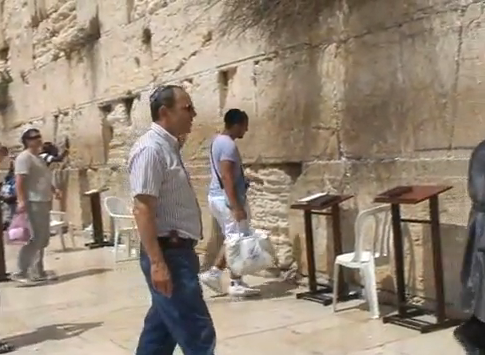
Jehuda Hartman returns to the Western Wall

Two months later, I visited the Western Wall myself and vividly remember the excitement that was still in the air.

Read the full Jerusalem Post report here.

Temple Mount Faithful petitions for State Comptroller’s excavation report

In a previous post, we reported on State Comptroller’s report on the illegal activities by the Waqf on the Temple Mount. According to the website of the Temple Mount Faithful:

“The goal of the Temple Mount and Land of Israel Faithful Movement is the building of the Third Temple on the Temple Mount in Jerusalem in our lifetime in accordance with the Word of G-d and all the Hebrew prophets and the liberation of the Temple Mount from Arab (Islamic) occupation so that it may be consecrated to the Name of G-d.”

The Jerusalem Post reports that this group, led by Gershon Salomon, has petitioned the High Court to have the full report published:

Fearing mass-scale destruction of holy artifacts under the Temple Mount, the Temple Mount Faithful, a group that calls for the Jewish takeover of the site, petitioned the High Court on Thursday to order the full publication of the secret State Comptroller’s Report on excavation works being conducted at one of the holiest places in the world.

Citing “harm to Israel’s national security and possible harm to its foreign relations”, the High Court has so far refused to publish the complete report.


HT: Joe Lauer

Jerusalem City calls for the Mughrabi Gate to be destroyed within two weeks

The Mughrabi Gate, located just above the Western Wall in Jerusalem, is the only entrance to the Temple Mount for non-Muslim tourists. After the collapse of the earthern ramp in 2004, a wooden bridge was erected as a temporary solution until a new and safer bridge could be built to replace the old dirt ramp. We reported on this problem in previous posts here, here, here and here.

The Jerusalem Post reported today that:

The Jerusalem City Engineer sent a strongly worded letter to the Western Wall Heritage Fund on Sunday, stating that the temporary bridge to the Mughrabi Gate must be destroyed within two weeks, or the city will tear it down.

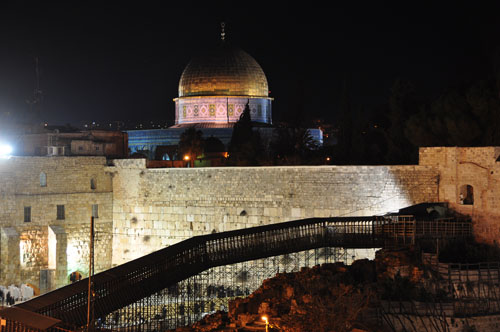
His  reasons were that the structure had become “hazardous due to deteriorating physical conditions”. The fragility of the temporary bridge is evident from this picture:

The Mughrabi Bridge at night. Photo: © Nathaniel Ritmeyer

“The municipality said that since the [Western wall] heritage fund received the necessary permits in March to build a replacement bridge, there is no reason to continue using the old bridge.”

The political ramifications, however, are such that nothing will probably done for a long time to come, which is good news for the many tourists that visit the Temple Mount every day.

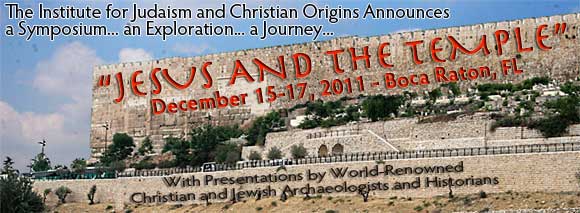
“Jesus and the Temple” Symposium in Boca Raton, FL

From December 15 – 17, 2011, a symposium on “Jesus and the Temple” is planned to take place in Boca Raton, Florida.

Focal Question: How significantly and in what ways did the Temple and its cult help define the social and spiritual life of early Jews, including Jesus and his earliest followers?

Purpose: To correct the popular impression that Jesus despised the Temple and its cult because he attacked the money changers and was apparently condemned by the leading high priests [the historicity of each event must be discussed]. To raise questions which are focused on pre-70 Jews, Jesus, his followers and the Temple and to seek a new consensus on the grid questions.

My topic will be “Imagining the Temple Early Jews Knew”.

Here are the details of the symposium.

The Western Wall of the Temple Mount Gets Cleaned for Passover, All Notes Taken Out

Did you ever wonder what happened to all those prayer notes that people stick in between the stones of the Western Wall of the Temple Mount? Once a year, in preparation for Pesach (Jewish Passover), they are taken out and buried. According to Jewish Law they cannot be trashed, as the name of God appears on most of the notes. This Israel National News report and video tells you how they do it:

The holiday of Passover is quickly approaching and as we are all busy cleaning our homes, the Kotel (Western Wall) is also being cleaned and the many notes which visitors place between the stones throughout the year are being removed. After the notes are removed, they are taken to genizah (storage for sacred documents).

You can watch the video here: 

Cleaning the Western Wall

“We do this so that there’s room for people who come in the future to place their notes,” explained the caretaker of the Kotel, Yehoshua Rachamim. “We also do it so the wall is Kosher for Passover and there are no traces of chametz between the stones.”

Rachamim added that the cleaning staff does not look at the contents of the notes under any circumstances.

“We don’t look at the notes,” he emphasized. “We only clean, gather the notes, place them in a bag, and take them for genizah.”

In addition to removing the notes, professional engineers are also working at the site, using a crane to ensure that the stones remain stable and that there is no fear that they could break and fall on the worshipers.

The work is being carried out by the Western Wall Heritage Foundation, and is being supervised by the Kotel’s rabbi, Rabbi Shmuel Rabinovich.


Jerusalem’s “Small Kotel” is not a holy site

In a previous post, we reported on the opening of the Small Kotel as a place for Jewish prayer. Now, however, it has been reported in IsraelNationalNews (Arutz Sheva) that the State of Israel has decided that the site is not holy:

The State’s representatives have determined that the “Kotel HaKatan” (“Small Kotel” or “Small Wailing Wall”), a wall which is a continuation of the Kotel in Jerusalem, is not a holy site. The statement was submitted to the court as part of the reply to a damages lawsuit filed by a group of Jews who prayed at the Small Kotel on Rosh HaShana of 5767 (2006).

One member of the group, Elihu Kleiman, was arrested after he blew the ram’s horn, or shofar. The group of Jews who sued for damages also said they were beaten by police, who denied them their freedom to worship at a holy site.

The “Small Kotel” is nothing but “an inner courtyard of several residential homes in the Muslim quarter,” the State determined in its response.

Like the Kotel, the Kotel HaKatan is an exposed face of the original western wall of the Temple Mount, built by King Herod over 2,000 years ago. However, compared to its famous “bigger brother,” the Small Wall is less accessible and looks less impressive: it is barely 10 meters long, less of its height has been exposed and its plaza is much narrower.

In fact, however, the Kotel HaKatan can be considered holier than the better known Kotel, because it is located 200 yards to the north – and therefore practically opposite the actual site of the Holy of Holies in the original Holy Temples.

Attorney Daniel Robins, who represents the group of Jews who were praying at the site in 2006 and who sued the State, told Arutz Sheva’s Hebrew-language service that Rabbi Shmuel Rabinovich, the Kotel Rabbi, testified before the court as to the sanctity of the site, but the State rejected the power of Jewish Law to determine the site’s sanctity.

Robins said that he hopes the State is not acting out of political considerations in rejecting the sanctity of the Kotel HaKatan. He noted that the site is included in the area that Defense Minister Ehud Barak wants to hand over to the Arabs in a peace deal.