The Temple Mount in the Washington Post

Yesterday, The Washington Post published an article on the Temple Mount.

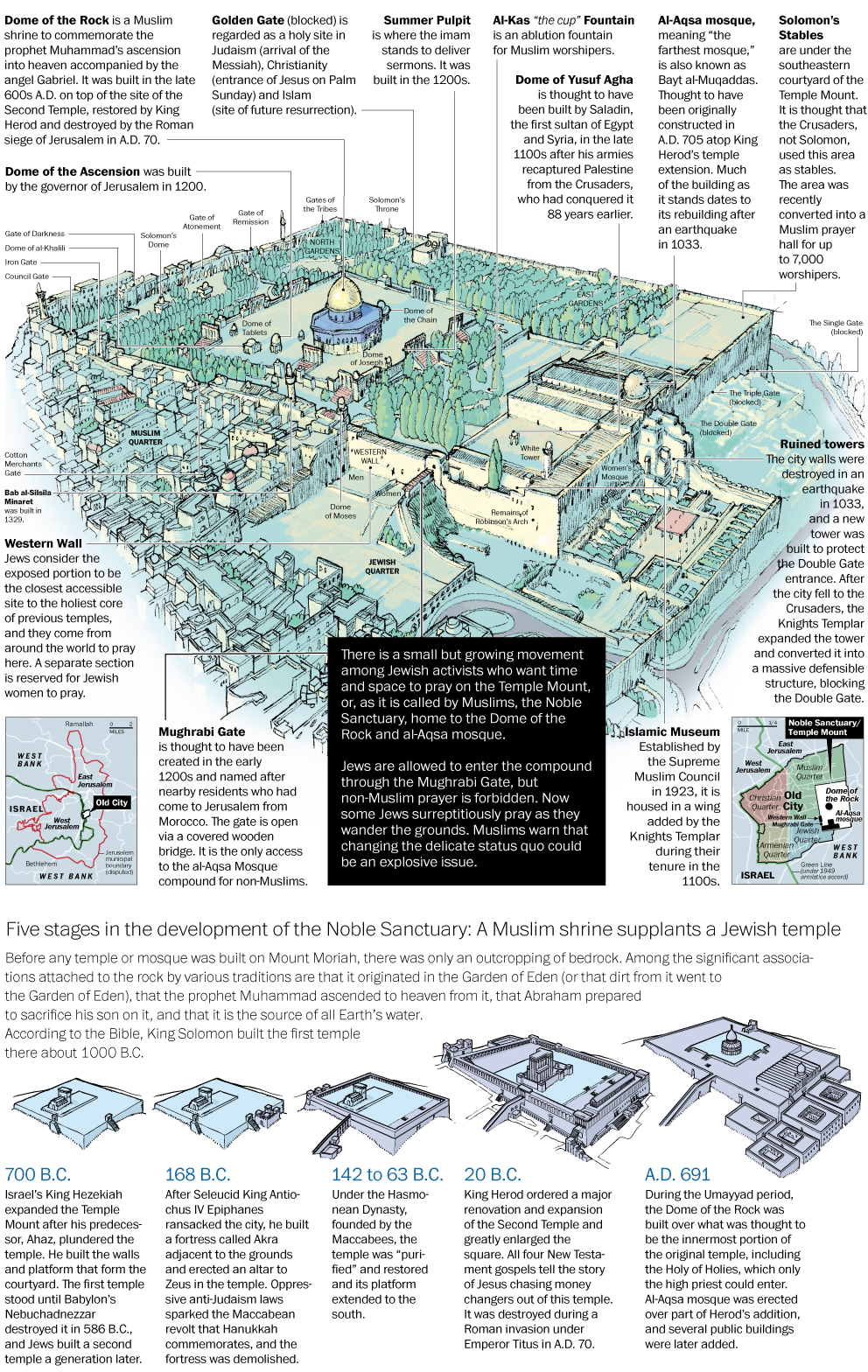
Muslims call it the Noble Sanctuary. Jews and Christians call it the Temple Mount. Built atop Mount Moriah in Jerusalem, this 36-acre site is the place where seminal events in Islam, Judaism and Christianity are said to have taken place, and it has been a flash point of conflict for millenniums. Many aspects of its meaning and history are still disputed by religious and political leaders, scholars, and even archaeologists.

Several cycles of building and destruction have shaped what is on this hilltop today.

These cycles of the Development of the Temple Mount are shown in the five sketches below the main site drawing:
Underground Battle for the Temple Mount

In today’s Makor Rishon (Hebrew) newspaper, Arnon Segal published an article, called Otiot porchot be-avir (letters blossom in the air). Based on the diary of the Rabbi of the Western Wall, Rabbi Meir Yehuda Getz, he retells the story of the underground excavations and the struggle that took place inside Warren’s Gate in 1981. Warren’s Gate is the northern-most of the four original Herodian gateways that gave access to the Temple Mount through the Western Wall.

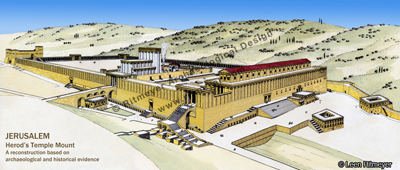
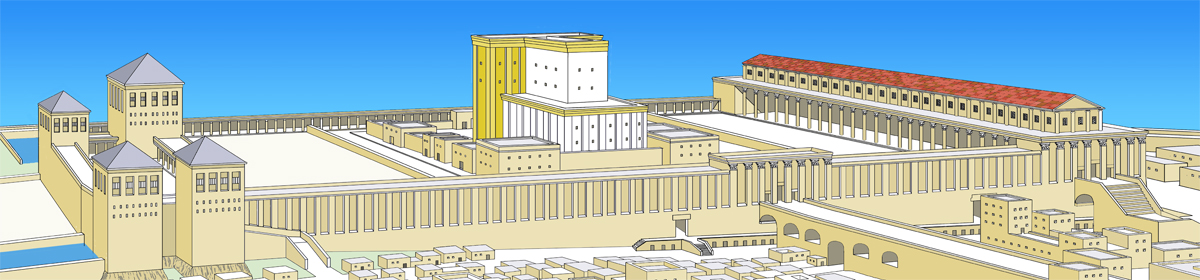
This well-known reconstruction drawing of the Temple Mount in Jerusalem during the Second Temple period is based on historical information and the results of the Temple Mount excavations, which were led by the late Prof. Benjamin Mazar from 1968-’78.
Herod the Great enlarged the existing Temple Mount to double its size and built a new Temple. In the Western Wall (left) there were four gates. Warren’s Gate is the northern-most gate in the Western Wall (on the left). The Southern Wall (right) had two gates. Above this wall stood the Royal Stoa. The Antonia Fortress at the northwest corner (far left) guarded the Temple Mount from the north.

In April 1866, Captain Charles Wilson inspected this underground passageway which for several centuries had been used as a water reservoir. Three years later, Charles Warren examined the cistern (Cistern 30, see below) and noted that its western end pierced the Western Wall. It measures 25.6×5.50m and its floor is 10.50m below the level of the Temple Mount. This cistern was originally a Herodian underground passage, leading up from Warren’s Gate to the Temple Mount, possibly having an internal L-shaped stairway like at Barclay’s Gate. A relatively modern stairway descends from the west into the cistern. Wilson later named this gate after Warren.

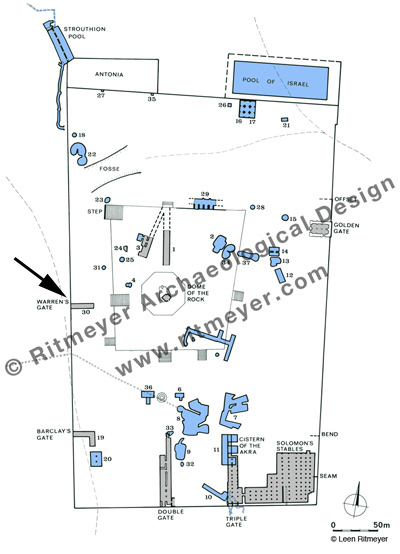
This plan shows the cisterns (blue) and underground passageways (grey) of the Temple Mount. The numbering system was developed by Charles Warren, who, in the 1860’s, explored many of these underground structures. Some of these underground passageways were part of Herodian gates that gave access to the Temple Mount, i.e. Cistern 30 is the underground passageway of Warren’s Gate (see arrow), Cisterns 19 and 20 are part of the underground passageway of Barclay’s Gate, Cistern 1 is the underground passageway of the ancient Tadi Gate.
Some of the water cisterns, such as Cisterns 7 and 8 were enormous underground water reservoirs, capable of holding some 2 million gallons of water. Most of these cisterns were initially underground quarries from which building stones for the buildings of the Temple Mount were taken. After the quarrying activities were stopped, these caverns were plastered and became water reservoirs.

This underground tunnel was accidentally rediscovered in 1981 during excavations that took place along the Western Wall north of Wilson’s Arch. During the construction of an underground synagogue, workers broke through the wall that had blocked up the gate opening.

Rabbi Getz believed that this gate was used in the past by priests going up to the Temple. He also believed that this passage led to the lost Temple treasures and to the Ark of the Covenant. After working in secret for about a month, Arabs found out from a media report that the Israelis were excavating below the Temple Mount. They descended into the cistern through two manholes from above and closed off the gate with a very thick concrete wall.

The dream of Getz to reach the Temple Treasures, especially the Ark of the Covenant, was dashed. According to his diary, he sat down with ashes on his forehead, praying:    “O God, the nations have come into your inheritance; they have defiled your holy Temple.” (Psa. 79:1).

Despite the fact that this excavation was illegal, it nevertheless would have been exciting to find out more about how exactly this underground passage originally worked.

HT: Yisrael Medad

Jerusalem the Movie filmed in iMax 3D

About two years ago, we mentioned in a post that an epic movie about Jerusalem was being made in iMax format. As of August 16, this year, the movie has been released and will be distributed by National Graphic. It shows stunning helicopter photography of the Land of Israel and tells the story of Jerusalem through the eyes of three young women, Christian, Jewish and Arab. Here you can watch the trailer:

We are pleased to have been able to contribute to this movie with reconstructions of Jerusalem in the Second Temple and Byzantine periods.

For further information see Facebook:

JERUSALEM releases worldwide in 2013, please click on ‘Welcome’ to sign up for our email list or visit www.jerusalemthemovie.com to learn more.

Description

Through the unrivaled beauty and visceral nature of the IMAX® experience, JERUSALEM seeks to increase public understanding and appreciation for Jerusalem’s historical, spiritual, cultural and artistic uniqueness, as well as highlighting some of the intersections between Judaism, Christianity and Islam.

Plot outline

Through the unrivaled beauty and visceral nature of the IMAX® experience, JERUSALEM seeks to increase public understanding and appreciation for Jerusalem’s historical, spiritual, cultural and artistic uniqueness, as well as highlighting some of the intersections between Judaism, Christianity and Islam.

Initially, the movie will be shown in these locations:

Boston, Massachusetts – Museum of Science

Special Event: Thursday, September 12, 2013

Public Start Date: Friday, September 20, 2013


Charlotte, North Carolina – Discovery Place

Public Start Date: Wednesday, September 18, 2013


West Nyack, New York – IMAX Theater at the Palisades

Public Start Date: Monday, September 23, 2013


Ottawa, Ontario – Canadian Museum of Civilization

Special Event: Monday, September 23, 2013

Public Start Date: Friday, September 27, 2013


McMinnville, Oregon – Evergreen Aviation Museum

Public Start Date: Friday, September 27, 2013


Seattle, Washington – Pacific Science Center

Special Event: Friday, September 20, 2013

Public Start Date: Saturday, September 28, 2013


Garden City, New York – Cradle of Aviation

Special Event: Wednesday, September 25, 2013

Public Start Date: Saturday, September 28, 2013


St. Louis, Missouri – St. Louis Science Center

Public Start Date: Tuesday, October 1, 2013


Lubbock, Texas – Science Spectrum

Public Start Date: Tuesday, October 1, 2013


Houston, Texas – Houston Museum of Natural Science

Public Start Date: Tuesday, October 1, 2013


Paris, France – La Geode

Public Start Date: Tuesday, October 15, 2013


Davenport, Iowa – Putnam Museum

Public Start Date: Friday, November 1, 2013


Hastings, Nebraska – Hastings Museum

Public Start Date: Thursday, November 7, 2013


London, England, UK – BFI IMAX Cinema

Premiere: January, 2014 (date TBD)


Second Annual Conference of Hekhal

Last year we attended the First annual conference of Hekhal: the Irish Society for the Ancient Near East that was held in Dublin, Ireland.

This year, the second conference, entitled “Pilgrimage, Travel, and Cult” will be held on 24-26 May 2013 at CITI, Braemor Park, Dublin 14.

Many scholars from different parts of the world, including Israel, will attend. On the Hekhal website there are links that let you download the sessions and abstracts of the different papers.

The sessions that I would find particularly interesting are: “Pools of Jerusalem: Pilgrimage, Purity and the Holy City” by David Gurevich, University of Haifa, Israel, and “The role of the Temple Mount after 70AD” by Shlomit Weksler-Bdolah, Israel Antiquities Authority.

HEKHAL is currently preparing the proceedings of its first annual conference for publication, which will contain our article on “Relating the Temple Scroll from Qumran to the Architecture of the Temple Mount in Jerusalem”.

The Eastern Gate of the Temple Mount in Jerusalem

I am often approached by people that are under the impression that the Eastern Gate of the Temple Mount had to be directly opposite the entrance leading into the Holy Temple.  According to Middot 1.3, there was only one gate in the Eastern Wall of the Temple Mount:  “the Eastern Gate on which was portrayed the Palace of Shushan”.

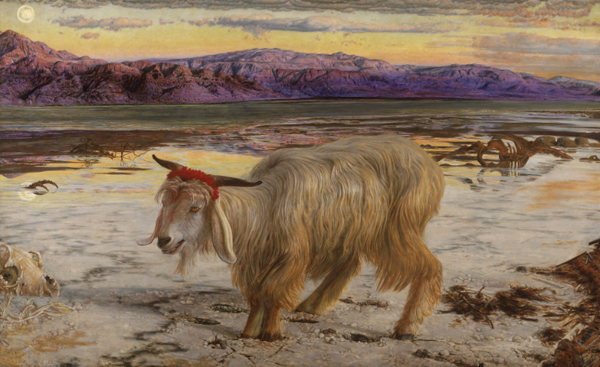
The Eastern Gate is an important gate of the Temple Mount, as on Yom Kippur the scapegoat that was chosen by the High Priest in front of the Temple, would have been led through the Court of the Women, down a stairway to and through the Shushan Gate and into the Kedron Valley. From there it was led over the Mount of Olives into the Wilderness of Judea.

Painting of the Scapegoat by William Holman Hunt

Another biblical scene takes us to the top of the Mount of Olives, where a priest would sacrifice a Red Heifer. Numbers 19 stipulated that in order for the people to be purified, a Red Heifer should be sacrificed, its ashes collected and put in a container with water. This was used to sprinkle those in need of purification. The Mishnah said that the priest that was consecrated to burn the Red Heifer would leave the Temple Mount with the Heifer and go through the eastern gate to the Mount of Olives. The problem of the identification of the eastern gate lies in two passages, in Mishnah Parah 3.9 and 4.2.  The first states that the priest that offered the Red Heifer on the Mount of Olives, sprinkled its blood seven times toward the Holy of Holies. According to the second passage, “if the blood was sprinkled not in the direction of the entrance [of the Holy of Holies] it is invalid.” There must therefore have been a direct line of vision between the Mount of Olives and the entrance to the Temple. From the place of this activity, he could look straight through the Nicanor Gate and see the entrance to the Temple.

The Temple Mount viewed from the east. © Leen Ritmeyer

The idea that the Shushan Gate had to be directly opposite the entrance to the Temple comes from a misunderstanding of the passage in Middot 2.4: “All the walls there were high, save only the eastern wall, because the [High] priest that burns the [Red] heifer and stands on top of the Mount of Olives should be able to look directly into the entrance of the Sanctuary when the blood is sprinkled.”  Does that mean that the Eastern Gate of the Temple Mount should be on the same line of vision, drawn between the Temple and the top of the Mount of Olives?

Looking from the top of the Mount of Olives through the Golden Gate one could never see the Temple, wherever one places it on the Temple Mount, as that gate is located far too low down. One cannot expect to look through a lower gate and see something that is higher than that gate. Only the drawing of a section would make that clear. In order to solve architectural problems, one needs to think in three dimensions.

The level of the top of the Mount of Olives (810 m. above sea level) is 75 m. (246 feet) higher than the Temple platform (735 m.). The sill of the Golden Gate is located some 21 m. (70 feet) lower than the Temple platform. How then could one look from the top of the Mount of Olives through the Golden Gate, or any other gate in the Eastern Wall of the Temple Mount, and hope to see the entrance to the Temple? It is totally impossible!

A line of vision from the top of the Mount of Olives through the Golden Gate makes it impossible to see anything on the Temple Mount, let alone the Temple. Looking through the Nicanor gate, however, one can see the entrance to the Temple clearly. Drawing © Leen Ritmeyer

We must conclude that the passage in Middot 2.4 needs to be read differently or that the writer didn’t remember the actual line of vision.  Which walls are referred to by “All the walls …”? Those of the Temple Mount or those of the Temple Courts? The previous passage (Middot 2.3) describes structures “inside the Temple Mount” and it ends with a reference to the Nicanor Gate. This was an extraordinarily beautiful gate with bronze doors made in Alexandria, that stood between the Temple Court and the Court of the Women, right in front of the Herodian Temple .

The Nicanor Gate stood in front of Herod’s Temple. It gave access from the Court of the Women to the Temple Courts. In front of this gate were fifteen semi-circular steps on which Levites sang the fifteen “Psalms of the Steps” (Psalms 120-134 of Degrees or Ascents). The gold-covered Temple towered above all other buildings.

There is a direct line of vision from the top of the Mount of Olives to the entrance to the Temple through the Nicanor Gate, while the walls of the Court of the Women were kept low (see illustration above). If one stands today to the east of the Dome of the Rock one can see the Mount of Olives clearly.  The Nicanor Gate therefore is the only gate that the writer of Middot could have had in mind. The High Priest that offered the Red Heifer on the Mount of Olives would have had to look through this gate in order to see the entrance to the Temple. I believe therefore that the gate mentioned in Middot 2.4 is the Nicanor Gate and not the Shushan Gate.

The Arch of Titus Digital Restoration Project

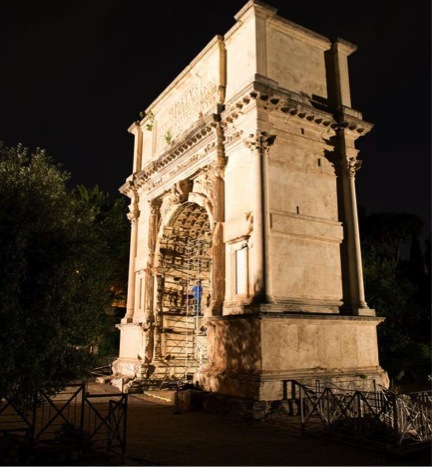
In a previous post we reported on the The Arch of Titus Digital Restoration Project in Rome, led by Prof. Steven Fine, which has as its aim the scanning of the menorah panel for evidence of ancient color.

The reliefs were scanned by Unocad at night to avoid the interference of sunlight.

Prof. Steven Fine noted that in the first presentation at the upcoming April 4 Kennes Torah Umadda (Congress of Torah and Science) in Jerusalem he will be discussing — for the first time in Israel — the discoveries made by the Arch of Titus Digital Restoration Project last summer and the implications of advances in the study of polychromy for the study of the arch (and of Jewish visual culture in general).

Here is the account that has been  published by the Center for Israel Studies of the Yeshiva Universtity in New York.

The Arch of Titus Project will have important significance for the study of Roman architecture, as no monument of the Flavian period has yet been subjected to pigmentation analysis to reveal its original coloration. It is also projected to be of great importance for the study of the appearance of the sacred vessels of the Second Temple in the first century CE, as well as of the Herodian building projects in ancient Judaea, especially King Herod’s rebuilding of the Second Temple in the first century CE. It will thus expand the reach of the new field of research surrounding polychromy in the ancient world beyond Classics and Classical Archaeology into the fields of Judaic studies and early Christian history.

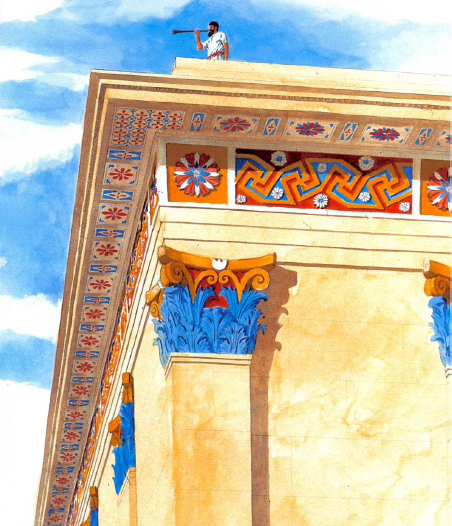
Steven Fine had asked me earlier this year what I thought about Eilat Mazar’s color reconstruction of Herod’s Temple Mount, whom she had  published in her Complete Guide to the Temple Mount Excavations, p. 43, with this comment:

The colours were chosen on the basis of parallels of painted architectural remains in the Judean Desert at Cypros and Masada.

As far as I remember, paint was only found on plaster in these sites, not on stone. No remains of any paint has been found so far on any excavated Herodian stone remains in the Temple Mount Excavations led by Prof. Benjamin Mazar from 1968-78.

The comment of archaeologist Stephan Zink in the above mentioned article is interesting:

The 2009 study of the remains of the Temple of Apollo on the Palatine by conservator Heinrich Piening, another member of our team, and archaeologist Stephan Zink showed that “most surfaces of the temple were kept uncolored as white marble (probably from Carrara) but a carefully-chosen color palette highlighted strategic elements such as capitals, entablature and doorframe. Although evidence for the original coloring remains fragmentary, sufficient information is available to allow us to consider the design strategies that lie behind the color scheme of the temple…”

So, some paint may have been used, but only sparsely. In his description of the Jerusalem Temple, Josephus (War 5.207-10; 222-23) is quite clear that the facade of the Temple “was covered with gold all over” …  “with plates of gold of great weight” and that “those parts that were not gilt, were exceeding white.” No color was therefore used in the entablature and columns that decorated the Temple’s facade.

According to Josephus, Herod’s Temple looked like a snow-clad mountain, for all that was not overlaid with gold was of the purest white and it lacked nothing that could astound either mind or eye. When the sun rose in the east, its fiery reflection blinded the people who watched the Temple from the Mount of Olives.
No wonder that some of Jesus’ disciples remarked “how the temple was adorned with beautiful stones and with gifts dedicated to God” (Matthew 24.1; Luke 21.5).


Where in the Temple was Jesus when he was 12 years old?

In his post of Monday, March 11, 2013, Todd Bolen of Bibleplaces, remarks on a statement reportedly made by Dan Bahat in an Italian newspaper:

There’s an article in the Italian press (with a Google translation in English here) in which Dan Bahat allegedly claims that he knows the exact place where Jesus taught the rabbis at the age of 12. He identifies an area on the south side of the Temple Mount where he says that excavations have uncovered the scales on which the teachers stood.

This is the paragraph that was translated by Google:

“The paths of Christian pilgrims in Jerusalem could be enriched by a new holy place” the point where Jesus’ amazed the rabbis with his wisdom when he was 12 years old. I think I can show exactly where this and ‘happened.” This is an area in the southern part of the Temple, where excavations have brought to light the scales on which the teachers of the law were standing normally.”

So much for Google translator that wrongly translated “scale” with “scales” instead of “steps”, as mentioned by Ferrell Jenkings in his comment on Todd’s blog. I once saw “out of sight, out of mind” translated as “invisible moron”! So, better get your dictionaries out.

It is difficult to pinpoint exactly where the event described by Luke 2.46 took place:

“After three days they [Mary and Joseph] found him [Jesus] in the temple, sitting among the teachers, listening to them and asking them questions”.

If Bahat was thinking of the monumental stairway leading up to the Double Gate, that would not be “in the temple”, but outside of it, and therefore can be dismissed. But, who were those “teachers” that Jesus questioned? According to the Talmud (see quote below), they were the members of the Temple Sanhedrin that met in special courts, such as the Chamber of Hewn Stone. Normally, non-members of the Sanhedrin couldn’t enter the premises where these teachers and lawyers met in order to question them, let alone a 12-year old. There were, however, occasions when these teachers came out upon the “Terrace” or “Rampart” (Hebrew: hel) of the Temple. This was a walkway in front of the buildings that stood to the south of the Temple and was located on the top of a flight of 12 steps.

An overall view of the Temple Mount from the southeast. The Eastern wall is in the foreground and the Temple with its buildings stands near the centre. The Antonia Fortress at the northwest corner of the Temple Mount is visible to the right of the Temple. The arrow points to the location of the 12 steps.

These 12 steps were most likely the “scale” which Bahat referred to. Although the only source that mentions this location is of a later date, it is still our only authority. It is stated in the Babylonian Talmud Sanhedrin 88b:

“… they all proceeded to the Hall of Hewn Stones, where they [i.e., the Great Sanhedrin] sat from the morning tamid  until the evening tamid; on Sabbaths and festivals they [the members of the Temple Sanhedrin] sat within the hel”.

Both terrace and steps are mentioned in Middot 2.3:

“Inside this [soreg] was the Rampart (hel), ten cubits broad. And there were twelve steps there; the height of each step was half a cubit and the tread thereof was half a cubit.”

We have illustrated this location in our book “The Ritual of the Temple in the Time of Christ” and in a corresponding CD.

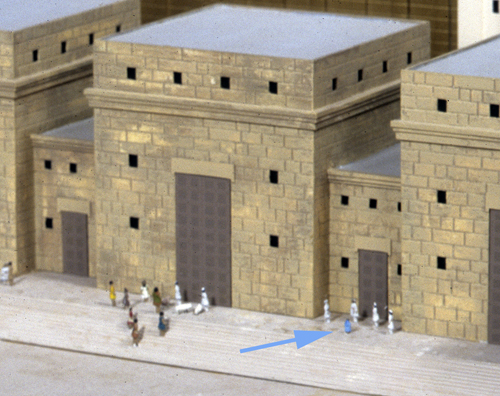
The 12-year old Jesus on the hel. © Leen Ritmeyer

In the illustration we see  the little figure of Jesus in blue (see arrow) with a few of the teachers (in white) on the hel above the 12 steps during that first visit to the Temple. Jesus was there during the Feast of Passover and it may possibly have been the first time that he would have realized that he was that to be that ultimate Passover sacrifice and that he would have to lay down his life for his friends.

The Temple Institute to move soon to a new location

It is always worth visiting the Temple Institute when visiting the Old City of Jerusalem.

The Temple Institute is dedicated to every aspect of the Holy Temple of Jerusalem, and the central role it fulfilled, and will once again fulfill, in the spiritual wellbeing of both Israel and all the nations of the world. The Institute’s work touches upon the history of the Holy Temple’s past, an understanding of the present day, and the Divine promise of Israel’s future. The Institute’s activities include education, research, and development. The Temple Institute’s ultimate goal is to see Israel rebuild the Holy Temple on Mount Moriah in Jerusalem, in accord with the Biblical commandments.

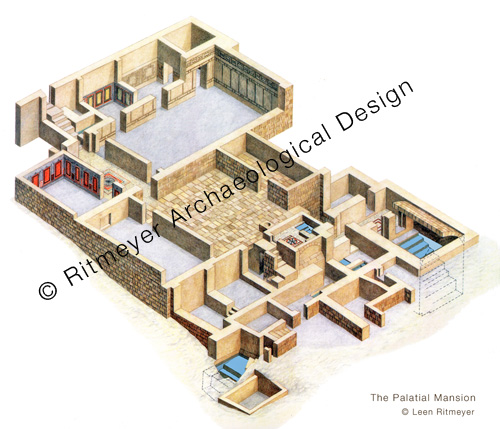
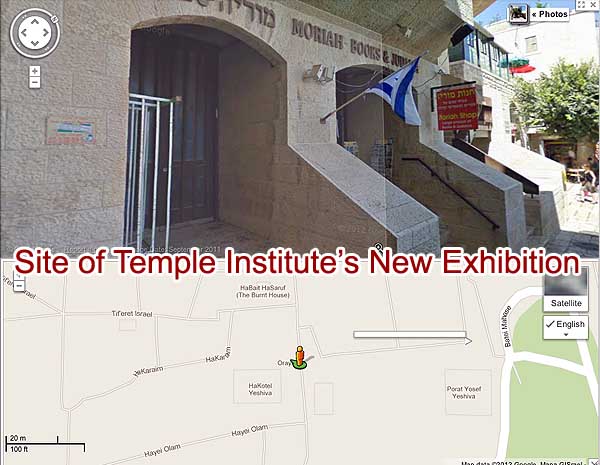
The Institute announced that early this year they are moving to a new location, a couple of hundred meters from their present location on Misgav Ladach Street. This new site is located directly above the Herodian Quarter that was excavated by the late Prof. Nahman Avigad and which contains the remains of what was possibly the Palace of Annas the High Priest.

The Palatial Mansion. © Leen Ritmeyer

The Temple Institute is delighted to announce that after twenty five years of introducing visitors the world over to the sacred vessels of the Holy Temple and the dream, along with the practical measures being taken for rebuilding the Holy Temple, our headquarters will be moving in early 2013 to a new, expanded facility, which will include a brand new Visitors Center. Just a few hundred meters from our current location the new center will be located just above the Yehudah HaLevy stairs which lead from Jerusalem’s Old City Jewish Quarter down to the Western Wall Plaza facing the Temple Mount. The new exhibition will include a highly advanced, state of the art presentation of the Temple-ready sacred vessels created by the Institute, garments of the High Priest, oil-paintings depicting aspects of the Divine service of the Holy Temple and model of the Holy Temple Complex. Visitors will also be able to see a scaled-down stone altar, made in accordance with Torah law, transportable and completely ready for use on the Temple Mount.

Photo: Temple Institute

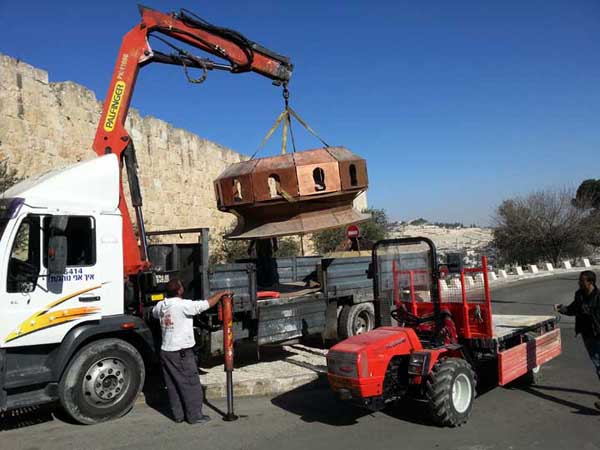
In the events section of their website they show a massive Laver being transported to the new premises:

The Laver is unloaded for transportation to the new location. Photo: Temple Institute

This post has many pictures showing how the Laver was made.

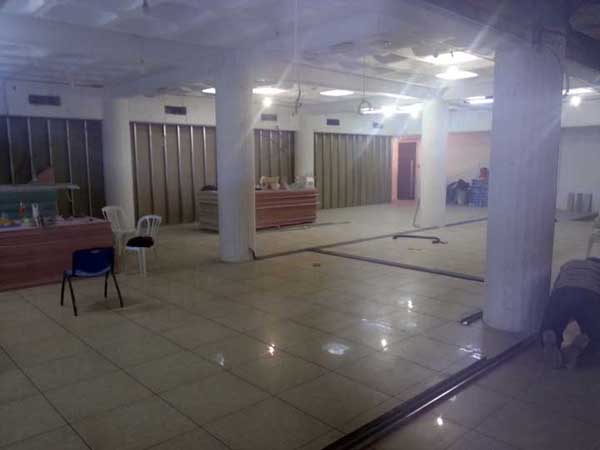
The exhibition space available will be three times as large as that at the current site. Below, we see one of the halls being prepared for future use:

Photo: Temple Institute


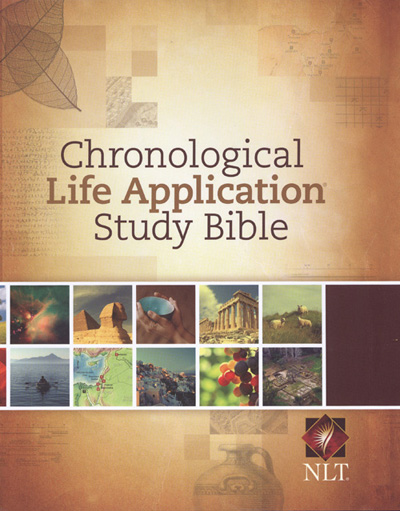
Chronological Life Application Study Bible

Last week I received a copy of the new Chronological Life Application Study Bible, produced by Tyndale House Publishers.

Its approach is quite unique in that the chapters are arranged in chronological order. As an example, it was surprising, but possibly accurate, to see Ps 90, which was written by Moses, placed at the end of the Book of Deuteronomy. Also helpful is the timeline at the top of each page, showing where in history the text is placed.

The new four-color Chronological Life Application Study Bible combines the proven resources of the Life Application Study Bible with a chronological format and several brand-new resources. The Bible is arranged in 10 chronological sections that help the reader to see how the various pieces of the Bible fit together. New section intros and timelines set the stage for the passages in each section. New archaeological notes and photographs help to bring God’s story to life in a whole new way.

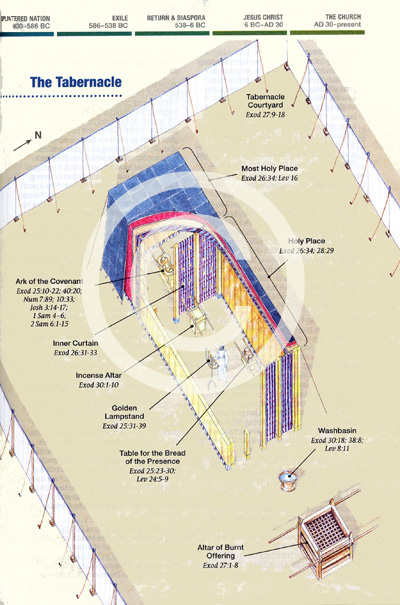
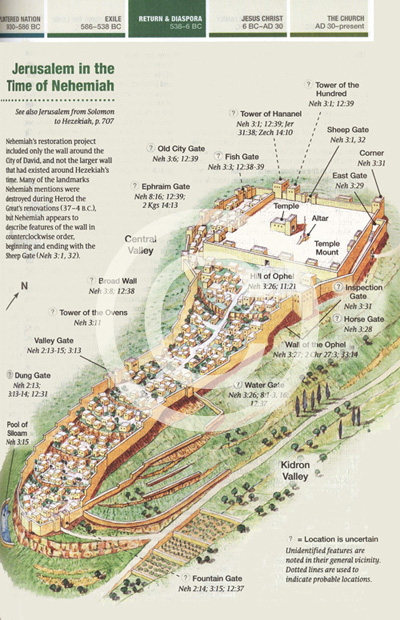
I was also pleased to see the new reconstruction drawings that I was asked to make for this Study Bible:

p. 197 The Tabernacle

p. 682 Jerusalem in the Time of David

p. 615 Solomon’s Temple

p. 707 Jerusalem from Solomon to Hezekiah

p. 1219 Jerusalem in the Time of Nehemiah

p. 1389 Herod’s Temple

p. 1489 The Tomb of Christ

Here are two samples:

The Tabernacle. Drawing © Leen Ritmeyer
Jerusalem in the Time of Nehemiah. Drawing © Leen Ritmeyer

N.B. The aim of the New Living Translation was of course, as explained in the Introduction:

“to render the message of the original texts of Scripture into clear, contemporary English. As they did so, they kept the concerns of both formal-equivalence and dynamic-equivalence in mind.”

Continued Destruction of the Temple Mount

Nadav Shragav wrote an interesting article, called Discarding History, about the continued destruction of the Temple Mount. Not only are archaeological artefacts removed and dumped, but also the walls of the Temple Mount continue to be damaged by the construction work carried out by the Muslim authorities:

The Temple Mount is not in our hands • The Muslim wakf continues to damage antiquities and archeological artifacts as authorities remain helpless to prevent it • Entire Jewish, Muslim and Christian histories are being brutally dumped in garbage sites.

Zachi Dvira of the Temple Mount Sifting Project was able to stop the removal of the illegally excavated archaeological remains, as this report shows.

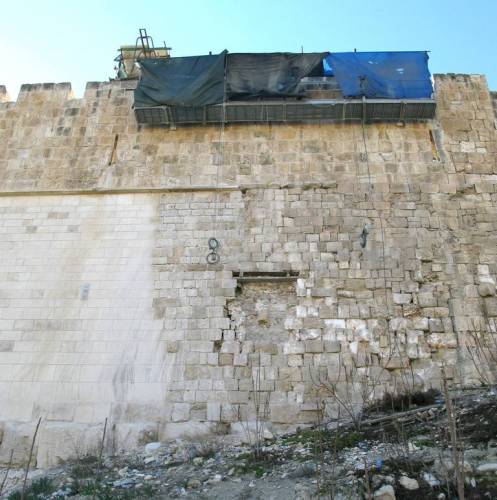
In previous posts I have reported on the danger of collapse of the Temple Mount walls, see for example here and here. Although this has been recognised by the Israel Antiquities Authority, nothing has been done to prevent further damage:

The cause of the danger was clear to the Antiquities Authority professionals: the construction work done by the wakf and the Islamic Movement, the passage of heavy equipment on the roof of Solomon’s Stables, the pouring of concrete slabs and the paving of the plaza in the area of the Stables. The paving diverted rainwater, which until then had drained into the soil, to the outer wall of the compound, damaging the wall.

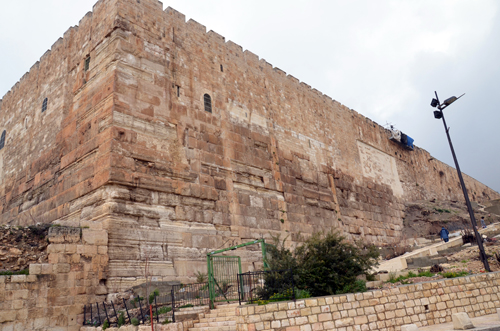
In previous years, a large bulging stretch in the Eastern Wall of the Temple Mount was repaired with unsightly paving stones. I have commented in another post (and here) about the danger of using wrong materials in this repair work. Here is a picture of that large repair in the Eastern Wall:

Photo: Alexander Schick.

Now, a new hole appeared right next to the previous repair:

Photo: Zachi Dvira.

It appears that a much larger part of the wall will collapse soon.