Renovation work is being carried out in the north of the Temple Mount. Large blue drapes cover part of the Antonia Rockscarp and razor-sharp barbed wire has closed off the area.
Large blue drapes cover the southern facade of the Antonia Fortress. Photo: Alexander Schick.
By the looks of it, the building on top of the rockscarp is undergoing much needed restoration. Here stands the madrasa (Islamic religious school) of al-Jawiliyya that was built in the Mamluk period, between 1315 and 1320. Inside this building is a large vaulted semi-enclosed area opening up to a courtyard which has adjacent rooms that look out over the Temple Mount area.
In the Ottoman period, this building was the seat of government of Jerusalem. To its west stands the Umarriya School for boys, that was established here during the British Mandate in 1923.
In the Herodian period, this was the location of the Antonia Fortress that overlooked the Temple Mount. In the northwest corner of the Temple Mount stands the Ghawanima minaret, behind which there was a staircase leading up to the roof of the porticoes and the entrance to the Antonia Fortress. This forms the backdrop to the scene portrayed in Acts 21 and 22. Climbing up this stairway, Paul would have reached the top of the north portico from where he addressed the people. Here Paul defended himself against his countrymen in the Hebrew language.
In the courtyard of this fortress, he was bound with cords and prepared for scourging. Proposals that this was the Praetorium of the gospels have been discounted and this is now understood to have been located in Herod’s Palace that stood in the west of the city.
The sockets for the northern portico can still be seen in the rockscarp today, cut into the Herodian masonry that formed the south wall of the Antonia, see the drawing below. This is one of many illustrations of the Antonia Fortress, published in my book The Quest – Revealing the Temple Mount in Jerusalem on pages 123-131. It is to be hoped that this renovation will not obscure or damage these vitally important archaeological remains.
Although it has been online for a while, this Virtual Walking Tour of the Temple Mount remains fascinating to watch. It has been produced by the Saudi Aramco World.
Haram al-Sharif, as the Temple Mount is known in Arabic, is the third holiest site for Muslims. On this artificial platform, that was extended by Herod the Great, stands the Dome of Rock, the Al-Aqsa and 40+ other smaller structures.
The site is known as the place to which Abraham was commanded by God to go to sacrifice his son Isaac, the place where Solomon built the First Temple and where, according to Muslim tradition, the prophet Muhammad went to heaven to receive the instruction to pray five times daily.
The narrator is the late Oleg Grabar, Professor Emeritus of Islamic Art and Architecture at the Institute for Advanced Study at Princeton, New Jersey. He is the author of The Dome of the Rock (2006, Harvard) and The Shape of the Holy: Early Islamic Jerusalem (1996, Princeton).
There are 32 stops with stunning panoramic photos. The “Autoplay” setting will take you through all the stops, while in “Manual” you can stop at any time, read the text or zoom in and navigate with your mouse through the stunning spherical panoramic photographs.
There are other tours of the Alhambra in Spain and the Suleymaniye Mosque in Istanbul, Turkey.
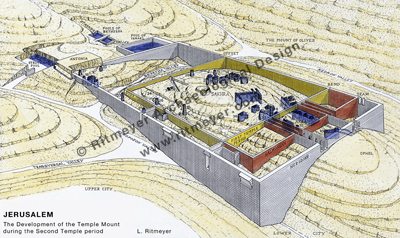
Certain images in the Image Library have been particularly popular with both teachers and publishers. Among these is the drawing of the development of the Temple Mount throughout the ages:
King Solomon built the First Temple on the top of Mount Moriah which is visible in the centre of this cut-away drawing. This mountain top can be seen today, inside the Islamic Dome of the Rock. King Hezekiah built a square Temple Mount (yellow walls) around the site of the Temple, which he also renewed. In the Hasmonean period, the square Temple Mount was enlarged to the south (red walls). Finally, King Herod the Great enlarged the mount to double its size (grey walls) by building 15 feet (5 m) thick retaining walls, which are still standing today. The many cisterns cut into the mountain are also shown.
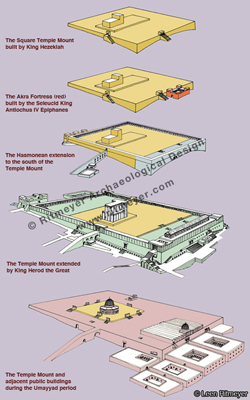
Often downloaded together with this is an image which shows a series of reconstruction drawings of the Temple Mount in the different historical periods:
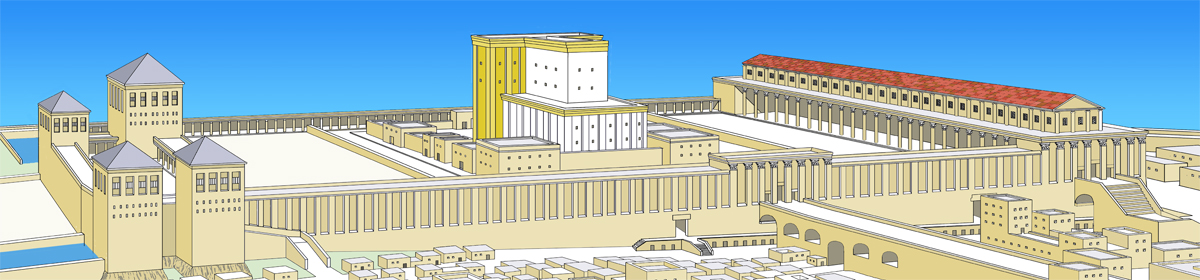
These five drawings show the five stages in the development of the Temple Mount in Jerusalem. From top to bottom: 1. The square Temple Mount built by King Hezekiah. 2. The Akra Fortress (red) was built by the Seleucid King Antiochus IV Epiphanes in 168 BC to control the local Jewish population. The fortress was destroyed by the Maccabees in 141 BC. 3. After the destruction of the Akra, the Hasmoneans extended the Temple Mount to the south (blue). 4. Herod the Great renewed the Temple Mount by enlarging the square Temple Mount to double its size and building a new Temple. 5. During the Umayyad period, the Dome of the Rock was built on the site of the Temple and the El Aqsa mosque on that of the Royal Stoa. Large public buildings were erected to the south and west of the Temple Mount
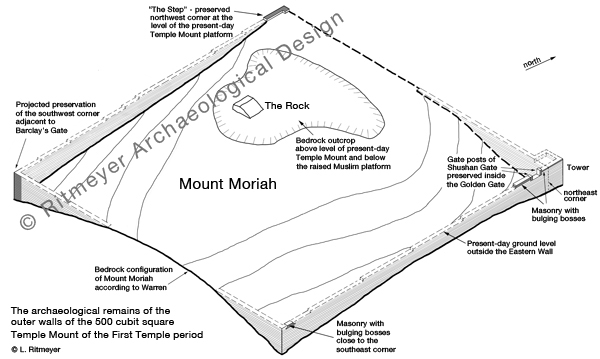
I recently had the opportunity of devoting myself to a study of the development of the mount in the time of Hezekiah and in the process discovered evidence of some dramatic political upheavals in the time of the later kings of Judah. This new drawing shows that virtually all four corners of the square Temple Mount have been preserved:
Isometric drawing showing the archaeological remains of the outer walls of the 500 cubit square Temple Mount. The dark-tinted areas are the actual or projected remains, connected with reconstructed masonry courses.
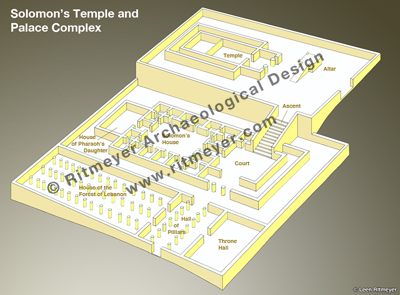
Space and time does not allow me to describe these remains here (seeThe Quest – Revealing the Temple Mount in Jerusalem for photographs and a detailed analysis). According to 1 Kings 6, King Solomon built a new Temple on Mount Moriah and the following chapter tells us that he also built a house (palace) for himself with a Hall of Pillars and a Hall of Judgment adjacent to it. It was presumably in the latter building that Solomon demonstrated his wisdom in dealing with the two women both claiming to be the mother of the same child. Next to this royal complex he built the House of the Forest of Lebanon, where he kept military equipment, such as the shields of beaten gold, that were later taken away by Shishak, king of Egypt.
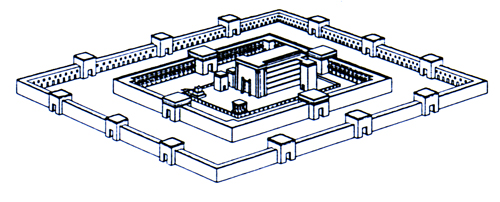
According to 1 Kings 6 and 7, Solomon built a new Temple and Palace Complex on Mount Moriah. This schematic drawing shows an arrangement of the different buildings, based on parallels with similar complexes excavated elsewhere in the Middle East. The main entrance was through the Hall of Pillars (1 Kings 7.6), which was flanked by the Throne Hall (1 Kings 7.7) on the right, where Solomon judged, and the armoury, called the House of the Forest of Lebanon (1 Kings 7.2-5) on the left. In the centre of this complex is the palace, called Solomon’s House (1 Kings 7.8a), which had a separate wing for his wife, Pharaoh’s Daughter (1 Kings 7.8b). From a large courtyard in front of Solomon’s House, a special Royal Ascent (1 Kings 10.5 KJV) led up to the Temple (1 Kings 6), which lay on higher ground.
There were two stages in the destruction of Jerusalem of the First Temple period. During the first stage, in the fourth month of 586 BCE, the city wall on the Western Hill, together with the Middle Gate, was destroyed, as well as the king’s palace and the ‘House of the People’ (Jer. 39.8). These two complexes consisted of Hezekiah’s newly built royal palace on the Western Hill of Jerusalem and the adjacent House of the Assembly, where the nobles of Judah held council.
The second stage of the conquest of Jerusalem took place in the fifth month when Nebuzaradan burnt the Temple and the king’s palace in the City of David (2 Kings 25.9-10).
So, what happened to Solomon’s original palace?
I had already suggested in The Quest that King Hezekiah was the original builder of the square mount. He was also a great reformer and is credited with reinstituting the Temple services. The first action he took was the opening of the doors of the Temple and the cleansing of its interior from desecration (2 Chron. 29.3-36). He encouraged the priests and Levites to rededicate themselves and to reinstate the Mosaic sacrifices. This was followed by the keeping of the Passover, which had not been kept for many years (2 Chron. 30.5).
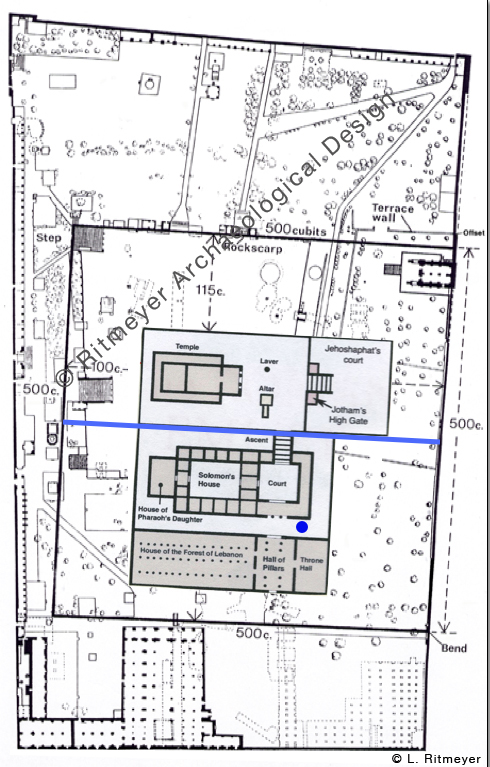
I had also noted that the Solomonic complex must have been completely dismantled by Hezekiah and the area it previously occupied incorporated within the extended square Temple Mount. His actions in removing the royal complex and thus separating it from the sacred area may have been motivated by the description of God’s anger in the prophecy of Ezekiel 43:8. Here the prophet describes the reason for God’s displeasure as: “their setting of their threshold by my thresholds, and their post by my posts, and the wall betweenme and them, they have even defiled my holy name by their abominations that they have committed: wherefore I have consumed them in mine anger.”
Plan of the present-day Temple Mount with the location of the 500 cubit square Temple Mount, showing Solomon's Temple and his adjacent royal and military complex.
On the above plan, the blue line indicates what would appear to have comprised the “wall between me and them”. It divides the square mount in two equal halves and may be an indicator as to how Hezekiah laid out the boundaries of the square Temple Mount. The blue dot indicates the place where pottery from an apparently undisturbed layer dating from the end of the First Temple period was found during repair work on the Temple Mount, see this previous post.
Solomon’s royal and military complex was located to the immediate south of the Temple. As history has shown, the royal household (e.g. Queen Athaliah and Kings Uzzah and Ahaz) tried on several occasions to control the temple services and the priesthood. By dismantling this royal complex, Hezekiah effectively separated state from religion.
Hezekiah’s religious and political reforms as expressed in his Temple platform construction would therefore have served as an inspiration and encouragement for the renewal of a purified priesthood and temple service, free from political interference.
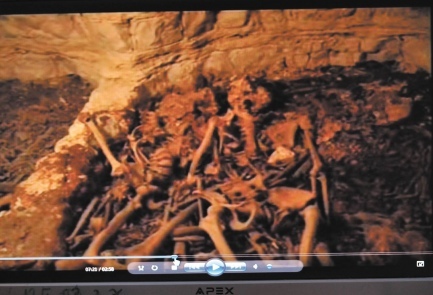
According to Israel Hayom, journalist Benny Liss screened a movie of the finding of a “mass grave” just outside the Golden Gate a few years ago. Apparently “thousand of skeletons and human bones” were buried in a cave near the Temple Mount.
Jews, Christians or Muslims? An image from the film of the skeletons. | Photo credit: Yoav Ari Dudkevitch
It is not clear if those bones belonged to Jews, Muslims or Christians. The announcement of the finding of this grave coincided with the Jewish Festival of Tisha be-Av, the day on which the Jews mourn the destruction of both the First and Second Temples. This, of course, shows that Benny Liss believes that they were Jewish, but the point is that that has not been proved yet.
We need to wait till the site can be excavated, before more definite conclusions drawn from this amazing find.
About a year ago, I published a post in which I warned that “Cement Creates Temple Mount Time Bomb”, which was published in Biblical Archaeology Review.
In that article I observed that:
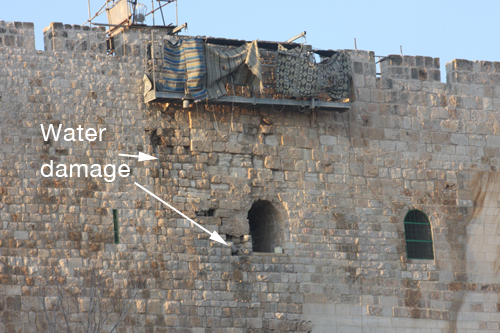
“ordinary cement was used in the repairs of walls and pavements. Large areas of new pavement have been laid in the southern part of the Temple Mount, again with ordinary cement in between the joints. This causes a greater flow toward the outer walls, which simply cannot absorb so much water.”
In a previous post, I warned of the structural problems created by wrong repairs to the Temple Mount walls:
One of the first lessons I was taught during the MA course in the Conservation of Ancient Buildings at the Institute of Advanced Architectural Studies of the University of York, UK, was that one NEVER uses ordinary Portland cement in the repair of ancient buildings. It prevents ancient walls from “breathing” and eventually causes the collapse of these walls. The Waqf’s continued use of modern building materials in the repair of these bulges and other walls is the equivalent of putting a time-bomb in the walls of the Temple Mount.
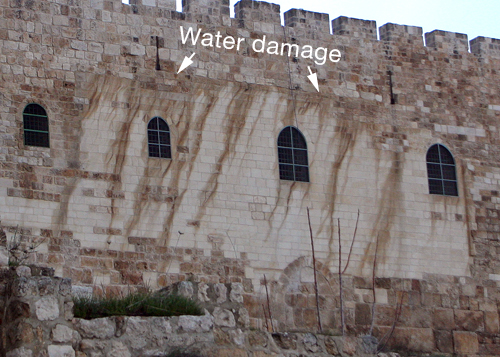
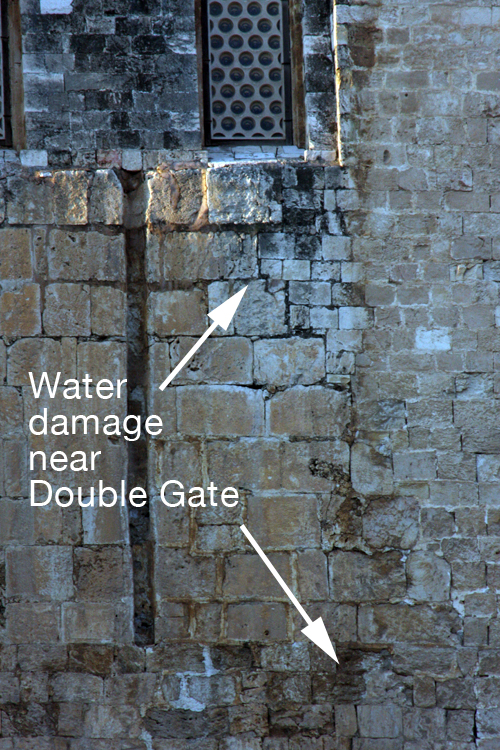
Alexander Schick sent me some photographs which shows that my prediction was true:
It is clear that the time bomb is ticking louder. It is only a matter of time when large sections of the Southern Wall of the Temple Mount will collapse. When that happens, the Muslims will predictably incriminate the Israelis, when, in fact, they only have themselves to blame.
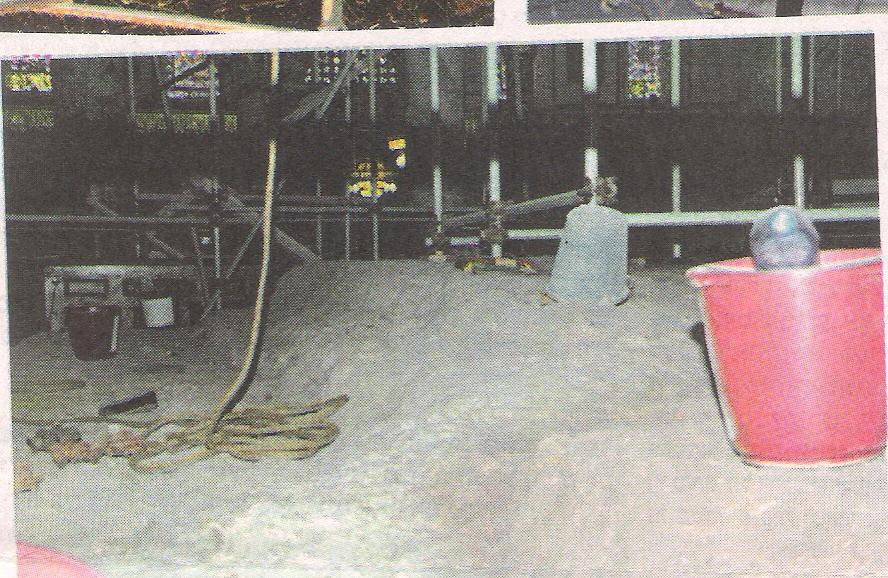
Yisrael Medad reported yesterday that renovation work is again being carried out inside the Dome of the Rock and that scaffolding has been put on The Rock, known as the Foundation Stone.
He rightly complains that none of the Israel State authorities have shown any inclination to commit themselves to the Protection of Holy Places Law:
The Holy Places shall be protected from desecration and any other violation and from anything likely to violate the freedom of access of the members of the different religions to the places sacred to them or their feelings with regard to those places…2 (a) Whosoever desecrates or otherwise violates a Holy Place shall be liable to imprisonment for a term of seven years.
His article was accompanied by these pictures, which were scanned from the Makor Rishon newspapaer:
Pails, ropes, the bottom rungs of a construction workers' support platform and other items required for the renovation of a building were placed on The Rock.The Dome of the Rock is being renewed and no one from amongst Israel's Chief Rabbinate nor any archaeological supervisory institution was asked to either agree, oversee or lend an opinion.
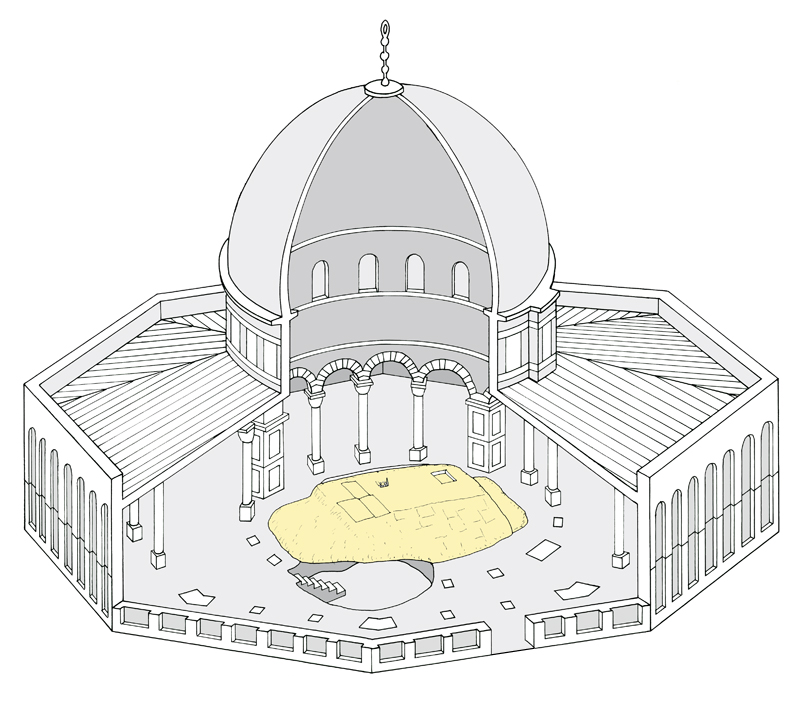
The Rock, known in Arabic as the Sakhra, around which the Dome of the Rock was built, was of course the location of the Holy of Holies of the Jewish Temple in Jerusalem. This drawing shows the location of The Rock inside the Dome of the Rock:
The plan shows the relationship between The Rock and Solomon’s Temple:
This plan shows The Rock, which is the top of Mount Moriah, (now inside the Islamic Dome of the Rock), where Abraham was sent to sacrifice his son Isaac (Genesis 22.2). The Holy of Holies (Most Holy Place) of Solomon's Temple stood on this mountain top. The walls of Solomon's Temple are indicated in blue. When Solomon built the Temple, it was necessary to create flat areas in order for the rectangular foundation stones to stand perfectly horizontal. The foundation trench of the southern wall of Solomon's temple can still be detected. The western and northern walls were built against rock scarps. In the centre of the Holy of Holies is a level depression that was specially made for the Ark of the Covenant (1 Kings 8.6,21). After the destruction of the First Temple in 486 BC, the Second Temple was built in the same location.
Medad’s article is followed up by Nadav Shragai’s blog post “The Temple Mount: Second Temple-era mikveh discovered under Al-Aqsa mosque”. This, of course, is not a recent find, as it was already discovered in the 1930’s by Hamilton, although made public only a few years ago. See these previous posts here and here.
Nadav’s post is, however, worth reading as it gives a potted history of what happened on the Temple Mount since the devastating earthquake in 1927.
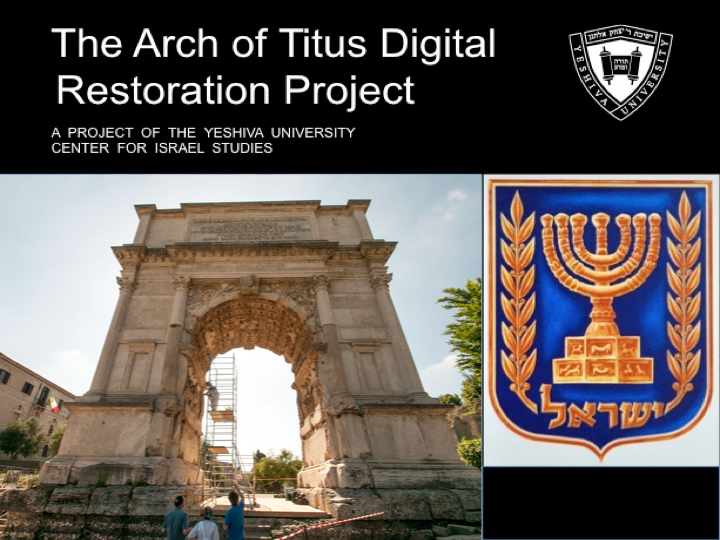
Dr. Steven Fine of the Yeshiva University Center for Israel Studies in New York is heading The Arch of Titus Digital Restoration Project in Rome, which has as its aim the scanning of the menorah panel for evidence of ancient color.
Today the results were announced:
From June 5 to 7, 2012 an international team of scholars led by the Yeshiva University Center for Israel Studies in partnership with the Soprintendenza Speciale per i Beni Archeologici di Roma undertook a pilot study of the Arch of Titus in the Roman Forum, the ancient civic center of Rome, Italy. The focus of attention was the Menorah panel and the relief showing the deification of Titus at the apex of the arch.
The arch was originally dedicated after the Emperor Titus’ death in 81 CE and celebrates his victory in the Jewish War of 66-74 CE, which climaxed with the destruction of Jerusalem and her Temple in the summer of 70 CE.
The arch has three bas reliefs. One shows the deification of Titus. Two other reliefs depict the triumphal procession held in Rome in 71 CE: in one we see Roman soldiers carrying the spoils of war through the city, including the famous Menorah (the seven-branched candelabrum) and other treasures of the destroyed Temple. These were put on display in Rome in the Temple of Peace not far from the arch. The second panel shows Titus riding in triumph through the city.
High resolution three-dimensional scans of the Menorah and the deification reliefs were made, and part of the Menorah relief was examined to determine whether any traces of paint decoration were preserved. A Breuckmann GmbH 3D scanner was used for the data capture. UV-VIS spectrometry was employed to detect color on the marble reliefs.
The pilot project was a complete success. The scan data were processed to create a 3D representation of the form of the reliefs with sub-millimeter accuracy. Traces of yellow ochre were found on the arms and base of the Menorah. This discovery is consistent with biblical, early Christian, and Talmudic writings and particularly eye-witness descriptions of the golden menorah by the first century historian Josephus.
In the next phase, the team plans to expand the search for ancient paint over the entire surface of the arch, which will also be scanned in 3D. The data collected will enable the Yeshiva University team to create a three-dimensional digital model of how the arch originally appeared, including the colors decorating its surface. The model will be added to Rome Reborn, a 3D digital model of the entire city of Rome at the peak of its development.
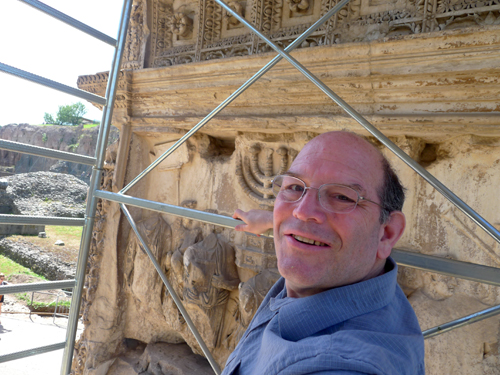
Dr. Fine on Site in Rome
It is interesting to note that polychromy is becoming a new focus in Jewish Studies. Usually synagogues and ancient buildings are shown in white, but originally much more color was used in the decoration of buildings than we would expect.
In the case of the Jerusalem Temple, it is often portrayed as a building with a white facade, but Josephus called Herod’s Temple “a structure more note-worthy than any under the sun” (Ant. 15.412) and in War 5.207–226 he gives a glowing description of the Temple (The Quest, p. 373):
The sacred edifice itself, the holy Temple, in the central position, was approached by a flight of twelve steps. The façade was of equal height and breadth, each being a hundred cubits; but the building behind was narrower…. The exterior of the building wanted nothing that could as- tound either mind or eye. For, being covered on all sides with massive plates of gold, the sun was no sooner up than it radiated so fiery a flash that persons straining to look at it were compelled to avert their eyes, as from the solar rays. To approaching strangers it appeared from a distance like a snow-clad mountain; for all that was not overlaid with gold was of the purest white. From its sum- mit protruded sharp golden spikes to prevent birds from settling upon them and polluting the roof.
The traces of yellow ochre that were found on the arms and base of the Menorah may support Josephus’ description of Herod’s Temple in Jerusalem.
Just returned from Dublin where our attendance at Hekhal’s conference on “The Other Temples” was time well spent. As Lidia Matassa, the society’s president, wrote in her introduction to the conference programme:
“Hekhal was born in July 2011, out of a desire to create a new academic society in Ireland, whose focus is the history of the ancient Near East. There are many academic conferences held in Ireland annually, but none whose focus is solely the history and historiography of the ancient Near East and the biblical world. It is the hope of the committee that over the next few years Hekhal will become prominent in the academic landscape and will provide a forum for the many academics whose work in this area finds itself without a proper and permanent place to be aired.”
The Church of Ireland Theological Institute, where the conference was held.
The programme can be seen on the society’s website, but we will try to give a bit of the flavour of the three days we spent together in the “fair city”. Jason Gosnell gave an overview of the subject, setting the scene with his talk: “Interpreting YHWH’s Space, an Examination of the Temples of the G-d of Israel”. David Morgan also explored the question of whether the multiple temple sites were in competition with or complementary to the Jerusalem Temple. There was lots of Hebrew conversation to be heard, with Israeli archaeologists reporting fresh from the field. Yossi Garfinkel gave the first academic presentation of the finds from Khirbet Qeiyafa, followed by an animated discussion session. In a talk called “The Temple in the hearts of Galileans”, Motti Aviam showcased the large decorated stone block found in Migdal (Magdala), which he identifies as a symbolic representation of the Temple in Jerusalem.
Attendees experienced some of the passion involved in Temple topics in the discussion arising from Yossi Patrich’s proposal of his theory on the development of the Temple Mount in opposition to the one I have proposed (See: Leen Ritmeyer, “The Hasmonean Temple Mount”, in: The Quest – Revealing the Temple Mount in Jerusalem, pp. 207-220). Patrich suggested that the outer court of the First Temple sloped downhill and that Simon the Just leveled it out. According to him, the southern boundary was determined by a Roman staircase which he mistakenly interpreted as a Hasmonean “staged wall”. My paper was entitled: “Relating the Temple Scroll from Qumran to the architecture of the Temple Mount in Jerusalem” and was based on work I carried out with the late Prof. Yigael Yadin shortly before his death.
Anne Katrine de Hemmer Gudme also spoke on a theme connected to the Jerusalem Temple, looking into the links between it and the temple on Mount Gerizim. Other talks based on the subject of Qumran were given by David Hamidovic and Jamal-Dominique Hopkins, while Benedikt Eckhardt dealt with: “The Yahad, Temple Ideology and Graeco-Roman Voluntary Associations”. The Temple at Elephantine was the subject of papers by Gard Granerod and Stephen Germany, while the theme of Egypt was also pursued by Andrew Krause in his: “Diaspora synagogues, Leontopolis, and the Other Jewish Temples of Egypt”. Meron Piotrkowski discussed Onias’ Temple.
The Gospel of Mark and the Epistle to Barnabas were the subjects of Clement William Grene and Douglas Estes respectively. Naphtali Meshel set up an interesting model for sacrificial language. Tyson Putthoff spoke on “The Edible Shekhinah: Temple, Vision and Transformation in Bavli Sotah 49a”. Members of the Hekhal committee also gave papers, Lidia Matassa examining the identification of a synagogue at Jericho, Jason McCann, “Imagining the Temple” and Jason Silverman suggesting that the renewal of the Jerusalem cult in the Persian period may have had ritual connections with Iran. Most encouragingly, there was still quite an audience for the last speaker, William Hamblin, whose subject “The Temple in the Qur’an”, brought us forward five hundred years from the destruction of the Temple, but showed its enduring spiritual significance.
The most popular site among attendees to visit in Dublin appeared to be the Chester Beatty Library, where biblical papyri dating from the second to the fourth century proved a great lure.
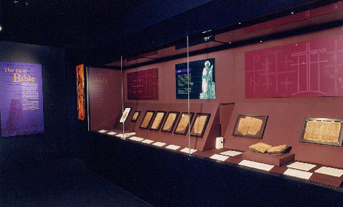
The Permanent display of the Pauline Letters, Chester Beatty Library, Dublin.
After the conference, speakers went their various ways, with most of them promising to submit their papers for publication in the conference proceedings. Another Hekhal conference is planned for 2013.
The Israel Antiquities Authority reports that in archaeological work it is conducting in the 2,000 year old drainage channel between the City of David and the Jerusalem Archaeological Garden:
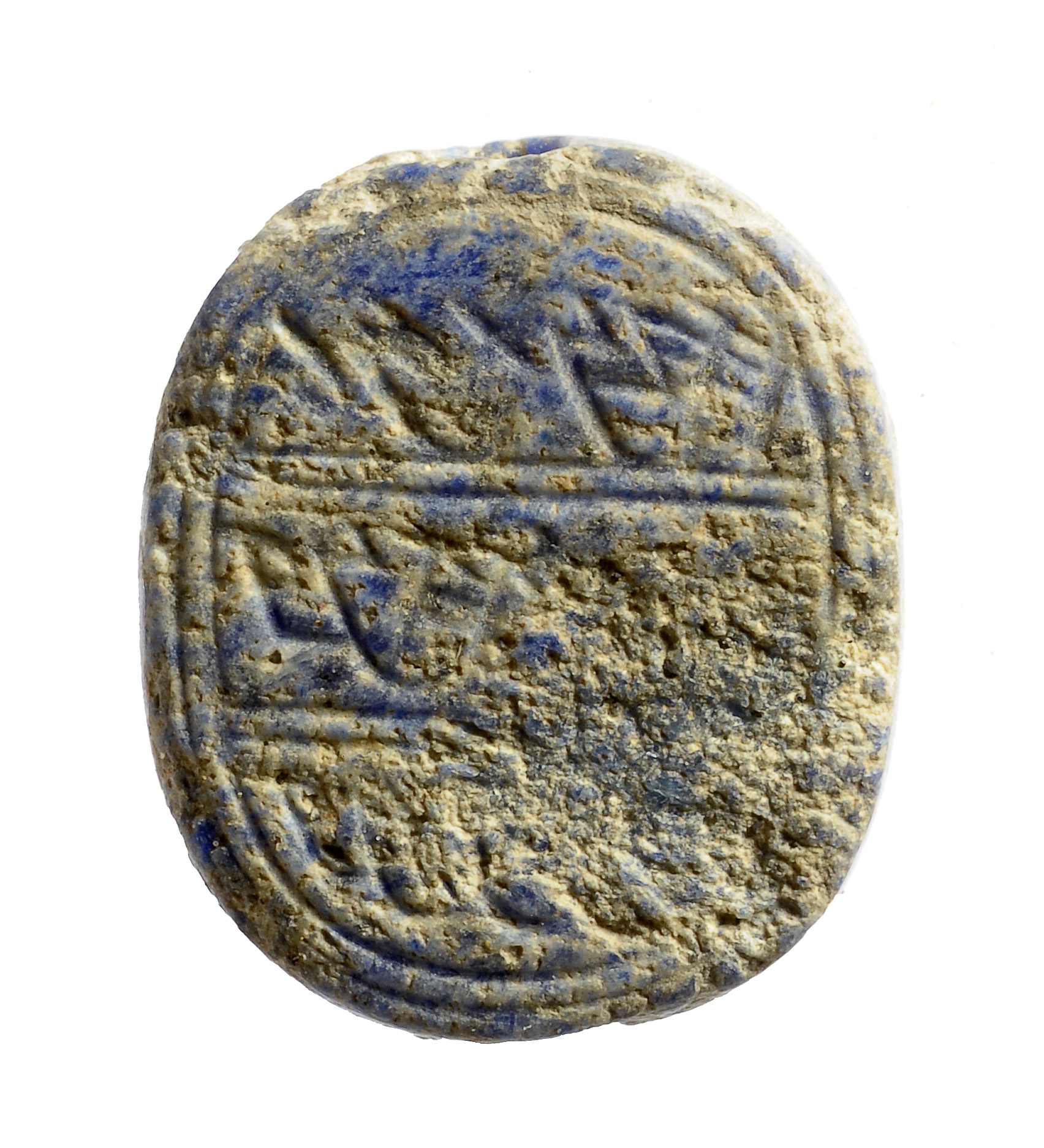
Remains were Discovered of the Closest Building to the First Temple Exposed so Far in Archaeological Excavations, and on its Floor – a Hebrew Seal Bearing the Name ‘Matanyahu’
People used personal seals in the First Temple period for the purpose of signing letters and they were set in a signet ring. The seals served to identify their owner, just as they identify officials today.
According to Eli Shukron, excavation director on behalf of the Israel Antiquities Authority, “the name Matanyahu, like the name Netanyahu, means giving to God. These names are mentioned several times in the Bible. They are typical of the names in the Kingdom of Judah in latter part of the First Temple period – from the end of the eighth century BCE until the destruction of the Temple in 586 BCE. To find a seal from the First Temple period at the foot of the Temple Mount walls is rare and very exciting. This is a tangible greeting of sorts from a man named Matanyahu who lived here more than 2,700 years ago. We also found pottery sherds characteristic of the period on the floor in the ancient building beneath the base of the drainage channel, as well as stone collapse and evidence of a fire”.
In a previous illustrated post I reported on walking through this drainage channel. The finding of a seal within building remains is exciting news.
In another post, I published this plan of the drainage channel near the southwest corner of the Temple Mount:
Plan of the drains at the southwest corner, as discovered by Warren, and their relationship to the square Temple Mount and the subsequent extensions. From: The Quest, Revealing the Temple Mount in Jerusalem, p. 234.
This plan shows that the drain cut through two tombs, which, according to the late Prof. Benjamin Mazar, belong to the Iron Age, as both have a ‘nefesh’ hole in the ceiling. There are several other tombs in this area with a similar design, one of which was converted into a mikveh in the Hellenistic period. These tombs are evidently part of a cemetery from the Iron Age.
As tombs are usually found outside the city walls (apart from the tombs of the kings), they probably date from before the time of King Hezekiah, who was the first king to include this area within his expanded city, when he built a wall round the Western Hill of Jerusalem. The building remains probably date to a time when pressure of space turned this location into a residential area, which could only have happened from the time of Hezekiah and onward.
HEKHAL is the name of the newly formed Irish Society for the Study of the Ancient Near East. It was created by a group of four Trinity College Dublin graduates who wish to:
promote research in the fields of ancient near eastern history and historiography, biblical studies, and archaeology with the long-term aim of increasing both academic and public understanding of the biblical and ancient near eastern world and its texts.
On 25–27 May 2012, they will hold their first annual symposium in Dublin, called:
Among the twenty-four speakers there are three Israeli archaeologists, Yosef Garfinkel, Joseph Patrich and Mordechai Aviam.
My talk is entitled “Relating the Temple Scroll from Qumran to the architecture of the Temple Mount in Jerusalem” and is scheduled for Sunday, 27 May, from 9.00 – 10.00 am.