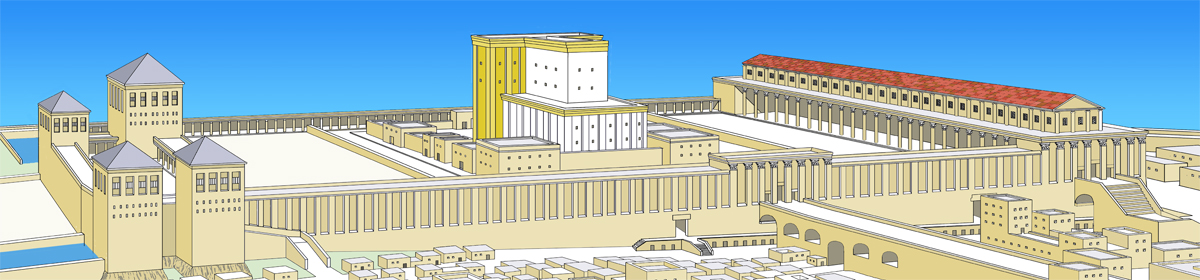
The Beautiful Gate of the Temple in Jerusalem

One of the questions I am frequently asked is where the Beautiful Gate of the Temple was located. This gate is mentioned in the New Testament (Acts 3.2,10) as the place where the lame man was begging. After he was healed by Peter and John ”he went with them into the temple courts, walking and jumping, and praising God” (Acts 3.8).

The “Beautiful Gate” is not mentioned in  other historical sources. Many scholars have accepted Thackeray’s comment on Josephus’ description of the Nicanor Gate, or the Corinthian Gate as he called it (War 5.201,204), that it “probably” was the gate of Acts 3.2,10. Edersheim was of the same opinion.
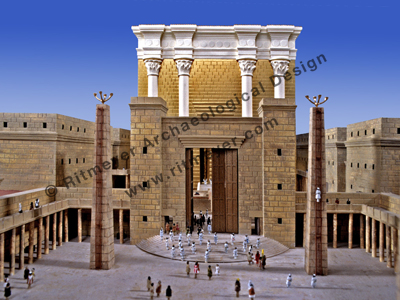
The Nicanor Gate stood in front of Herod's Temple. It gave access from the Court of the Women to the Temple Courts. In front of this gate were fifteen semi-circular steps on which Levites sang the fifteen "Psalms of the Steps" (Psalms 120-134 of Degrees or Ascents). © Leen Ritmeyer

The Nicanor Gate (Middot 1.4, 2.3,6; Yoma 3.10, etc.) was certainly beautiful, but the question is, would the lame man have been allowed to enter so far into the Temple Courts? This appears not to have been the case, as once he was healed, he entered into the Temple Courts (Acts 3.8), so the Nicanor Gate could not have been the Beautiful Gate. According to Acts 3.11 the healed man and Peter and John were in Solomon’s Porch, which is to the east of the Court of the Women.
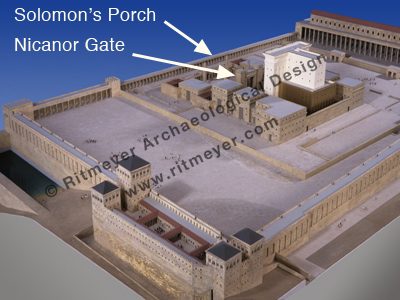
An overall view of a model of the Temple Mount looking from the northwest. In the foreground is the Antonia Fortress, while the Temple with its surrounding buildings stood close to the centre of the Temple Mount. The lower portico above the Eastern Wall (upper centre) was known as Solomon's Porch, mentioned in John 10.23 and Acts 3.11; 5.12. © Leen Ritmeyer

Others have suggested that the Beautiful Gate must have been one of the outer gates of the Temple Mount. Because of its proximity to Solomon’s Porch, some have suggested that the Shushan Gate in the Eastern Wall of the Temple Mount, may have been the Beautiful Gate, as it had a beautiful representation of Shushan the Palace (Middot 1.3).
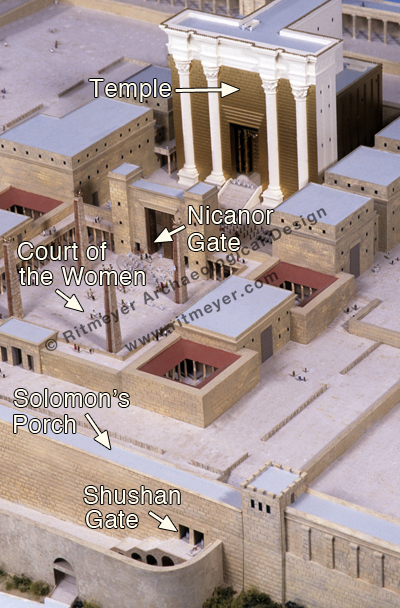
Herod's Temple Mount viewed from the northeast. On the east of the Temple was the large Court of the Women (centre left), also known in the Gospels as the Treasury. The Eastern Wall of the Temple Mount with the Shushan Gate and the city wall can be seen at the bottom of the image. © Leen Ritmeyer

According to Mishnah Kelim 1.8, nobody with an issue of any kind was allowed into the Temple Mount. Although the lame man need not have had an issue, his infirmity may have put him in the same category. Another point to consider is the fact that he was begging. To get the best results, one would want to be where the traffic was greatest, which is another argument which would rule out the Nicanor Gate, as not many people were allowed to go through this gate. It would also rule out the Shushan Gate, which was mainly used for ceremonial purposes.
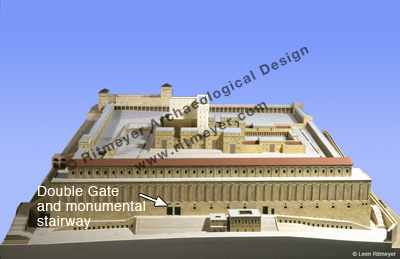
An overall view of a model of Herod's Temple Mount looking from the south. In the foreground is the Royal Stoa above the Southern Wall, while the Temple with its surrounding buildings stood close to the centre of the Temple Mount. There were two gates in the Southern Wall, the Double Gate with its monumental stairway is on the left and the Triple Gate on the right. © Leen Ritmeyer


A more likely location would have been the Double Gate in the southern wall of the Temple Mount, which I have described in my book The Quest, Revealing the Temple Mount in Jerusalem, pp. 67-74.  A 210 feet (64 m) wide monumental stairway led up to this gate from the lower plaza. Because of its monumental proportions, this gate was probably used by most of the pilgrims going to worship at the Temple.
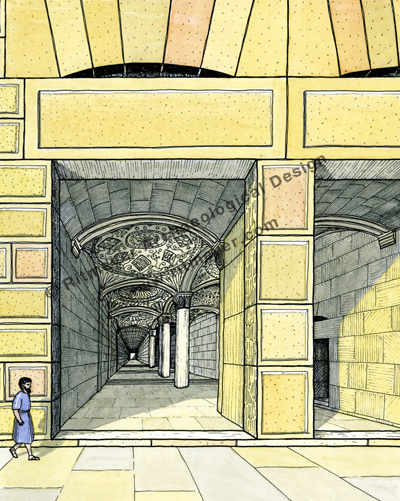
A reconstruction drawing of the Double Gate of Herod's Temple Mount in Jerusalem. Most of the elements have been preserved, including the domes inside the double passageway. Some researchers have proposed that this beautifully decorated gateway was the Beautiful Gate of the Temple, mentioned in Acts 3.10. © Leen Ritmeyer

The ceiling inside the passageway has beautifully carved domes, which have survived up to today. Most of the worshipers went up to the Temple Courts through this gate, which was certainly beautiful and very effective for begging purposes, as suggested on p. 74 of the above mentioned book.

We suggest then that Peter and John healed the lame man at the Double Gate and from there he went “walking and jumping” to Solomon’s Porch.

This entry was posted in Jerusalem, Temple Mount. Bookmark the permalink.

18 Responses to The Beautiful Gate of the Temple in Jerusalem

  1. Pingback: Tweets that mention The Beautiful Gate of the Temple in Jerusalem | Ritmeyer Archaeological Design -- Topsy.com

  2. James Miller says:

    Very good article. One question:

    You mention that, “To get the best results, (a beggar) would want to be where the traffic was greatest, which is another argument which would rule out the Nicanor Gate, as not many people were allowed to go through this gate.”

    While the Nicanor gate certainly would not have had much traffic (comparatively speaking), can an argument be made that the traffic present at this gate was the most “affluent”, as the treasury for monetary offerings was located in the Court of the Women, and thus those who were present there would, in theory, have the most money to give a beggar?

    Thanks much for all of your work!

    james miller

  3. Wayne Stiles says:

    Thanks for this valuable insight. I had also heard a possible identification of the Beautiful Gate was the eastern Golden Gate (or same location). Also, I thought the double gates of the Southern Steps were the exit . . . while the triple Hulda gates were the entrance to the Temple Courts. Thanks again.

  4. James,
    If the beggar was already in the Court of the Women where the Nicanor Gate is located, why does it say that after he was healed he entered into the Temple Courts? He must have been outside the Temple Courts, as, because of his infirmity he most likely wasn’t allowed in anyway.
    There was very little traffic through the Nicanor Gate. It was used by the Levitical Choir, and for ceremonies such as the suspected adulteress and the healed lepers. Apart from that Israelite males could go into the Court of the Israelites, which they mainly did at Passover. Most of the priests would have entered the Temple Courts through the many side gates that surrounded the Temple and I have my doubts about their generosity in the light of the parable of the Good Samaritan.

  5. Wayne,
    The Shushan Gate stood where the Golden Gate is located today and I have discussed the possibiltiy that it might have been the Beautiful Gate in my post. The information about entry and exit through the Huldah gates comes from Middot 1.3: “two Huldah Gates on the south, that served for coming in and for going out”. As Middot only relates to the 500 cubit square Temple Mount, it does not refer directly to the Double and Triples Gate, of which we do not know their original names. The Double Gate double passageway would, however, have exited opposite the Huldah Gates.
    There is interesting information about this circulation in Middot 2.2, where it says that people entered on the right and exited through the left gate. Ad the Double Gate was used by most worshipers, I believe that the eastern gate of the Double Gate was used for going in and the western for going out. However, if anything wrong had happened, one went in the opposite direction, so that he may be noticed and people could comfort the person. This would have been the ideal place for begging purposes. One of the blessings people would say was: “May He that dwells in this House give you comfort”. That certainly happened in the record of Acts 3.

  6. Thanks for this valuable insight. I had also heard a possible identification of the Beautiful Gate was the eastern Golden Gate (or same location). Also, I thought the double gates of the Southern Steps were the exit . . . while the triple Hulda gates were the entrance to the Temple Courts. Thanks again.

  7. Very good article. One question: You mention that, “To get the best results, (a beggar) would want to be where the traffic was greatest, which is another argument which would rule out the Nicanor Gate, as not many people were allowed to go through this gate.” While the Nicanor gate certainly would not have had much traffic (comparatively speaking), can an argument be made that the traffic present at this gate was the most “affluent”, as the treasury for monetary offerings was located in the Court of the Women, and thus those who were present there would, in theory, have the most money to give a beggar? Thanks much for all of your work! james miller

  8. James, If the beggar was already in the Court of the Women where the Nicanor Gate is located, why does it say that after he was healed he entered into the Temple Courts? He must have been outside the Temple Courts, as, because of his infirmity he most likely wasn’t allowed in anyway. There was very little traffic through the Nicanor Gate. It was used by the Levitical Choir, and for ceremonies such as the suspected adulteress and the healed lepers. Apart from that Israelite males could go into the Court of the Israelites, which they mainly did at Passover. Most of the priests would have entered the Temple Courts through the many side gates that surrounded the Temple and I have my doubts about their generosity in the light of the parable of the Good Samaritan.

  9. Marisol,
    You are probably right saying that those passing through the Nicanor gate had most money to give, but would they – see my earlier reply to James.

  10. Sharron,

    See my reply to Wayne.

  11. Ina Franks says:

    Wayne, The Shushan Gate stood where the Golden Gate is located today and I have discussed the possibiltiy that it might have been the Beautiful Gate in my post. The information about entry and exit through the Huldah gates comes from Middot 1.3: “two Huldah Gates on the south, that served for coming in and for going out”. As Middot only relates to the 500 cubit square Temple Mount, it does not refer directly to the Double and Triples Gate, of which we do not know their original names. The Double Gate double passageway would, however, have exited opposite the Huldah Gates. There is interesting information about this circulation in Middot 2.2, where it says that people entered on the right and exited through the left gate. Ad the Double Gate was used by most worshipers, I believe that the eastern gate of the Double Gate was used for going in and the western for going out. However, if anything wrong had happened, one went in the opposite direction, so that he may be noticed and people could comfort the person. This would have been the ideal place for begging purposes. One of the blessings people would say was: “May He that dwells in this House give you comfort”. That certainly happened in the record of Acts 3.

  12. elija says:

    what is the size of the original herod’s double gate?

  13. Elija,

    It is about time that you start reading my book “The Quest – Revealing the Temple Mount in Jerusalem” ;)
    Each gate is 5.00 m wide and 7.70 m. high and the Double Gate’s exterior width is 11.90 m.

  14. elija says:

    Well i do appreciate your free response, and your free informative blog :)

  15. elija says:

    here at
    http://www.preteristarchive.com/Ancient_Revelations/pdf/1884_king_discoveries_temple_hill.pdf page 73
    states that the width of the Double Gate is “5.4864 meters”
    ??

    also claims that it’s the same as the balclay’s gate! how did he know that?

  16. All these measurements were taken by Charles Warren, who investigated these underground structures below the Temple Mount in the 1860′s. I have also taken measurements inside the Double Gate, the Triple Gate, Solomon’s Stables and the Golden Gate and have found that Warren’s measurements were correct on most accounts.

  17. emmanuel says:

    well fellows i’m no researcher like you guys but i just want to say keep up the good work, at least for the sake of myself and other collegues who may be keen to know but not able to do much research staff.

  18. Pingback: There's Only One Gate Jesus Won't Enter | Wayne Stiles

Leave a Reply

Your email address will not be published.

You may use these HTML tags and attributes: <a href="" title=""> <abbr title=""> <acronym title=""> <b> <blockquote cite=""> <cite> <code> <del datetime=""> <em> <i> <q cite=""> <strike> <strong>