The Tomb of Jesus

The presumed Tomb of Jesus in the Holy Sepulchre has recently been discussed again, this time on The Bible and Interpretation website. In this article, which is a follow-up of a previous one, PhD student Eldad Keynan of the Bar Ilan University suggests that the tomb in the Holy Sepulchre was a Sanhedrin tomb that was used for the temporary burial of Jewish felons and that the permanent tomb of Jesus was elsewhere.

The tomb beneath the rotunda was not a “normal” or a “standard” tomb. However, we believe it is indeed the temporary tomb of Jesus. It was significantly smaller than the standard\normal tombs; it was different in structure; it was connected to another tomb nearby.
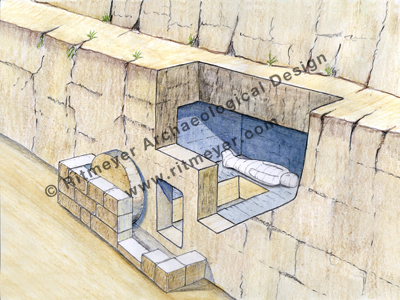
In this reconstruction drawing, we see a newly hewn tomb that could have been used for the first phase of burial, the so-called “primary burial,” where the body was laid out on a bench.

A newly hewn, but unfinished tomb could have been used for primary burial, as we explained here:

Over 1,000 tombs have been studied around Jerusalem, and we know now that the first stage in tomb construction is the cutting out of a single chamber with benches arranged along the three sides, leaving a pit in the middle, so that the workmen could stand upright while working. A tomb could be left like this for a while, until the other chambers were added.

Such a newly hewn tomb could be used for the first phase of burial, the so-called “primary burial,” where the body was laid out on a bench. A year or so later, when only bones were left, these were placed in “ossuaries” or bone boxes. This was called “secondary burial.”

If the tomb in the Holy Sepulchre was a Sanhedrin tomb, then it could hardly have been a “new sepulchre”, as described in John 19.41. It would also contradict the fact that Jesus was laid in Joseph of Arimathea’s “own new tomb, which he had hewn out in the rock” (Matthew 27.60; Luke 23.53).

Keynan appears to be a supporter of the Talpiot Tomb as the permanent tomb of Jesus. The fact, however, that Jesus came from Nazareth is often overlooked in the discussion. We believe that Jesus was raised from the dead, but if, for the sake of argument, Jesus was buried in a permanent tomb, that would have been his family tomb in Nazareth and not in Jerusalem. It is nevertheless interesting to read about Jewish burial practices, as Jesus was a Jew and must have been buried according to Jewish customs.

More on Solomon’s Mines

This report was in the San Diego news a couple of days ago:

Thomas Levy, a UCSD professor of anthropology and Judaic studies, has
pioneered three highly sophisticated digging excavations in an area
called Khirbat en-Nahas, located in southern Jordan, attracting the
attention of NOVA/National Geographic Television, which sent a crew to
Jordan with him last fall.

Levy, also the associate director of the Center of Interdisciplinary
Science for Art, Architecture and Archaeology (CISA3), wasn’t looking
for King Solomon’s mines at first. He was actually researching the
role of ancient technology on the evolution of society. But what he
found in Jordan was groundbreaking — thousands of tons of slag, a
by-product of smelting ore, and different types of blowpipes. Using
the process of radiocarbon dating, his team discovered there was
industrial-scale metal production of copper precisely in 10th century
BC.
“It would have been like the Pittsburg of Palestine,” said Levy.

There are two sides to the King Solomon debate, he said. First, there
are those who “minimize the historicity of the Old Testament, saying
there was no Solomon because during the 10th century there were no
societies capable of creating a kingdom, only petty nomads.” On the
other side, there are those who maximize the content of the Old
Testament, he said.

“We don’t have proof that we have found Solomon’s mines, but what we
have proof of is that there were kingdoms in the 10th century,” said
Levy. “I think he existed.”

You can see a preview of the movie here:

HT: Jack Sasson

Update: The “Quest for Solomon’s Mines” is being streamed (53 minutes) at PBS, but in the UK you can’t see it, for a message says: “We’re sorry, but this video is not available in your region due to rights restrictions.” Sad …

PA rejects that the Western Wall of the Temple Mount is Jewish

In this Jerusalem Post report, several correspondents quote Prime Minister Binyamin Netanyahu’s spokesman Mark Regev:

Denying the Jewish connection to the Western Wall is to deny reality. If you deny the Jewish connection to the Western Wall you are in fact denying the Jewish connection to Jerusalem and the land of Israel itself. When they deny the Jewish connection, they are unfortunately raising very serious questions as to their true commitment to reconciliation.

Gershon Baskin, the joint CEO of the Israel/Palestine Center for Research and Information, who had sent a letter to the Palestinian leadership in the wake of the Post article, calling the findings of al-Mutawakel Taha “a serious mistake” and “a stain on the Palestinian Authority, makes the following remark:

Any observer, even a non-professional archeologist, can discern that the stones used to construct the Western Wall (the Kotel) are from the era of Solomon’s Temple and the Temple rebuilt by King Herod which was hundreds of years before Islam appeared on the world stage.

Reconstruction model of Herod's Temple Mount showing the Western Wall with the stairway of Robinson's Arch in the foreground

It makes one despair that even some Israelis don’t seem to know that the Western Wall is Herodian and not Solomonic. See yesterday’s post.

HT: Joe Lauer

PA Declares ‘Western Wall Was not Jewish’ until 16th Century AD

The Israeli press is full of reports of a paper prepared by Al-Mutawakel Taha, a senior official with the PA Ministry of Information to “refute” Jewish claim to the Western Wall.

The Jerusalem Post quotes him as follows:

Many studies published by Jewish experts have affirmed that there is no archeological evidence that the Temple Mount was built during the period of King Solomon,” the paper added. “One can only conclude that the Al-Buraq Wall is a Muslim wall and an integral part of the Aqsa Mosque and Haram Al-Sharif. No one has the right to claim ownership over it or change its features or original character. Also, no one has the right to agree with the occupation state’s racist and oppressive measures against history and holy sites.”

He is correct in saying that the Western Wall was not built in the time of Solomon. However, he appears to be ignorant of or chooses to ignore the history of the Temple Mount between Solomon and the Early Muslim period.

The drawing below from our Image Library shows the five stages in the development of the Temple Mount in Jerusalem. From top to bottom:

1. The square Temple Mount built by King Hezekiah around the Temple built by King Solomon.
2. The Akra Fortress (red) was built by the Seleucid King Antiochus IV Epiphanes in 168 BC to control the local Jewish population. The fortress was destroyed by the Maccabees in 141 BC.
3. After the destruction of the Akra, the Hasmoneans extended the Temple Mount to the south (blue).
4. King Herod the Great renewed the Temple Mount by enlarging the square Temple Mount to double its size and building a new Temple.
5. During the Umayyad period, the Dome of the Rock was built on the site of the Temple and the El Aqsa mosque on that of the Royal Stoa. Large public buildings were erected to the south and west of the Temple Mount.

The Development of the Temple Mount from Hezekiah to the Early Muslim period

I made the reconstruction drawing of the Herodian Temple Mount below at the end of the 10-year long excavation project led by the late Prof. Benjamin Mazar (1968-’78). The Western Wall, where the Jews pray today, is shown in red. This approx. 60 m. long wall is part of the 485 m. long western retaining wall of the Herodian Temple Mount. Many finds from the Second Temple period, such as Hebrew inscriptions, coins and also the architectural style prove that the present-day walls of the Temple Mount are irrefutably Herodian. To deny this is ignorance in the extreme.

Herod's Temple Mount with the Western Wall shown in red

Roman Bathing Pool found in Jerusalem

The discovery of the remains of a bathing pool that may have belonged to a Roman bathhouse has been widely reported. I read about it first in the Jerusalem Post. The original announcement was made by the IAA (Israel Antiquities Authority). Here is a link to the pictures.

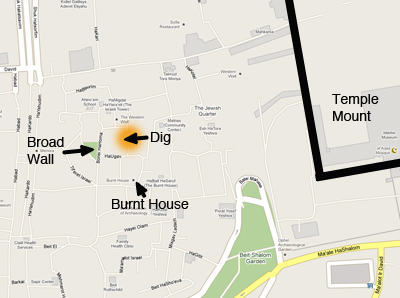
The dig is located in 10 Haomer Street in the Jewish Quarter of the Old City of Jerusalem, which is north of the Burnt House and east of the Broad Wall.

Location of the Roman Bathing Pool

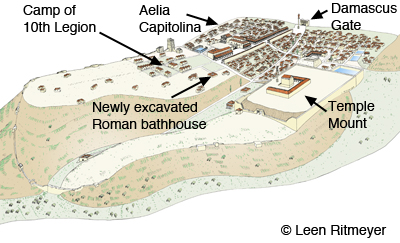
The announcement of the discovery came at a time when I was preparing to add a reconstruction drawing of Aelia Capitolina to our new Image Library. It gave me the opportunity to add the newly discovered bath house to this drawing:

Reconstruction drawing of Aelia Capitolina (the name of Jerusalem in the Roman period) showing the location of the newly discovered bathhouse

The drawing illustrates the comments of Yuval Baruch, who noted:

the importance of the discovery, which sheds light on the study of post-destruction Jerusalem.

“Despite the very extensive archaeological excavations that were carried out in the Jewish Quarter, so far not even one building has been discovered there that belonged to the Roman legion,” he said.

“The absence of such a find led to the conclusion that Aelia Capitolina, the Roman city which was established after the destruction of Jerusalem, was small and limited in area.”

“The new find, together with other discoveries of recent years, shows that the city was considerably larger than what we previously estimated. Information about Aelia Capitolina is extremely valuable and can contribute greatly to research on Jerusalem because it was that city that determined the character and general appearance of ancient Jerusalem and as we know it today. The shape of the city has determined the outline of its walls and the location of the gates to this very day.

The development of the Western Wall plaza near the Temple Mount

In a previous post, we reported on the new plans for the development of the Western Wall plaza. Israel’s cabinet has now decided to allot NIS 85 million ($23 million) for this project.

The project  will upgrade physical and transportation infrastructure at the site, provide access to new archeological findings, and run educational programs for soldiers and students.

The PA, of course, objects to the plan. Here is the report as it appears in today’s Jerusalem Post. A similar report appears in Haaretz.

Iran from the air

Received this from Jack Sasson [agade]:

The full length documentary “Baadeh Sabaah ” [Lover’s Wind, Vent des Amoureux, 1970]  by the late French filmmaker, Albert La Morisse [1922-1970], has been posted online in Persian and English. It runs 70.57 minutes.

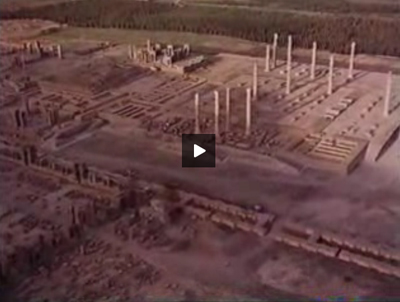
The documentary was  mostly shot from a helicopter and captures a sweeping aerial view of Iran in 1969-1970, including some magnificent footage from Persepolis and Susa among other historical sites of various periods.  The narrative is told by the wind.  The film was shot in 35mm and there are a few minor glitches as expected – not unusual.  Content is breathtakingly captivating.

Morisse died in a helicopter crash over Karaj Dam near Tehran while shooting extra footage for the documentary.  The 6:59 minutes of the surviving footage is also posted.  The film was completed by Albert’s wife Claude La Morisse in 1978.  It has never been shown in Iran.

The Lover's Wind

Watching this evocative movie is a great way to see the spectacular archaeological remains of Iran. Persepolis appears 16 minutes into the movie.

The American Schools of Oriental Research (ASOR) 2010 Annual Meeting

The Annual Meeting of ASOR starts tomorrow in Atlanta. This is the first year in a while that I am unable to attend due to other commitments. There are many interesting lectures, but I would like to have attended the following:

Norma Franklin (Tel Aviv University), “Ivories, Votive Capitals, Stele, and Beyond: The Origin of the Proto-­Ionic or Volute Motif and its Evolution”

Kimberly Bauser (Boston College),“Khirbet Qana (Cana of Galilee): In Galilee and in the Gospel of John”

Carl Savage (Drew University), “Bethsaida: The Context for Jesus’ Ministry from the Archaeological Perspective of a Corner of the ‘Evangelical Triangle’”

Yardenna Alexandre (Israel Antiquities Authority), “Pagans and Jews: The Hellenistic and Roman Villages at Cana of Galilee (Karm er-­Ras)”

Doron Ben Ami (Israel Antiquities Authority) and Yana Tchekhanovets (Israel Antiquities Authority), “A Roman Mansion Found in the City of David”

Sarah Collins (British Museum), “Recent Results from the Excavations at Sidon, Lebanon”

Steven Collins (Trinity Southwest University), “The Rise and Ruin of a Bronze Age City-­ State: Insights from the 2009/2010 Excavations at Tall el-­Hammam, Jordan

Session on Teaching Archaeology to Undergraduates: Success Stories and Cautionary Tales

Aren M. Maeir (Bar-­Ilan University), “The 2010 Season of Excavations at Tell es-Safi/ Gath: Bronze and Iron Age Remains”

Amihai Mazar (The Hebrew University of Jerusalem), “Jerusalem before the 8th Century B.C.E.: An Archaeological Assessment”

Oh well, perhaps next year in San Fransciso …

Controversy about David and Solomon

National Geographic magazine’s feature article for the December 2010 edition is devoted to “David and Solomon — Kings of Controversy” and asks “Was the Kingdom of David and Solomon a glorious empire—or just a little cow town? It depends on which archaeologist you ask.”

It is difficult to determine if the archaeological remains do indeed belong to David’s Palace, but the location is a logical one. Long before Eilat Mazar’s controversial dig started, I already made a reconstruction drawing of David’s Palace, based on the results of Yigal Shiloh’s excavations in Area G. This drawing is one of the many images in our new Image Library.

Reconstruction of King David's Palace - © Leen Ritmeyer 1995

HT: Joe Lauer

King Solomon’s Mines

In a previous post we reported on the copper mines that have been excavated in Jordan.

On November 23, 2010, the NOVA program on PBS will be on:

Quest for Solomon’s Mines — Archeologists seek the truth about the Bible’s most famous king and his legendary riches.” The Program Description states: Countless treasure-seekers have set off in search of King Solomon’s mines, trekking through burning deserts and scaling the forbidding mountains of Africa and the Levant, inspired by the Bible’s account of splendid temples and palaces adorned in glittering gold and copper. Yet to date, the evidence that has claimed to support the existence of Solomon and other early kings in the Bible has been highly controversial. In fact, so little physical evidence of the kings who ruled Israel and Edom has been found that many contend that they are no more real than King Arthur. In the summer of 2010, NOVA and National Geographic embarked on two cutting-edge field investigations that illuminate the legend of Solomon and reveal the source of the great wealth that powered the first mighty biblical kingdoms. These groundbreaking expeditions expose important new clues buried in the pockmarked desert of Jordan, including ancient remnants of an industrial-scale copper mine and a 3,000-year-old message with the words “slave,” “king,” and “judge.”

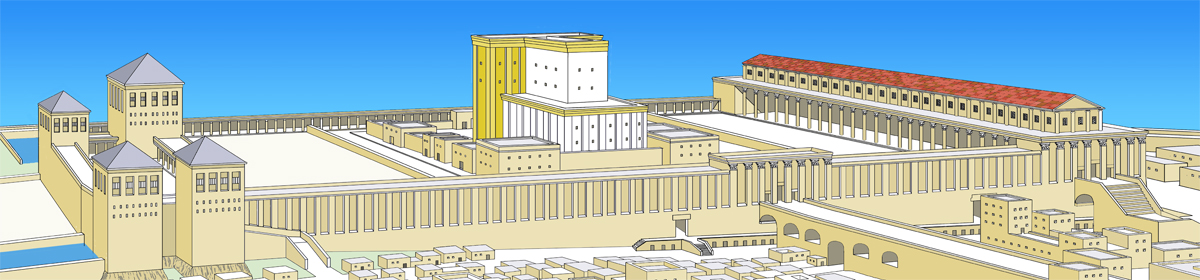
According to the Biblical text in 1 Kings, Solomon’s Temple had many bronze vessels, such as the Altar, the two giant columns Yachin and Boaz, the bronze Sea and ten smaller basins. See this image from our new Image Library:

Reconstruction of Solomon's Temple - © Leen Ritmeyer

HT: Joe Lauer