Israel expects major earthquake

There have been previous earthquake warnings in Israel and Haaretz reports today again that a major earthquake may hit Israel at any tine. Read the full report here.

Dr. Avi Shapira, the chairman of the inter-ministry steering committee for earthquake preparedness, asserts that a strong earthquake can be expected here within the next 50 years. That is, it could happen today, tomorrow, 10 minutes from now, or 10 years from now. A powerful quake in Israel is therefore not a question of “if,” but rather a question of “when.”

The El Aqsa mosque on the Temple Mount suffered major damage in the earthquake of 1927

The last deadly earthquake struck the Land of Israel in July 1927, damaging Jericho, Nablus, Ramle, Jerusalem and many rural locales. In January 1837, a strong earthquake occurred in the Galilee, and killed thousands of people in Safed and Tiberias. In Safed alone the number was estimated at 2,400.

Three people were killed when this house on the Mount of Olives was destroyed in the earthquake of 1927

The earthquake that took place during the last year of King Uzziah was still remembered some 400 years later (Zech. 14.5).

Epigraphy and Daily Life – Conference in Memory of Hanan Eshel

From the Agade list:

“See, I will bring a scroll recounting what befell me” (Ps 40:8)

The Second International Conference of the Jeselsohn Epigraphic Center
of Jewish History, Epigraphy and Daily Life – From the Bible to the Talmud,
is dedicated to the memory of Professor Hanan Eshel, who sadly died on 8 April of this year at the age of 52, and will take place on Sunday, 2 January, 2011, The Nanotechnology Building (no. 206), Bar-Ilan University. Here is the program:

09:15 – 09:45 Reception
09:45 – 10:30 Greetings

Chair: Dr. Esther Eshel, Acting Head of the Jeselsohn Center,
Bar-Ilan University

Prof. Moshe Kaveh, President, Bar-Ilan University
Prof. Eliezer Tauber, Dean of the Faculty of Jewish Studies, Bar-Ilan University

Prof. Avraham Faust, Chair, The Martin (Szusz) Department of Land of
Israel Studies and Archeology, Bar-Ilan University

10:30 – 12:00 Session 1: The First Temple Period
Chair: Dr. Ze’ev Meshel, Tel-Aviv University

Prof. Shmuel Ahituv, Ben-Gurion University of the Negev
The Kuntillet Ajrud Inscriptions: Language and Religion

Prof. Amihai Mazar, The Hebrew University of Jerusalem
Comments on 10-9th Centuries BCE Inscriptions from the Land of Israel
and their Research

Prof. Aaron Demsky, Bar-Ilan University
Researching Literacy in Ancient Israel – Recent Approaches

12:00 – 13:00 Lunch

13:00 – 14:30 Session 2: The Second Temple Period
Chair: Prof. Amos Kloner, Bar-Ilan University

Prof. Lester L. Grabbe (University of Hull, UK)
Scribes, Writing, and Epigraphy in the Second Temple Period

Dr. Ada Yardeni, The Hebrew University of Jerusalem
The Unprovenanced Aramaic Ostraca from Idumea

Prof. Uriel Rappaport, University of Haifa
Historical Aspects of the Jewish Coin Inscriptions

14:30 – 15:00 Coffee Break

15:00 – 16:30 Session 3: The Mishnaic and Talmudic Periods
Chair: Prof. Albert Baumgarten, Bar-Ilan University

Dr. Uzi Leibner, The Hebrew University of Jerusalem
Inscriptions from the Synagogue of Khirbet Wadi Hamam

Dr. David Amit, Israel Antiquities Authority
Jewish Stamps for Bread, Wine and Olive Oil

Prof. Gideon Bohak, Tel-Aviv University
Amulets in the Daily Lives of Jews in Antiquity

16:30 – 17:15 Coffee Break

17:15 – 18:15 Special Session in Memory of Hanan Eshel
Chair: Dr. David Jeselsohn, Founder of the Jeselsohn Epigraphic Center
of Jewish History

Prof. Lawrence H. Schiffman, New York University
Hanan Eshel’s Contribution to the Study of the Dead Sea Scrolls

Israel Remembers the Holy Temple

Today, the 10th of the Hebrew month Tevet, Israel Remembers the Holy Temple and the Holocaust.

Friday is the tenth day of the Hebrew month of Tevet, a fast day on which Jews remember the siege of Jerusalem that preceded the destruction of the First Temple and the Babylonian exile. The siege is described in the Bible in the Book of Kings.

It is always sad to remember the destruction of such a beautiful building. Read more here.

Solomon's Temple

The design of this beautiful model of Solomon’s Temple is based on the description in the Book of Kings. The Temple had a high Porch, supported by two bronze pillars, called Yachin and Boaz. The inner sanctuary was divided into two rooms, the Holy Place and the Holy of Holies (Most Holy Place), where the Ark of the Covenant stood. A three-storey high structure surrounded the sanctuary. In front of the Temple stood the Altar, the bronze Basin (Sea) and ten smaller basins.
This Temple was frequently damaged and rebuilt during its long history and it was the Temple described in the Book of Chronicles, that was destroyed by the Babylonians in 586 BC.

The sadness of its destruction is expressed in the Book of Lamentations 2.1:

How the Lord in his anger
has set the daughter of Zion junder a cloud!
He has cast down from heaven to earth
the splendor of Israel;
he has not remembered his footstool
in the day of his anger. (ESV)

Roman statue discovered in Ashkelon

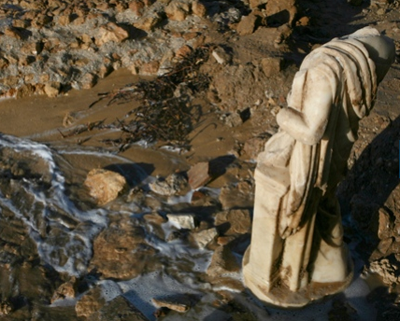
It doesn’t often happen that the weather helps archaeologists. Haaretz reported that a massive storm caused a collapse along the Ashkelon coast and revealed a statue of a headless woman. The report also has a slide show of the discovery.

The massive storm that swept through Israel over the weekend caused a great deal of damage to archaeological sites all along the Mediterranean coast, but also uncovered a an impressive statue of a woman between 1650 and 1800 years old in Ashkelon.

A statue from Roman times discovered in Ashkelon after a cliff collapsed, revealing archaeological treasures. © Ilan Assayag

The Beautiful Gate of the Temple in Jerusalem

One of the questions I am frequently asked is where the Beautiful Gate of the Temple was located. This gate is mentioned in the New Testament (Acts 3.2,10) as the place where the lame man was begging. After he was healed by Peter and John “he went with them into the temple courts, walking and jumping, and praising God” (Acts 3.8).

The “Beautiful Gate” is not mentioned in  other historical sources. Many scholars have accepted Thackeray’s comment on Josephus’ description of the Nicanor Gate, or the Corinthian Gate as he called it (War 5.201,204), that it “probably” was the gate of Acts 3.2,10. Edersheim was of the same opinion.

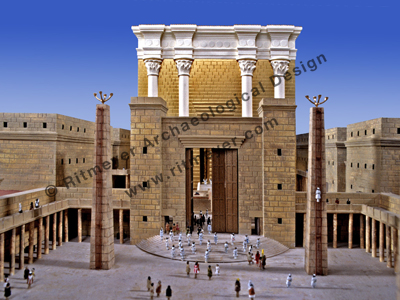
The Nicanor Gate stood in front of Herod's Temple. It gave access from the Court of the Women to the Temple Courts. In front of this gate were fifteen semi-circular steps on which Levites sang the fifteen "Psalms of the Steps" (Psalms 120-134 of Degrees or Ascents). © Leen Ritmeyer

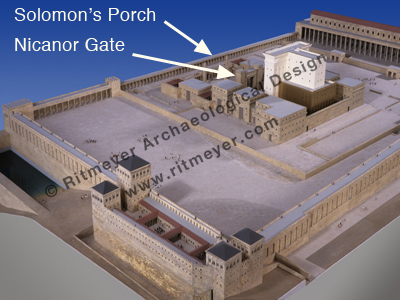
The Nicanor Gate (Middot 1.4, 2.3,6; Yoma 3.10, etc.) was certainly beautiful, but the question is, would the lame man have been allowed to enter so far into the Temple Courts? This appears not to have been the case, as once he was healed, he entered into the Temple Courts (Acts 3.8), so the Nicanor Gate could not have been the Beautiful Gate. According to Acts 3.11 the healed man and Peter and John were in Solomon’s Porch, which is to the east of the Court of the Women.

An overall view of a model of the Temple Mount looking from the northwest. In the foreground is the Antonia Fortress, while the Temple with its surrounding buildings stood close to the centre of the Temple Mount. The lower portico above the Eastern Wall (upper centre) was known as Solomon's Porch, mentioned in John 10.23 and Acts 3.11; 5.12. © Leen Ritmeyer

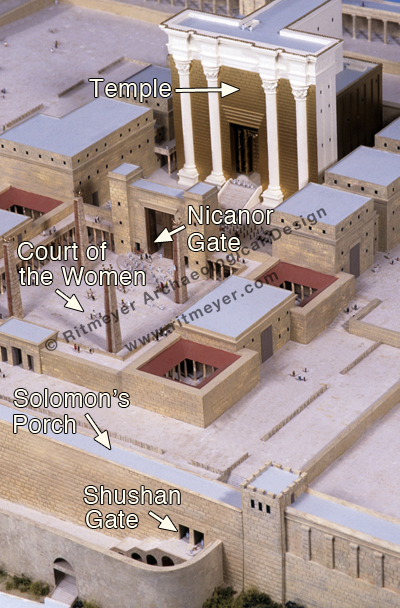
Others have suggested that the Beautiful Gate must have been one of the outer gates of the Temple Mount. Because of its proximity to Solomon’s Porch, some have suggested that the Shushan Gate in the Eastern Wall of the Temple Mount, may have been the Beautiful Gate, as it had a beautiful representation of Shushan the Palace (Middot 1.3).

Herod's Temple Mount viewed from the northeast. On the east of the Temple was the large Court of the Women (centre left), also known in the Gospels as the Treasury. The Eastern Wall of the Temple Mount with the Shushan Gate and the city wall can be seen at the bottom of the image. © Leen Ritmeyer

According to Mishnah Kelim 1.8, nobody with an issue of any kind was allowed into the Temple Mount. Although the lame man need not have had an issue, his infirmity may have put him in the same category. Another point to consider is the fact that he was begging. To get the best results, one would want to be where the traffic was greatest, which is another argument which would rule out the Nicanor Gate, as not many people were allowed to go through this gate. It would also rule out the Shushan Gate, which was mainly used for ceremonial purposes.

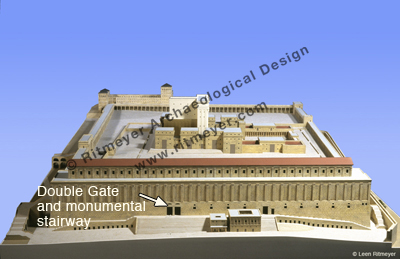
An overall view of a model of Herod's Temple Mount looking from the south. In the foreground is the Royal Stoa above the Southern Wall, while the Temple with its surrounding buildings stood close to the centre of the Temple Mount. There were two gates in the Southern Wall, the Double Gate with its monumental stairway is on the left and the Triple Gate on the right. © Leen Ritmeyer

A more likely location would have been the Double Gate in the southern wall of the Temple Mount, which I have described in my book The Quest, Revealing the Temple Mount in Jerusalem, pp. 67-74.  A 210 feet (64 m) wide monumental stairway led up to this gate from the lower plaza. Because of its monumental proportions, this gate was probably used by most of the pilgrims going to worship at the Temple.

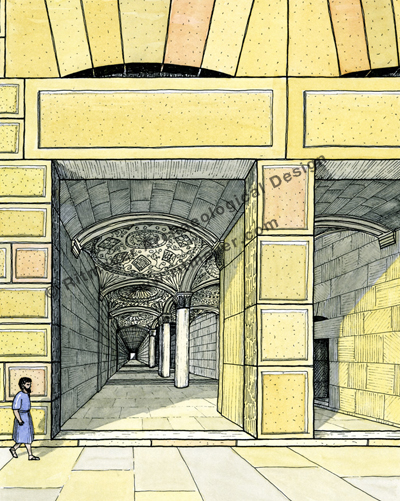
A reconstruction drawing of the Double Gate of Herod's Temple Mount in Jerusalem. Most of the elements have been preserved, including the domes inside the double passageway. Some researchers have proposed that this beautifully decorated gateway was the Beautiful Gate of the Temple, mentioned in Acts 3.10. © Leen Ritmeyer

The ceiling inside the passageway has beautifully carved domes, which have survived up to today. Most of the worshipers went up to the Temple Courts through this gate, which was certainly beautiful and very effective for begging purposes, as suggested on p. 74 of the above mentioned book.

We suggest then that Peter and John healed the lame man at the Double Gate and from there he went “walking and jumping” to Solomon’s Porch.

Ancient Maps of Jerusalem and Palestine

In his Weekend Roundup, Todd Bolen mentioned that “The Israel National Library website has an extensive collection of maps of Palestine, dating from 1462 to 1927.”

Hundreds of maps of Jerusalem and the Holy Land have been digitized and put on the website. This is a treasure trove for map lovers. The website has a fascinating introduction to the Story of the Maps. You can search for maps by date or by the person who made them. Many maps have been made by fellow Dutchmen, which made me feel at home.

Being in the process of building our own Image Library, which involves the scanning and digital enhancing of the many drawings I have made over the last decades, we can fully appreciate what a laborious work it must have been to get all these maps digitized.

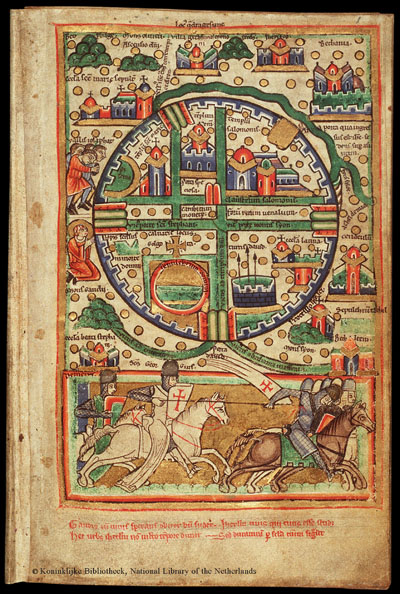
Map of Jerusalem ca. 1200. © Koninklijke Bibliotheek

My attention was naturally drawn to the special section on Jerusalem. The oldest digitized map dates from ca. 1200 and is well-known, having been reprinted frequently. The original map is part of a Latin Psalter which is kept in the Koninklijke Bibliotheek (National Library of the Netherlands) in The Hague.

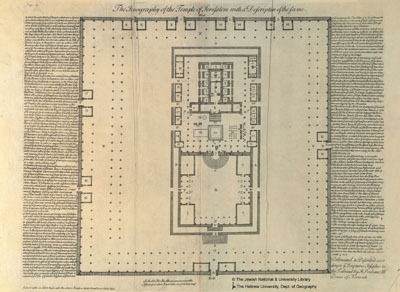
The Ichnography of the Temple of Jerusalem by H. Prideaux DD. © The Jewish National and University Library & The Hebrew University of Jerusalem

A Temple plan, entitled “The Ichnography (ground plan) of the Temple of Jerusalem with a description of the same. Delineated & Described according to the Scriptures, Josephus & the Talmud by H. Prideaux DD. Dean of Norwich” shows that he has struggled to harmonize the Temple descriptions in Josephus and the Mishnah. The lengthy description makes for interesting reading.

Looking at these old maps, we can be thankful for the many archaeological excavations that have taken place in Jerusalem and are still on-going, so that we now have a much clearer picture of Jerusalem and the Holy Land.

Barclay’s Gate in the Western Wall of the Temple Mount

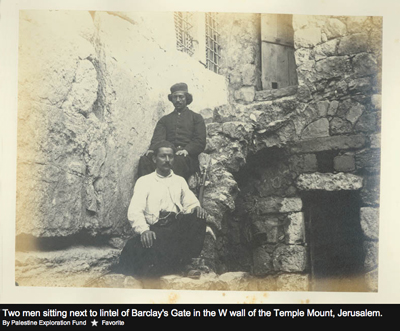
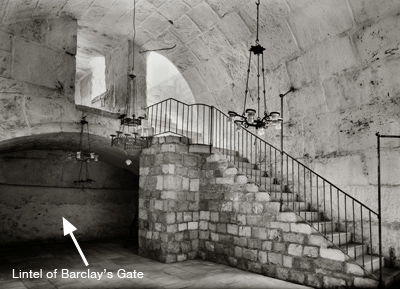
One of the readers of a previous post drew attention to a Palestine Exploration Fund (PEF) photograph of the lintel of Barclay’s Gate. In the caption, we are taken to task for publishing an incorrect interpretation of the lintel in BAR XV No.6, pages 23-42.


We wrote the following comment below this photograph:

The incorrect black outline on the photograph on p. 28 of the BAR issue was unfortunately added by the editors and not by ourselves. For the correct drawings of the lintel of Barclay’s Gate, see our book The Quest, Revealing the Temple Mount in Jerusalem, pp. 26, 28.

Whoever put up this caption didn’t look carefully at the drawing next to the photograph in the BAR issue, where the lintel is drawn correctly.

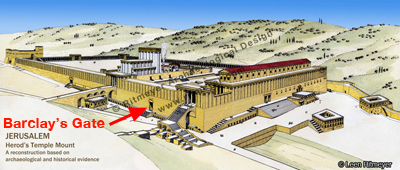
Barclay’s Gate is one of the four gates in the Western Wall of the Herodian Temple Mount:

The red arrow points to Barclay's Gate - © Leen Ritmeyer

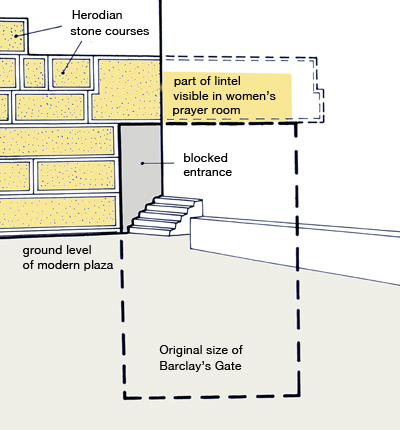
This study drawing shows the depth of the original gate, which is still buried underground:

This drawing shows that only the upper three stone of the left jamb of Barclay's Gate can be seen today, the rest are still buried below ground. The size of the original gate is based on the explorations of Charles Warren in the 1870's.

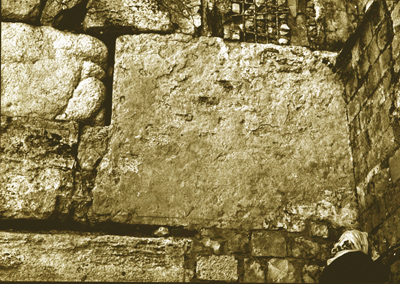
This close-up photograph shows that the projection on the left side of the lintel is not very sizeable:

This photograph shows the projection on the left side of the lintel.

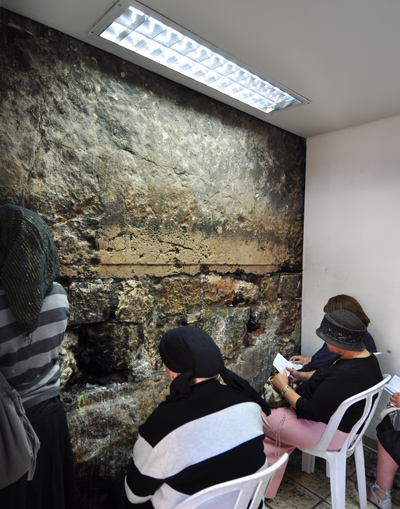
A central part of the lintel can be seen in the small room where women pray:

The central part of the lintel over Barclay's Gate - photo Clare Ritmeyer

Here is a view of the same lintel from inside the Temple Mount:

The lintel of Barclay's Gate seen from inside the Temple Mount - photo: Eric Matson Collection

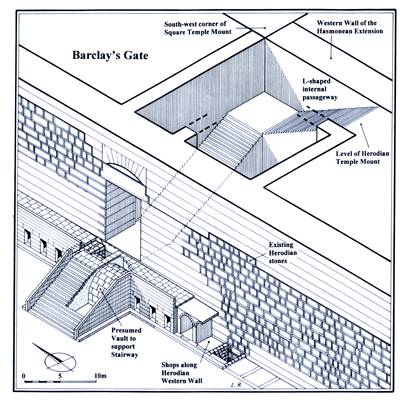
Barclay’s Gate is one of the two lower gates in the Western Wall, the other is Warren’s Gate. Both these gates had internal passageways with steps by which one could ascend to the Temple Mount. This reconstruction drawing shows how Barclay’s Gate worked in the Second Temple period:

Isometric reconstruction drawing of Barclay's Gate - © Leen Ritmeyer

If the new plans for the Western Wall plaza were carried out, the full size of this gate would be visible to all.

New Studies on Jerusalem

The 16th Annual Conference of the Ingeborg Rennert Center for Jerusalem Studies on “NEW STUDIES ON JERUSALEM” will be held on Thursday, December 16th, 2010 in the Mintz Auditorium (Building 404), Bar-Ilan University, Ramat-Gan. Here is the program:

8:20 Gathering

8:45 Opening remarks:

Prof. Joshua. Schwartz, Director of the Ingeborg Rennert Center for Jerusalem Studies

Prof. Avraham Faust & Dr. Eyal Baruch, conference organizers

Session 1 – 9:00- 10:50 Chair: Aren Maeir

09:00 Gabriel Barkay – Kathleen Kenyon in Jerusalem – The Excavations which Terminated a Brilliant Career

09:20 Tsvika Tsuk – The Water Sources of the First Temple at Jerusalem

09:40 Gershon Galil – King David’s First Decade as King of Jerusalem and his Relations with the Philistines in Light of the Qeiyafa Excavation and Inscription

10:00 Moshe Garsiel – The Latent Literary Encounter between Samuel, the Prophet from Shiloh and Ramah, and Nathan, the Prophet of the Jerusalemite Court

10:20 Hillel Geva – The Development of Northern Jerusalem during the Second Temple Period: the Archaeological Evidence and its Significance

10:40 Discussion

10:50 Break

Session 2 – 11:20- 13:10 Chair: Joshua Schwartz

11:20 Ram Bouchnick, Guy Bar-Oz & Ronny Reich – On the Importance of Poultry in the Animal Economy of Judea in the Late Second Temple Period

11:40 Joseph Patrich – The Building Project of Simeon the Just on the Temple Mount: the literary sources, suggested remains and a graphical representation

12:00 Ofer Sion – The Upper Aqueduct of Jerusalem in the area of Jaffa Gate

12:20 Emmanuel Friedheim – Was There a Meeting between Jewish Monotheism and Polytheism in the Second Temple?

12:40 Michael Ben Ari – The Battle of Jerusalem: Destructive Divisiveness or Strategic Coordination, A New Reading of the Writings of Josephus Flavius

13:00 Discussion

13:10 Lunch Break

Session 3 – 14:20-16:40 Chair: Moshe Fischer

14:20 Yehoshua Peleg – The Passover Sacrifice in the Herodian Temple

14:30 Naomi Sidi, Eli Shukron & Ronny Reich – Late Second Temple Period Pottery from the Stepped Street in the Tyropoenon Valley and from the Drain Under It: A ComparativeStudy

14:50 Boaz Zissu & Amos Kloner – Horvat Midras (Kh. Durusiya) – A Reassessment of an Archaeological Site from the Second Temple Period and the Bar-Kokhba Revolt

15:10 Ze’ev Safrai – The Memory of the Temple

15:30 Amos Kloner & Boaz Zissu – A Street Pavement Along Lions Gate Street and its Dating to the First Century CE

15:50 Eitan Klein – The Origins of the Rural Settlers in the Judean Mountains and Foothills during the Late Roman period

16:10 Bat-Sheva Garsiel – The Status of Jerusalem in the Period of the Umayyad and the Abbasid Dynasties (From the mid seventh to the ninth Century CE)

16:30 Discussion

16:40 Break

Session 4 – 17:00- 18:40 Chair: Adrian Boas

17:00 Michael Ehrlich – The Ovens of the Holy Sepulcher during the Crusader Period

17:20 Shlomo Lotan – Exploring and Recovering the Concealed Part of the German Crusaders Church of Saint Mary in the Center of the Jewish Quarter in Jerusalem

17:40 Perez Reuven – A Manuscript Fragment in Arabic Written in Hebrew Letters from the Mamluk Period Found at the Al-Aqsa Mosque

18:00 Gérald Finkielsztejn – The Convent Outside the New Gate that Saved West Jerusalem (1894-1948)

18:20 Oded Shay – “Jerusalem is the Washington of Israel”: The journey to Jerusalem of the Zionist Functionary Dr. Otto Abeles, 1925

18:40 Discussion

The Conference is dedicated to the Memory of Israel Shalem z”l, a Fellow of the Rennert Center. The meeting is open to all (free of charge)

The conference proceedings (approximately 300 pp., including 17articles in Hebrew, with English abstracts) will be on sale during the conference

For additional information, please contact the Ingeborg Rennert Center for Jerusalem Studies:

<jrslm1@mail.biu.ac.il> or Avi Faust <fausta@mail.biu.ac.il>.
HT: Jack Sasson

The Pinnacle of the Temple

Ferrell Jenkins has an interesting post on the Pinnacle of the Temple.

In my reading the most common view is that the southeast corner of the Temple Mount is the place mentioned in Mark and Luke as  the pinnacle of the temple.

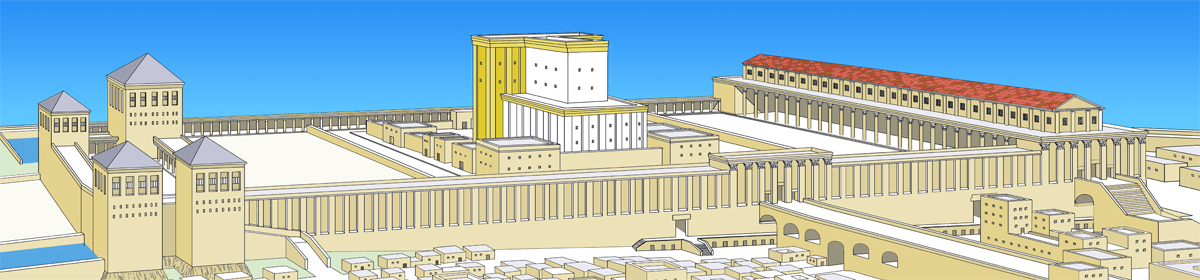
An overall view of a model of the Temple Mount looking from the south.

He aso quotes from Benjamin Mazar’s book The Mountain of the Lord:

Benjamin Mazar, The Mountain of the Lord, shows a photo of the southeast corner of the wall with the comment that this “is known as the ‘pinnacle of the Temple’ (Mark 11:11; Luke 4:9),” page 149.

Although this statement does appear in the book, I remember discussing this problem with him and he said that he actually saw the  southwest corner of the Temple Mount as a more likely candidate for the pinnacle of the Temple. One needs to determine what was the most important element in the temptation of Jesus to throw himself down from the pinnacle. Was it the height of the corner above what lay below or did the temptation lie in impressing as many people as possible with that jump?

The southwest corner of the Temple Mount may have been the site of the 'pinnacle' of the Temple.

As the southwest corner was a busy junction between the major north-south street running through Jerusalem and the Plaza in front of the Southern Wall of the Temple Mount, there would have been many more people to impress here than on the much quieter southeast corner.

It is in a setting such as this that we can visualise the dramatic scene that would have taken place had not Jesus challenged the temptation with the power of God’s Word.

The Palace of Darius at Susa

For Francophiles and Susaphiles, a lecture will be given by Jean Perrot, one of world’s greatest archeologists, who headed the French teams working in Iran from 1968 to 1978. Now, at 90 years of age, the author of “Le Palais de Darius à Suse” will give a lecture to launch his book.

Venue: Zoroastrian Cultural Centre, 2 bis Ave Montespan. 75116 Paris. (Niveau 177 Ave Victor Hugo), Métro : Rue de la pompe – Victor Hugo – Trocadéro.

Time: 15 December 2010, 19.30 pm.

Cost: €8.00 or €5.00 for members and students.

Reserve your place beforehand at: infoassoccz@gmail.com

HT: Jack Sasson